

The line extends 465 miles between the two states
Minnesota Power has broken ground on a $450-millon North Dakota high-voltage direct-current modernization project with Mortenson as general contractor. The new facility is planned to replace 50-year-old transmission infrastructure including new converter stations and substations in North Dakota and Minnesota, and is linked to potentially massive new demand—a $2 billion Google data center proposed in Hermantown, Minn. in the northeast part of the state.
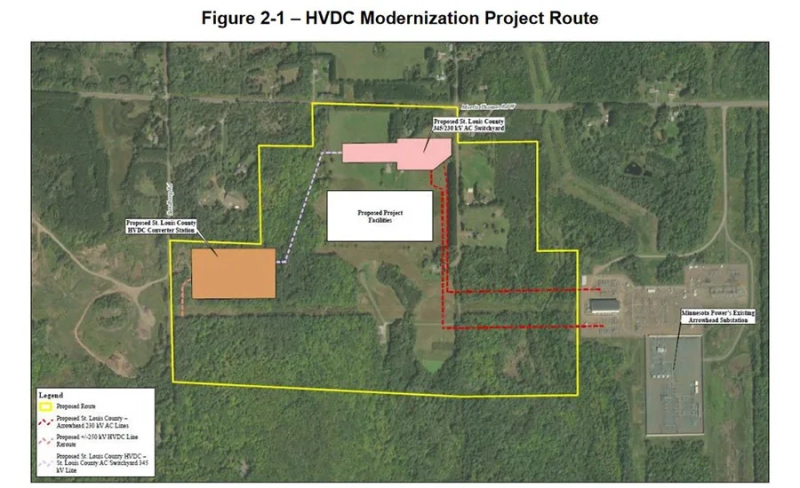
The converter station at Center, N.D., along with one at the other end of the 465-mile-long line in Hermantown, near Duluth, is planned to convert alternating current generated locally into direct current for long-distance transmission and can also convert direct current back into alternating current when needed.
The project is part of a $900-million investment already underway in Minnesota with Mortenson as general contractor on that portion to make transmission grid improvements.
The line delivers renewable wind energy from Minnesota Power’s Bison Wind Energy Center in North Dakota.
“One of the most important benefits of this modernization is flexibility,” Josh Skelton, Minnesota Power CEO, said in a press release. “When extreme weather hits, when system conditions change quickly, or when energy is needed in a different place than expected, the ability to move power both ways on this line becomes a real advantage.”
Siemens Energy is supplying HVDC technology for the project.
The line began operating in 1977 and is one of only five overhead HVDC lines in the U.S. Minnesota Power started more than ten years ago to identify the need to replace equipment dating to the 1970s, it says. In 2025, the North Dakota Public Service Commission approved permits for the transmission project.
In March, Minnesota Power signed an agreement with Google to supply power to the proposed Hermantown data center, which would entail 700 MW of new clean energy resources including 300 MW of wind energy and 400 MW of battery storage.
The Hermantown data center is still under consideration and has faced opposition from residents opposed to its proposed $80 million property tax break and who have concerns about water, noise and power use.
Kimley Horn Associates is engineer and landscape architect for the proposed data center.
Whether the data center is built or not, Minnesota Power says HVDC technology is especially effective over long distances, losing 15% to 30% less energy than a comparable alternating current line.