

A look at global trends in the coming year
Содержание:
Construction activity is beginning to steady in many parts of the world, with costs not rising as fast as in recent years. Most countries expect escalations to be between 2% and 6% in 2026. This shows a more balanced market, but it does not mean that construction is getting easier.
Uncertainty remains high, and is accelerating. Labor shortages, supply chain issues and political instability continue to affect projects. Many organizations are delaying or rethinking plans. The work is there, but risks are slowing progress.
Construction still is moving forward, but project success depends on early planning and good risk management. In 2026, the global focus will be on simpler procurement, faster decisions and delivery models that can flex with changing conditions.
Related Link:
ENR 2025 Fourth Quarterly Cost Report (PDF)
(Subscription Required)
UK and Europe
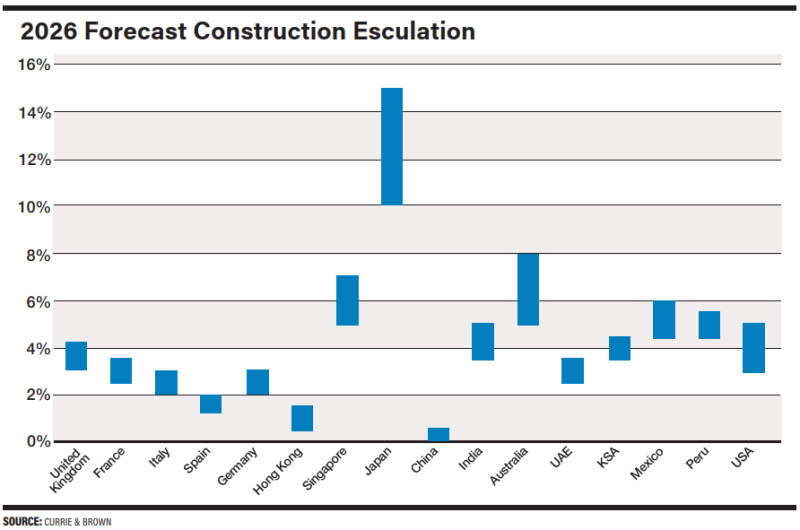
Construction in the UK and Europe is moving slowly. High labor costs, expensive finance and approval delays are making it harder to start and finish projects. Cost increases in 2026 are expected to reach 3.6% in the UK, 3% in France, 2–3% in Germany and Italy and 1.6% in Spain. These numbers suggest steady inflation, but they don’t tell the full story.
Labor shortages are a key driver of regional increases. Material price hikes, particularly for imported mechanical, electrical and plumbing components, and volatile energy prices also are adding pressure. Interest rates make it harder to secure funding, while strict rules and long planning processes are slowing delivery. Even with more stable pricing, it’s still hard to get projects off the ground.
Asia and Australia
Currie & Brown reports a mix of conditions across Asia. In India, infrastructure and technology investments are keeping activity strong. Cost hikes of between 3.5% and 5% are expected.
Singapore continues to experience pressure from labor shortages and materials cost increases due to geopolitical tensions, with cost escalations of 5 to 7% forecast. Thailand can expect cost hikes of between 3 and 5%, also driven by higher labor and material costs, particularly for the rapidly growing high-tech sector. Malaysia will see costs rise about 3%, reflecting stable demand and strong local supply chains. Government infrastructure investment and international semiconductor manufacturing continue to bolster construction growth.
Hong Kong’s construction costs are set to stabilize or rise slightly in 2026, with public works and a recovering housing sector driving escalation of about 1%. In China, costs are likely to remain flat, with a real estate investment slowdown cutting demand and leading to more competitive pricing and limited inflation. Taiwan’s cost escalation ranges from 4% to 6%, while Japan faces significant pressures—10% to 12% for base materials and up to 16% for MEP. Across the region, access to skilled labor and the impact of cross-border supply chains are key risks to watch.
Australia cost escalation is forecast at 5 to 8%. Labor shortages and interest rate pressure are keeping costs up, while tariff uncertainty adds more risk. The sharpest hikes are expected in high-demand sectors such as data centers and infrastructure, particularly in Queensland, where skilled worker shortfalls are most acute.
Middle East
“In 2026, the focus will be on simpler procurement, faster decisions and delivery models that can flex with changing conditions.”
—Rachel Personius, Director, Currie & Brown
After years of rapid expansion, the region is entering a more measured phase. Large-scale Saudi Arabia projects are still going ahead, but many are being delayed or rephased. In the UAE, ambitious infrastructure, high tech, hospitality and residential developments tied to population growth will sustain healthy building activity.
Saudi Arabia and the UAE expect cost escalation of 4% and 3%, respectively. Labor and capability constraints remain key issues, with specialist trades hard to find. Costs are also affected by long supply chains and inflation on imported materials, although investment to strengthen local supply is improving matters. Some contractors are adding extra risk costs into their pricing. With a slower pace, particularly in Saudi Arabia, there’s more time to plan but also more pressure to get things right. While the regional pipeline remains significant, the outlook is more stable than expansive. Delivery will rely less on pace and more on precision, with greater attention on sequencing, scope control, risk allocation and early decision-making.
Latin America
“Many organizations are delaying or rethinking plans. The work is there, but the risks are slowing progress.”
—Rachel Personius, Director, Currie & Brown
Construction in Latin America is set to grow in 2026, especially in Mexico where nearshoring, logistics, data centers, rail and energy investment are the main drivers, and in Peru, where mining, infrastructure and renewables will lead growth.
Delivery remains tough. Labor shortages and long delays on imported materials will continue to be an issue. Mexico’s cost escalation is expected to be around 4.5% to 6%, with pressure highest in rail, data centers and energy. In Peru, escalation is forecast at 4.5% to 5.5%, especially in mining, transport and energy.
Conclusion
2025 has not been a crisis year, but it’s not been simple either. Disruption is structural and uncertainty is something to be worked with, not waited out. Across regions, the signals are clear: Delivery risk is rising, volatility is embedded and complexity is the new normal.
The key is mindset. Success will come from early planning and clear decisions. That means spotting risks sooner, building strong teams and staying flexible. It means using good data and choosing tools that improve control. Certainty does not just come from the market. It comes from how a project is set up. In 2026, the best results will come from those who plan for change, not just for progress.
Rachel Personius is Sustainability & Construction Business Intelligence Director at Currie & Brown, a London-based firm with more than 70 global offices providing project and cost management advisory services for the built environment.