

Crews cut through a 1,000-year-old Arizona Indigenous ground etching days after a $45.6M contract change added work without extending the timeline
Updated 8:01 p.m. EDT
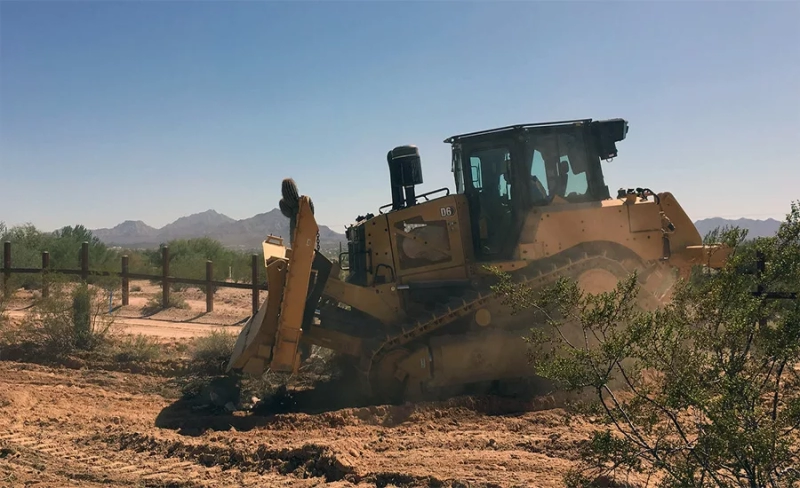
Construction crews working on a U.S. border wall segment in southern Arizona bulldozed part of a documented Indigenous cultural site on April 23, cutting through the Las Playas Intaglio at Cabeza Prieta National Wildlife Refuge, according to U.S. Customs and Border Protection.
One week earlier, CBP had added millions of dollars’ worth in scope to the active construction contract in the week leading up to the incident, according to federal procurement records reviewed by ENR.
BCCG, the design-build joint venture of BCSS, Caddell Construction of Montgomery, Ala., and Gibraltar of Burnet, Texas, held the $659-million contract for Smart Wall construction in U.S. Border Patrol’s Tucson and Yuma sectors, according to federal procurement records reviewed by ENR on USAspending.gov. Stephen Strickland, president of Caddell’s governmental division, did not respond to a request for comment.
The joint venture is one of five prequalified contractors eligible to build under CBP’s border infrastructure program, which carries a combined obligated value of $3.5 billion across BCCG’s awards alone.
The incident at the intaglio should have been avoidable. The Tohono O’odham Nation said in a statement that the site had previously been identified by a cultural protection monitor as one the contractor was required to avoid. Tohono O’odham Nation Chairman Verlon Jose called the loss devastating and entirely avoidable.
«The site was also an irreplaceable piece of the United States’ history, one none of us can ever get back,» Jose said. The Nation said it was not notified of the damage until April 28—five days after the incident occurred.
Looking for quick answers on construction and engineering topics?
Try Ask ENR, our new smart AI search tool. Ask ENR →
Archaeologist Richard Martynec, who has studied the site since 2002, told The Washington Post he visited two weeks before the damage and found stakes already placed through the roughly 272-ft.-long ground figure, marking the wall’s planned route. He said there were no tire tracks leading to the stakes, indicating they were set on foot rather than by vehicle to avoid disturbing the site.
The damage drew immediate criticism from preservation professionals. Aaron Wright, a preservation anthropologist and rock imagery expert at Archaeology Southwest, a Tucson-based nonprofit focused on cultural heritage preservation in the Southwest, said the damage went beyond vandalism.
«It was a deliberate act of harm, disgrace and disrespect carried out in our names, on our public land, and with our tax monies,» Wright said in a statement.
RELATED
Border Wall Contractor Says $2B Federal Award Package Sets Stage for 2026 Construction
A Lack of Oversight
On April 23, clearing equipment cut a roughly 60- to 70-ft.-wide swath across the intaglio, a fish-shaped geoglyph etched into desert pavement west of Ajo, Ariz., in Cabeza Prieta National Wildlife Refuge. The etching is considered sacred by the Hia-Ced O’odham and Tohono O’odham peoples and is believed to be at least 1,000 years old.
CBP spokesperson John Mennell confirmed the defacement in a statement, calling it inadvertent and saying the remaining portion of the site has been secured. «Commissioner Scott is engaged directly with tribal leadership to determine appropriate next steps,» Mennell said in an email to ENR.
In a follow-up, CBP confirmed BCCG’s role on the Tucson 1 Wall Project and said the April 16 modification «added scope typical for construction projects and was unrelated to the Las Playas Intaglio incident,» but did not address ENR’s remaining questions about procurement structure and field-level QA controls.
CBP offered no explanation as to how the construction equipment entered the site or how it damaged a site flagged for avoidance.
Federal procurement records offered minimal detail on the contract change beyond the amount. USAspending.gov data show CBP signed a supplemental agreement on April 16, adding more than $45 million in scope to BCCG’s Tucson and Yuma sector contract, with the transaction description «ADD WORK, NO ADDITIONAL TIME.»
RELATED
First Border Wall Contracts of Second Trump Term Awarded in Texas, San Diego
Waiver Framework
The incident occurred within a delivery structure in which standard federal cultural resource protections had been suspended. DHS issued waivers under Section 102 of the REAL ID Act authorizing border barrier construction to proceed without compliance with the National Environmental Policy Act, the National Historic Preservation Act and other federal review frameworks.
Read More
Section 106 | National Historic Preservation Act of 1966
Under normal project delivery, Section 106 of the National Historic Preservation Act requires federal agencies and their contractors to identify and seek to avoid impacts to historic properties, including Indigenous cultural sites, before ground disturbance begins.
The waiver removed those statutory requirements, and what protections remained were those incorporated voluntarily or contractually by CBP and BCCG—among them, the boundary stakes observed at the ancient site before the damage. The gap between those stakes and the equipment that subsequently crossed them is the central accountability question the public record has yet to answer.
Similar execution conditions were established at the outset of the current buildout. ENR previously reported that DHS waived more than two dozen environmental regulations to restart border wall construction in California and Texas in 2025, allowing work to proceed immediately under existing contract vehicles. Those projects were awarded through an indefinite-delivery/indefinite-quantity procurement shared among a small pool of contractors, including BCCG.
The delivery structure reflects a broader shift in federal border construction toward bundled, multi-sector design-build contracts executed by a small pool of prequalified joint ventures.
When due diligence is waived, and scope expands without added time, field-level controls become the last line of protection—and the point of failure when they break.