

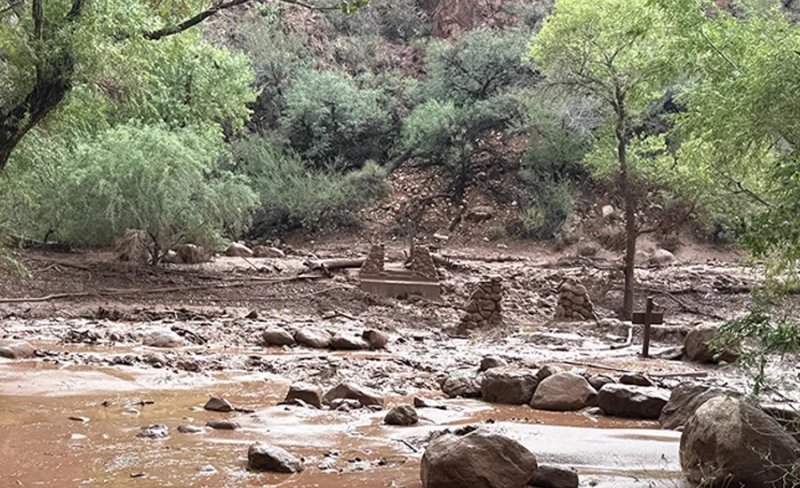
Critical water system remains offline with 40% of Transcanyon Waterline damaged or destroyed
Flash flooding in Grand Canyon National Park Aug. 29 damaged or destroyed significant portions of the Transcanyon Waterline, knocking the critical water system out of service and disrupting a $208-million replacement project nearing the end of construction, according to the National Park Service.
Flooding began about 2:30 p.m. local time in Bright Angel Canyon and the Phantom Ranch area as thunderstorms produced heavy rain over the Bright Angel Creek basin below the Dragon Bravo Fire burn scar. By 2:42 p.m., National Weather Service radar estimated 0.25 to 0.5 in. had fallen.
Floodwaters destroyed nearly all footbridges spanning Bright Angel Creek and damaged trails, utilities and other infrastructure, according to NPS. Two people were killed, with search and recovery operations ongoing as of Sept. 1.
RELATED
Digging Deeper:
Crews Battle Site, Logistics on $208M Grand Canyon Transcanyon Waterline Replacement Project
The 12.5-mile Transcanyon Waterline, built in the 1960s, transports water from Roaring Springs on the North Rim through the canyon to Havasupai Gardens, where it is pumped to the South Rim. The system supplies potable water and fire suppression to South Rim and inner-canyon facilities, including more than 800 historic buildings, according to NPS.
The $208-million replacement relocates the South Rim water intake from Roaring Springs to Bright Angel Creek near Phantom Ranch, eliminating about seven miles of the existing line. Work also includes new steel pipeline and water treatment plants at Phantom Ranch and the South Rim.
Preliminary assessments announced Aug. 31 found about 40% of the waterline damaged or destroyed, leaving the system nonoperational and prompting Stage 4 water restrictions, closure of overnight lodging and dry camping on the South Rim.
NPS has not identified the affected segments or said how much, if any, involves newly installed portions of the replacement project, nor has it released a repair cost or revised construction schedule.
Scott Bailey, chief operating officer at Stronghold Engineering Inc., the project’s prime contractor, told The New York Times the flood damage could delay the project by at least two to three months. Perris, Calif.-based Stronghold won the construction contract in March 2023. When ENR examined the project in February, construction was approximately 70% complete.
Before the flood, NPS projected construction would wrap up in October, though its published schedule allowed for delays. Final system testing, certification and turnover were planned for 2027.
Flood Risk Has Long Shaped Waterline
A wildfire that burned across the Grand Canyon’s North Rim in 2025 had already prompted federal officials to assess increased runoff and debris-flow hazards in the Bright Angel Creek watershed. The Dragon Bravo Fire burned 149,399 acres, including 71,129 acres managed by Grand Canyon National Park.
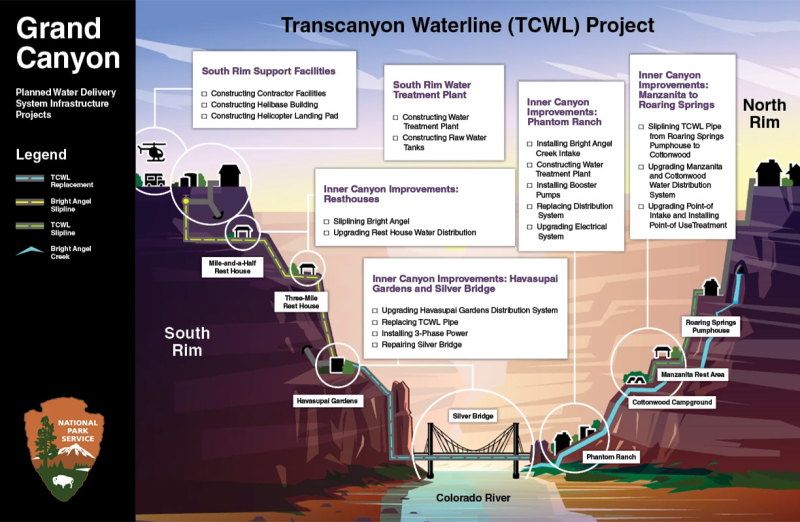
NPS schematic shows planned Transcanyon Waterline improvements from the South Rim to Roaring Springs, including replacement pipeline, sliplining and a new Bright Angel Creek intake near Phantom Ranch. Click to enlarge.
Map courtesy National Park Service
An Interior Dept. Burned Area Emergency Response (BAER) team subsequently projected runoff increases of two to eight times upstream of Phantom Creek and one to two times downstream to the Colorado River.
The BAER team found infrastructure in those locations had been designed above modeled floodplains. Although it expected short-term increases in runoff and debris flows, the assessment concluded they were unlikely to significantly affect identified assets under normal storm conditions.
NPS and the U.S. Geological Survey subsequently added stream and precipitation gages in the Bright Angel Creek watershed to provide real-time data and warning of rising water levels.
The waterline has a history of flood damage. Construction of the original aluminum system began in January 1965. By December 1966, the Roaring Springs-to-Phantom Ranch section had been completed and was expected to enter service within days when a major flood swept through Bright Angel Creek, according to a contemporaneous U.S. Geological Survey report.
NPS says the 1966 flood carried away trees, boulders and newly installed pipe, with a subsequent survey finding about 40% of the project destroyed or missing. The original $2-million cost rose to $5 million, and reconstruction began in late 1967.