

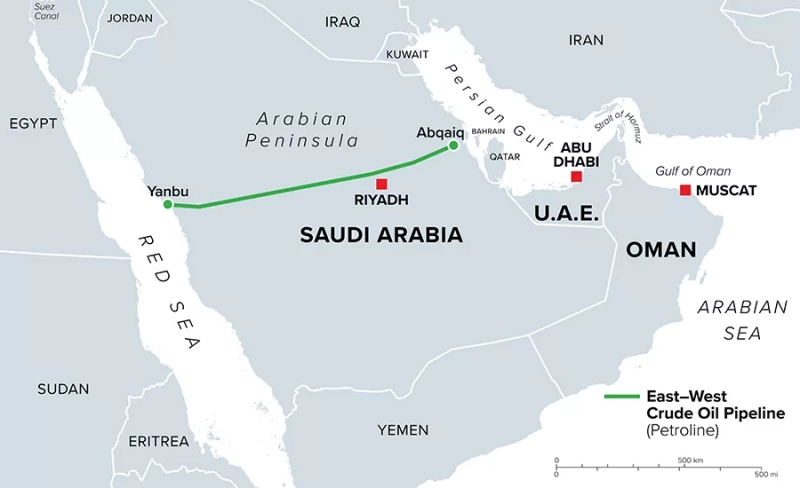
Saudi Arabia’s state news agency confirmed April 9 that the country’s 1,200-km East-West oil pipeline—known also as Petroline—was attacked only hours after a two-week ceasefire allegedly agreed to April 8 by the U.S. and Iran was supposed to be in place, with damage to a pumping station along the route. Also hit were several oil fields and processing facilities in the country.
The Saudi Press Agency cited sources in the Saudi Ministry of Energy saying that damage to a pumping station on the pipeline resulted in a loss of about 700,000 barrels per day. Petroline runs from the Abquaiq processing facilities and oilfields in eastern Saudi Arabia to facilities in Riyadh and the west.
The agency also said attacks on upstream production facilities at the Manifa and Khurais oil fields,
Oil flow through the pipeline and production at the Manifa field were both restored as of April 12, the ministry said.
France-based TotalEnergies also said April 10 that the SATORP refinery complex in Jubail jointly owned with national oil company Saudi Aramco was shut down after sustaining damage overnight April 7-8 to one of its two processing trains, and that that the French energy firm has shut or is shutting its production also in Qatar, Iraq and UAE, representing about 15% of total output.
The East-West pipeline was built during the 1980-1988 period of the Iran-Iraq War when the two countries were engaged in «the tanker war,» which involved attacking each other’s oil tankers as they moved to exit the Persian Gulf. Wary of being targeted during that war, Saudi Arabia opted to build a pipeline running from its prolific eastern oilfields to the western Red Sea port of Yanbu, Since then, the area, also including al-Jubail, have been developed into a major heavy industrial region.
Iran’s current forced closure of the Strait of Hormuz has restricted about 20% of global crude and other petroleum product supply. To address that, Saudi Arabia boosted throughput via Petroline, alleviating some strain in meeting global supply balance.
Looking for quick answers on construction and engineering topics?
Try Ask ENR, our new smart AI search tool. Ask ENR →
Petroline has an upgraded capacity to transport about 7 million barrels per day through several pipelines to processing and export facilities at Yanbu.
Any serious Petroline flow disruption could create further havoc to oil prices. Only a few tankers have traveled through the strait in recent days, with Iran demanding a toll of some $2 million for tankers from friendly nations before allowing them to pass.
A ceasefire mediating session between the U.S. and Iran underway in Islamabad, Pakistan ended on April 12 with no agreement reached and President Donald Trump announcing a U.S. Navy blockade of Hormuz, Reuters reported.
During the course of the war, which began on Feb. 28, Saudi Arabia and all other members of the Gulf Cooperation Council—Kuwait, Bahrain, Qatar, the United Arab Emirates and Oman—have endured attacks by Iranian missiles and drones targeting energy facilities and public utilities.
QatarEnergy is set to restart limited liquefied natural gas production at its Ras Laffan and Mesaieed energy complexes, according to sources cited by Reuters on April 8, after attacks in early March caused major damage and facility shutdown. The company is now mobilizing technical and craft workers, with improved security conditions, according to Bloomberg.
A spokesperson for Japan-based engineer-construction contractor Chiyoda Corp. told the media site it could resume work at Ras Laffan, after its workers were evacuated in March from front-end design on an onshore gas field expansion project and other work. It is not clear how long the gas field expansion projects will be delayed by the conflict.
A return to production depends on full ship passage through the Strait of Hormuz and damage repair, which could take months or years, with supply backlog in critical site components, said energy consultant Wood Mackenzie. It said that if restart begins in early May, it would take until end of August for full operation of Ras Laffan’s current 12 operable trains. About 20% of its capacity could take several years to restore.
Saudi Arabia’s Ras Tanura refinery on the Gulf coast was struck by drones on March 2, causing a temporary halt in operation, with the massive Shaybah oil field in eastern Saudi Arabia near the UAE border, Jubail petrochemical complex on the Red Sea and Samref Refinery in Yanbu also attacked last month. The latter is 50/50 owned by ExxonMobil. Loading was halted at Yanbu Port for a short time in mid-March after Iran targeted Red Sea shipping routes.
Numerous Iran-based energy production sites and other civil infrastructure also have been attacked and damaged by the U.S. and Israel, according to updates by Bloomberg and The New York Times.