

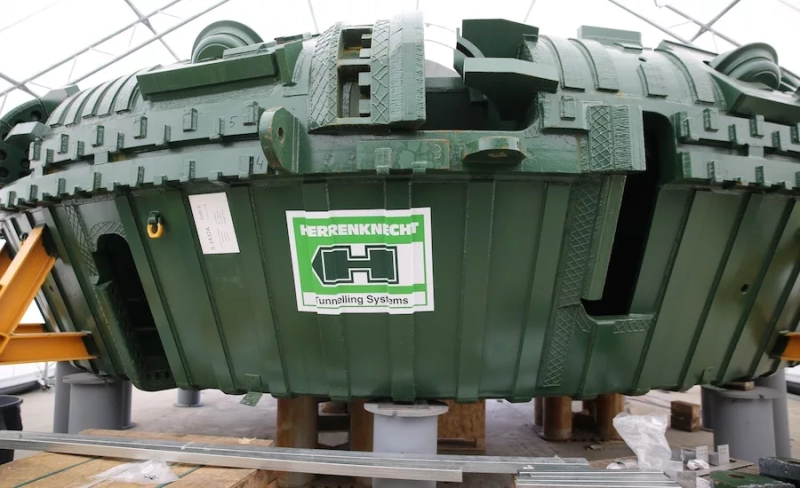
Target for tunnel boring machines’ launch is «as soon as possible»
Following a brief interruption in funding due to a dispute with the U.S. Dept. of Transportation, the Hudson Tunnel Project is back on track according to officials. Crews are moving toward assembling the first set of tunnel boring machines (TBMs) to be deployed on the $16-billion project.
The regional megaproject’s schedule was in jeopardy earlier this year when the U.S. Dept. of Transportation withheld previously awarded federal funds at the direction of the Trump administration. Those funds were eventually released, but the full impact of the interruption on costs and schedule is still being calculated, project officials tell ENR.
But the larger program has been able to regain some momentum in the last weeks, aided by the fact it is proceeding through separate contracts, they add.
“The Hudson Tunnel project is ten projects,” explains James Starace, chief of program delivery for the Gateway Development Commission. “Of the ten projects, five are in construction of varying completion.”
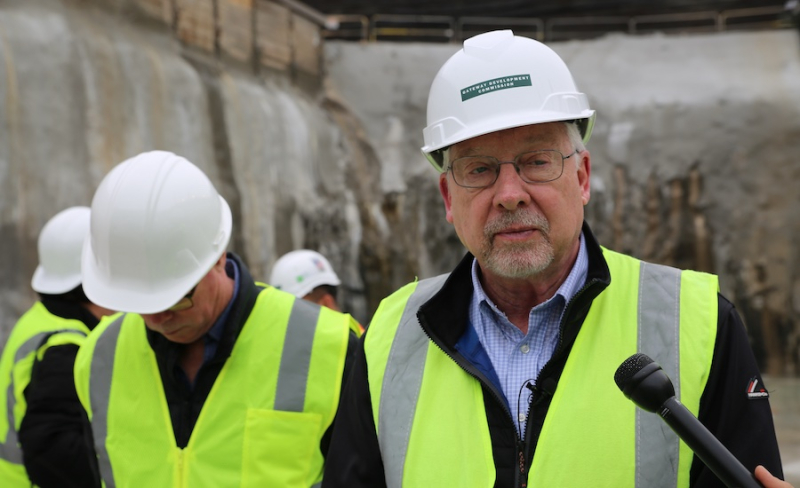
Gateway project delivery lead James Starace addresses reporters at the Tonnelle Avenue project site in New Jersey.
Photo by Jeff Rubenstone/ENR
Already complete is the Tonnelle Avenue Bridge, in North Bergen, N.J., where an embankment under a busy road was replaced with a bridge to allow rail service below. Other work underway includes ground stabilization efforts in the Hudson River; building the 12th Avenue access shaft on the Manhattan side; conventional excavation of the tunnels connecting that shaft to Penn Station; and the current project focus: digging twin tunnels through a mountain on the New Jersey side to the Hudson River shoreline.
Prepping for a TBM Launch
At the Tonnelle Avenue site, work is now focused on preparing the launch pit for the pair of TBMs that will excavate a mile through a mountain to get to the Hudson River. A $465.6-million contract for these New Jersey-side tunnels was awarded to Schiavone Dragados Lane joint venture in 2024.
Two Herrenknecht TBMs have been delivered to the site and are being prepped for assembly and launch. Starace confirmed to ENR that the German-based manufacturer had already delivered one TBM to the site and had the other in production when federal funding was interrupted earlier this year. Despite the legal dispute over project funding, Herrenknecht did not delay its delivery of the second TBM, he says.
Once the TBMs start boring, it’s 5,100 ft straight through the solid rock of the Palisades Sill. At an anticipated rate of progress of about 30 ft per day, boring the tunnels is expected to take roughly a year. Each TBM includes an erector that places 6-ft precast concrete tunnel liners as it bores the tunnel, allowing the machine to advance in roughly 6-ft increments.
The twin TBMs will eventually bore through to a prepared access shaft in Weehauken, N.J., near the shore of the Hudson River.
Both of the single-shield TBMs feature 28-ft, 8-in.-dia cutterheads with 500-ft-long gantries behind them. Crews operate the TBM from a control cabin inside to keep it on target, since the segmented TBM is able to make course corrections to its travel path. The hard, abrasive rock of the mountain will also require regular replacement of the 59 tungsten-carbide cutter wheels on each cutterhead, whose performance can be monitored from the control cabin.
Each TBM is assembled from 96 segments, some weighing up to 185 tons, requiring heavy-duty cranes to lower them into the launch pit for assembly. Ground stabilization and construction of pads for these high-capacity cranes are underway. A launch date for the TBMs to begin their boring has not yet, been set but the goal is to begin «as soon as possible,» says Starace.
Once the Palisades TBMs complete their journeys and are removed, the Weehauken shaft will serve as the launch point for the TBMs that will bore beneath the Hudson River to New York City.
The contract to drill the twin tunnels under the Hudson River has not yet been awarded. But the project’s chief engineer, Hamed Nejad, notes that work will involve a completely different set of TBMs, custom-made to suit the geologic conditions of each site. Unlike the hard rock of the Palisades Sill, the soft soils of the Hudson River will require grout injection and ground freezing.
“We get that question a lot: ‘why not use the same machines?’” says Nejad. “The next portion of tunnel is a combination of rock and soft [materials] that only gets softer. We have to buy a totally new machine to fit the conditions of that site.”
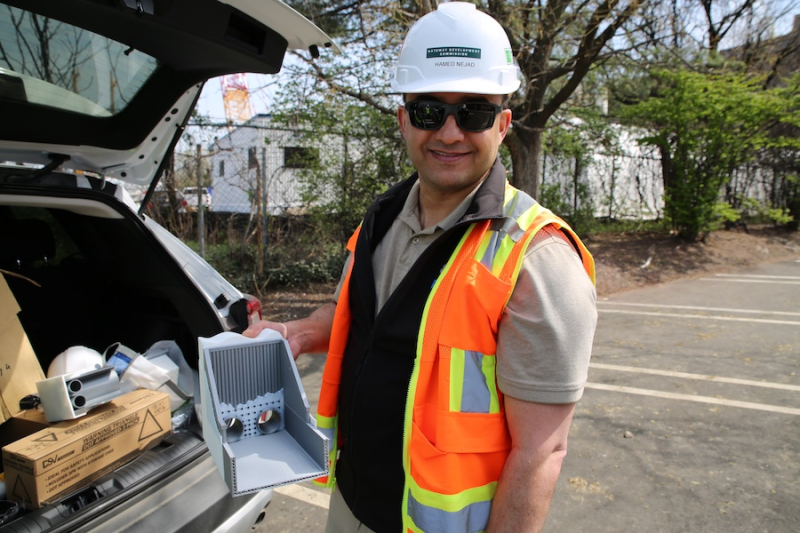
Chief Engineer Hamed Nejad shows off a 3D-printed model of the planned launch site for the Tonnelle Avenue TBMs. Photo by Jeff Rubenstone/ENR
Back at the launch site, prep work is already underway to construct a muck pit to collect the spoil that will be ejected out of the rears of the TBMs. As of this week, there is still about 75 ft of rock face left to be excavated by conventional means before the TBMs can be lowered in and assembled. The workforce at the site has been fairly stable at 60 to 70 people during this phase, but Starace says that will likely increase once the TBMs launch.
Much Tunneling Still Lies Ahead
The consistent hard rock of the Palisades Sill means the team can plan on fairly consistent boring. The real planning to address the risk of unknown conditions is for the Hudson River tunnel segment—especially as it approaches the Manhattan shoreline. “The west side of Manhattan from 8th Avenue [westward] is all reclaimed landfill,” explains Nejad. “There’s old ports, ship anchors. If a TBM hits any of these ship anchors, it won’t go through them. To de-risk the job, we need to stabilize that ground.”
This means excavating west from the 12th Avenue shaft toward the river using a digger shield to clear out possible obstructions. Once that is complete, that space will be backfilled so the river TBMs can eventually bore through uniform material without any surprises, says Nejad. A $1.18-billion contract for the Manhattan shaft as well as the tunnel excavation to tie it into existing tunnels at Hudson Yards was awarded last year to Frontier Kemper-Tutor Perini joint venture.