

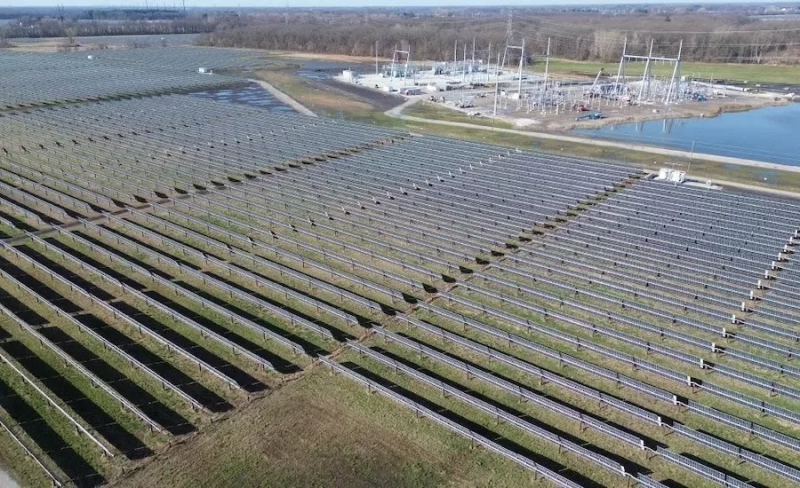
Developer Doral adds estimated $460-million project to its U.S. portfolio even as the Trump administration squeezes the solar industry
Israel-based clean energy developer Doral Group Renewable Energy Resources is expanding its U.S. footprint in solar energy—despite growing political headwinds—selecting Bechtel this month to design and build a 430-MW solar power project in Texas. The Cold Creek Solar+Storage project, sited in Schleicher and Tom Green counties, will have more than 850,000 solar modules and include a 340-MWh battery energy storage system.
Bechtel said the project will store excess solar power for use by the Electric Reliability Council of Texas, or ERCOT, grid for high demand periods. The contractor did not disclose project cost, but it was stated by the developer at an estimated $460 million, according to a report by Globes, an Israel-based business publication. Doral said construction will begin in the first quarter of 2026, with Bechtel committing to complete work by mid 2028.
“The Cold Creek project highlights the power of an all-of-the-above energy strategy,” said Scott Austin, Bechtel general manager of renewables and clean power. “Texas continues to lead the nation in blending traditional and renewable resources to strengthen its grid. We are proud to bring Bechtel’s experience to this important project.”
Bechtel ls currently managing design, engineering and construction for the final three phases of the 1.6-GW Mammoth solar project in Starke County, Ind., set to boost the state’s solar power generation capacity by more than 20%, and be one of the largest U.S. solar projects when completed at the end of 2026, the contractor said. SOLV Energy completed its first 400 MW phase last year. Mammoth is estimated to cost at least $1.5 billion.
Jason Van Deusen, vice president of project management for Doral’s Philadelphia-based U.S. operation, Doral Renewables, said Cold Creek would create more than 500 jobs at peak construction and is the developer’s fifth utility-scale solar facility in the state.
Doral also said it has secured a power purchase agreement with an unnamed “corporate buyer” for the project to cover 75% of its energy output, describing the off-taker as a “well-known and experienced energy buyer” that is a new commercial client for the company, which said it operates in 21 states. “This new relationship is a substantial accomplishment and a foundational agreement as Doral continues to expand its operating portfolio across the country,” said Sean Boyle, Doral vice president of markets, noting intent «to continue this momentum as we embark on another significant project and contribute to the vision of a diverse energy portfolio and resilient grid in America.”
The firm has also proposed the 1.3-GW Vista Sands project in Portage County, Wis., an estimated $1-billion, 7,000-acre solar array approved earlier this year by Wisconsin utility regulators. Doral aims to start construction next spring and begin operating in 2028 or 2029. It includes about 300 MW of battery storage and is set to be the largest solar project in the state’s history. No contractor has been announced. The developer last summer settled a lawsuit with opponents concerned about project impact on an endangered species in Wisconsin.
Doral, considered a pioneer in solar and energy storage development in Israel, is also building its first facility to produce green hydrogen. In addition to the U.S. and Israel, the firm operates in Canada, Europe and elsewhere, with a global solar and storage development portfolio of about 18 GW, it said.
Tax Credit Crunch
But renewables project financing now faces new barriers, with the Trump administration squeeze on the federal investment production tax credits affecting solar and wind energy projects. Under new rules issued in August—after Trump signed the budget bill in July and issued an executive order to phase out the credits—a project can still qualify if it meets a July 4, 2026, deadline to break ground and is completed by 2030. Projects that don’t start construction by that date must be operating by Dec. 31, 2027, to qualify.
“Quite a lot is at risk,” said Rachel Patterson, senior policy director at Evergreen Action, a climate advocacy group, who is concerned that with lengthy state permitting for projects, those that lack approvals may not advance in time to qualify for credits. “By meddling with tax credit implementing rules, Trump is trying to create legal headaches and delays that will prevent clean energy projects from commencing construction in time to claim the credits,» she said. «That directly leads to fewer low-cost energy projects being built and higher costs for those that do.”
Despite the headwind, Nick Cohen, president and CEO of Doral Renewables, says the firm is moving forward with its U.S. projects, aiming to seek traditional project financing if the company cannot qualify projects in time for the tax credits, he told E and E News, although noting that power prices would also likely rise. “As long as there’s demand for power and not enough supply, we’ll have customers to buy our power,” he said. «So our business is actually in a very good position because there’s so little supply out there and such strong demand.”
According to S&P Global, data center power need is expected to rise 22% in 2025 and nearly triple by 2030, with giant tech companies still eyeing solar energy to power the centers quickly.
ENGIE and technology giant Meta recently announced power purchase agreements for more than 1.3 GW of generation from four Texas solar power projects, including a new 600-MW facility near Lubbock. Meta also announced Oct. 30 it has agreed to purchase renewable energy certificates related to two utility-scale solar projects in Louisiana, the 185-MW Beekman Solar and the 200-MW Hollis Creek Solar project, both being developed by Austin-based Treaty Oak Clean Energy and set to operate in third-quarter 2027.
While the energy from both projects will support regional reliability, they will also contribute to Meta’s broader operations and decarbonization strategy, the tech firm said. “When we announced our AI data center in Richland Parish, Louisiana, last year we committed to working with our partners to bring new energy to the grid – and this agreement with Treaty Oak does just that,” said Urvi Parekh, Meta head of global energy. The firm says it has procured more than 3 GW of solar power so far in 2025.
Still, risks remain for the renewables sector. About two-thirds of wind projects and nearly three quarters of solar projects set to be online by 2030 have not yet begun construction, according to recent U.S. Energy Information Administration statistics.
Abigail Ross Hopper, group president and CEO of sector trade group Solar Energy Industries Association, says politically motivated administration actions such as tax credit rollbacks, funding cuts and new project review mandates by Interior Secretary Doug Burgum could threaten more than 500 U.S. solar projects that are set to provide 116 GW of capacity—more than half of all new power to be generated in the U.S. through 2030—just as electricity demand from AI is exploding.
Eighteen states are at risk of losing more than half of their planned power capacity through the end of the decade, the group said in a new analysis.
“Every delay and disruption drives up power bills and hands economic opportunity to China,» Hopper stressed. «We need to get back to building.”