

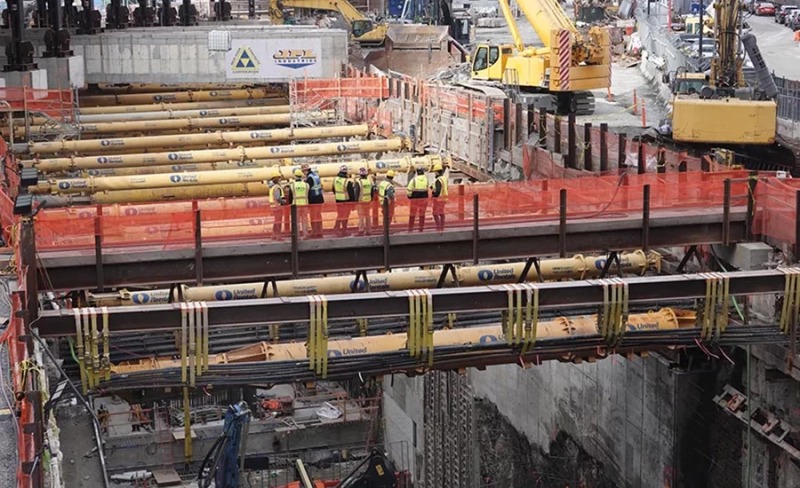
The text of this article was updated Feb. 6 to reflect new information.
After hearing arguments on Feb. 6 for New York and New Jersey’s emergency request to restore funding to the $16-billion Hudson Tunnel Project, U.S. District Court Judge Jeannette A. Vargas ordered the federal government to stop withholding billions in federal grants, reported the New York Times.
The Times reported the development at almost 9 pm Eastern time, about four hours after the stated 5 pm deadline at which the program would be shut down. “Plaintiffs have adequately demonstrated that they would imminently suffer” irreparable harm if the project was “forced to shut down its operations,” Vargas wrote in the 11-page ruling.
The ruling came after a day spent by crews winding down much of those operations on various sites.
In a statement, GDC said it «is pleased» with the court’s decision. «We thank our partners in New York and New Jersey for taking action to help us access the federal funding for the Hudson Tunnel Project,» the statement said. «As soon as funds are released, we will work quickly to restart site operations and get our workers back on the job.»
Earlier at the Southern District of New York court hearing in Manhattan, Vargas was skeptical of the U.S. Justice Dept. claim that the states and their partners could fund the project themselves.
“I think they’re saying they’re going to have to fund this wind-down because New York and New Jersey cannot provide all of this funding,” said Vargas, according to Courthouse News Service.
Looking for quick answers on construction and engineering topics?
Try Ask ENR, our new smart AI search tool. Ask ENR →
Shankar Duraiswamy, a lawyer representing New Jersey, said during the hearing that idling the project would cost the state and New York significant resources, according to Reuters. «Project sites cannot simply be abandoned,” he said. “There is literally a massive hole in the earth in North Bergen, New Jersey, that must be secured.»
Reuters also reported that Justice Dept. lawyer Tara Schwartz said the states could pay for the project without federal funds. «The states claim there’s this parade of horribles that’s going to occur if they have to put hammers down,» she said. «But the GDC [Gateway Development Commission overseeing the project] is funded by the states, federal government and Amtrak … so it’s not clear why the states can’t keep the project going.»
Meanwhile, President Donald Trump said earlier that he would release funds if Washington Dulles Airport and New York City’s Penn Station rail terminal were renamed for him.
Separately, the commission filed a breach-of-contract lawsuit in the U.S. Court of Federal Claims, seeking $205 million in disbursements and damages tied to curtailed work. The suit argues that the funding agreements do not permit unilateral suspension or termination absent a documented breach. and that a pause would drive substantial additional costs tied to resequencing and restart. “Our goal has always been to work with our federal partners and get funding flowing again,” Prendergast said in a statement, adding that the commission must hold the federal government to its contractual obligations to avoid a shutdown.
A Megaproject at a Crossroads
Earlier in the day on Feb. 6, the commission said it would suspend the project at 5 pm if federal funding was not unlocked. The announcement said work would stop on active sites in New York and New Jersey, with four major procurements for the remaining construction packages placed on hold until funding was restored.
A prolonged shutdown could jeopardize roughly 11,000 jobs tied to current work and threaten the project’s intended broader economic—about 95,000 jobs and $19.6 billion in economic activity, according to commission officials. They announced on Jan. 27 that the project’s federal funding disbursements had been exhausted.
“Today is a setback, but it’s not the end,» commission CEO Tom Prendergast said in a statement, «To those who have long championed the project, our workforce and the riders who are relying on [the commission] to finally deliver the modern, reliable commute they deserve: know that our work is far from over.» He said the commission «will continue to do everything in our power to get our funding restored and deliver the most urgent infrastructure project in the country.”
The White House press office did not immediately provide a comment in response to the project’s scheduled suspension.
Sidebar
Legal Context: The Lawsuits Behind the Hudson Tunnel Funding Fight
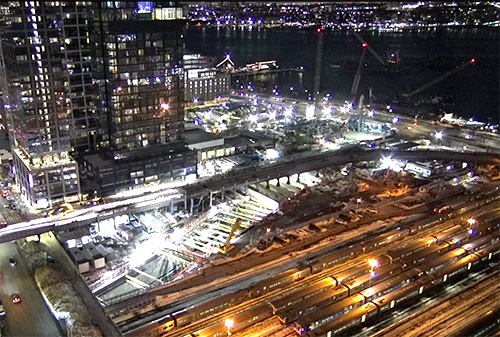
A night aerial from the Gateway Development Program’s HYCC-3 construction camera on Feb. 5 shows active work zones on the Hudson Tunnel Project. This sidebar explains the legal actions and funding decisions now shaping whether that work can continue.
Courtesy of the Gateway Development Program
The hearing came as project sponsors said they have exhausted available cash and credit following a federal funding freeze that has since escalated into a declaration by President Donald Trump that the project is terminated.
The dispute traces back to late 2025, when the U.S. Dept. of Transportation halted grant and loan disbursements that had already been obligated for the project, citing a compliance review. In January, Trump publicly declared the Hudson Tunnel Project “terminated,” a posture that New York, New Jersey and the project sponsor say cut off federal cash flow needed to sustain construction already underway.
Despite the funding standoff, several early civil packages tied directly to the near-term tunneling sequence have continued, including approach construction in New Jersey, Hudson River ground stabilization and Manhattan approach work.
Project filings and prior ENR reporting indicate that some of this work is designed to proceed continuously, meaning a shutdown would require crews to secure partially completed excavations, stabilize work zones and demobilize specialized equipment—costs incurred before any restart can occur. Contractors would then face remobilization, resequencing and lost access windows once work resumes, compounding schedule and cost exposure.
With federal disbursements frozen and no replacement funding in place, the commission had warned that it exhausted available cash and credit, prompting preparations for a potential pause absent court intervention.
Read More
N.Y., N.J. v USDOT | Preliminary Injunction Request
State officials argued that even a short interruption would have immediate workforce and cost consequences. New Jersey Gov. Mikie Sherrill (D) warned that “1,000 workers will immediately lose their jobs” if construction halts. New York Gov. Kathy Hochul (D) said the funding freeze—and the administration’s subsequent declaration that the project is terminated—threatened “thousands of union jobs and billions of dollars in economic benefits” tied to a corridor that carries roughly 200,000 daily rail passengers.
ENR Commentary
Gateway Funding Freeze Threatens a National Rail Artery
In court filings, the two states argued that emergency relief was needed because continued suspension would cause irreparable harm to an active construction program. New Jersey Acting Attorney General Jennifer Davenport said the freeze “jeopardizes safe and reliable infrastructure and puts thousands of jobs at risk,” while New York Attorney General Letitia James warned that stopping work on the Hudson crossing would be “disastrous for commuters, workers and our regional economy.”
RELATED
Federal Funding Freeze Threatens to Halt $16B Hudson Tunnel Project
The Hudson Tunnel Project would add a new two-tube rail tunnel beneath the Hudson River and rehabilitate the 116-year-old North River Tunnel, which was damaged during Superstorm Sandy. Together, the tunnels are central to maintaining capacity through the nation’s busiest passenger rail corridor.