

Bill extends federal construction programs through Dec. 11 but omits some transit and passenger-rail appropriations
Updated 10:07 p.m. ET, Aug.8, 2026
The Senate passed a stopgap funding package 90-6 early on Aug. 8 that would extend federal highway and transit programs through Dec. 11 but would not preserve all Infrastructure Investment and Jobs Act advance appropriations supporting transit and passenger rail.
Read More
Division A —
Continuing Appropriations Act, 2027
The Saturday vote followed Senate action Aug. 3 to invoke cloture on the measure as lawmakers work toward approving government funding before current appropriations expire Sept. 30.
The legislation would continue most agency operations at fiscal 2026 rates.
Division A of the proposal would continue appropriations through Dec. 11, or until the applicable fiscal 2027 spending bill is enacted into law.
The measure covers federal accounts supporting transportation, Army Corps of Engineers civil works, Bureau of Reclamation programs, environmental infrastructure and military construction.
Under the measure, federal agencies could generally continue projects and activities funded in fiscal 2026 but could not start work that lacked current-year appropriations or other authority. The measure also directs agencies to take only the most limited funding actions necessary during the extension and restricts large early grant distributions that could preempt Congress’ final spending decisions.
Looking for quick answers on construction and engineering topics?
Try Ask ENR, our new smart AI search tool. Ask ENR →
Read More
Division C —
Surface Transportation Extension Act of 2026
A separate Surface Transportation Extension Act, included as Division C, would extend expiring highway, transit and related authorities through the resolution’s funding period. Highway Trust Fund and Mass Transit Account programs would receive prorated fiscal 2027 authorization based on their fiscal 2026 amounts, with corresponding obligation limits.
The transportation division would also keep available through Sept. 30, 2027, certain non-formula highway funds that otherwise would lapse on Sept. 30
Division A would separately carry the remaining balances from selected fiscal 2023 highway infrastructure programs into fiscal 2027 and extend older Federal Transit Administration capital investment grant funds through fiscal 2031 to liquidate valid obligations already incurred.
The package does not carry forward all annual advance appropriations provided by the 2021 infrastructure law through fiscal 2026.
Transportation Funding Divide
The American Public Transportation Association and 85 coalition partners—including the Associated General Contractors of America, American Road & Transportation Builders Association, American Council of Engineering Companies, American Society of Civil Engineers and American Association of State Highway and Transportation Officials—urged Congress to preserve fiscal 2026 transportation funding from both the Highway Trust Fund and infrastructure law advance appropriations in any short-term extension.
The groups say the absence of advance appropriations would reduce public transit investment by 20% and passenger-rail investment by 83%, leaving passenger rail without guaranteed funding during the extension.
Unlike highway programs, which receive contract authority from the Highway Trust Fund, many transit and passenger rail programs rely on infrastructure law advance appropriations that expire Sept. 30 unless Congress extends them.
In a July 27 letter to party leaders in both chambers, the coalition warned that reducing transportation funding even temporarily could inject uncertainty into state and local investment decisions and delay the start or completion of infrastructure projects. The signers span contractors, engineers, public agencies, labor unions and construction-material and equipment suppliers.
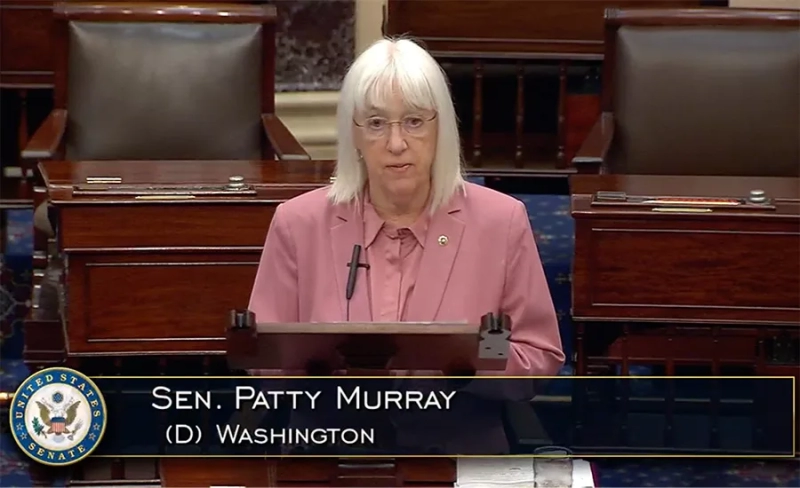
Senate Appropriations Committee Vice Chair Patty Murray (D-Wash.) confirmed Aug. 4 that negotiators had not agreed to extend the advance appropriations. «Republicans also rejected our efforts … to extend the critical advanced appropriations provided by the Bipartisan Infrastructure Law, which will expire on October 1,» she said.
While supporting the Senate proposal as a temporary bridge, Associated General Contractors of America said a stopgap extension is «no substitute for a multi-year bill.» The association noted that the measure would keep core highway and transit programs operating but would not extend certain IIJA programs that increased transportation investment, meaning it would not maintain the law’s full investment levels.
Project-Specific Exceptions
The bill contains narrower provisions intended to prevent disruption to specific federal construction work. The U.S. Dept. of Energy could continue long-lead procurement for the Waste Isolation Pilot Plant’s Hoisting Capability Project and avoid demobilization or contract termination on three projects for its National Nuclear Security Administration unit in Nevada and New Mexico.
Another exception would allow the U.S. Army and U.S. Navy to use current or unobligated prior-year military construction funds for unaccompanied housing at the Medical Education and Training Campus at Joint Base San Antonio, despite the resolution’s general restriction on new starts.
Additionally, the proposal would raise an authorization ceiling for the Bureau of Reclamation Bay-Delta program from $32.6 million to $40 million, allowing the agency to use previously appropriated funds for program management and oversight. It would preserve remaining federal Middle Mile Deployment broadband funds through Sept. 30, 2027.
A separate provision would prevent the Office of Management and Budget from issuing or implementing a proposed rule to revise government-wide federal grant requirements through Dec. 11.
Appropriations Committee Chair Susan Collins (R-Maine) said the proposed rule could politicize grants and harm rural communities, families and biomedical research. Ranking member Murray said it could allow political appointees to withdraw funding for projects including bridges and hospitals.
RELATED
Grant Certainty Emerges as New Fault Line in Transportation Bill Talks
Supporters of the provision argued that temporarily blocking the proposed OMB grants rule would help prevent political interference in federal financial assistance. Democrats cited concerns that the rule could affect major infrastructure grants, including projects such as the New York-New Jersey Gateway Program and Chicago Transit Authority’s Red Line extension.
Because the Senate-approved legislation differs from the measure previously passed by the House, lawmakers must reconcile the two versions before identical legislation can clear both chambers and be sent to President Donald Trump for his signature.
AGC said the industry’s focus remains on enactment of a long-term surface transportation bill. The group called the bipartisan BUILD America 250 Act the leading reauthorization proposal and warned that delays in long-term transportation funding create uncertainty about future projects.