

Crews in southern Utah County are nearing completion on one of the most consequential water infrastructure projects in the Western U.S. as they prepare to finish the final 4.3-mile segment of the Spanish Fork–Santaquin Pipeline, the last major construction link in a multibillion-dollar project that will provide locals with a viable water supply for decades.
Led by the Central Utah Water Conservancy District (CUWCD) and general contractor VanCon Inc., the Santaquin Reach is the culmination of a 17-year endeavor to transport Colorado River water through the Wasatch Mountains to the high-growth communities of southern Utah County. By tapping into the massive storage at Strawberry Reservoir in the mountains, the Spanish Fork–Santaquin Pipeline (SFSP) provides enough water to protect 240,000 residents from drought.
“Completion of the SFSP is a critical milestone in building the backbone that enables the rapidly growing communities in the south end of Utah County to begin taking water allocations petitioned for decades ago,” says Brad Perkins, project manager for the Central Utah Project.
With the SFSP nearly complete, the Utah Lake System (ULS) now delivers Strawberry Reservoir water in a continuous pipeline along a 35-mile stretch from Orem to Santaquin. In Orem, the ULS connects with other pipelines to deliver water as far north as Salt Lake City.
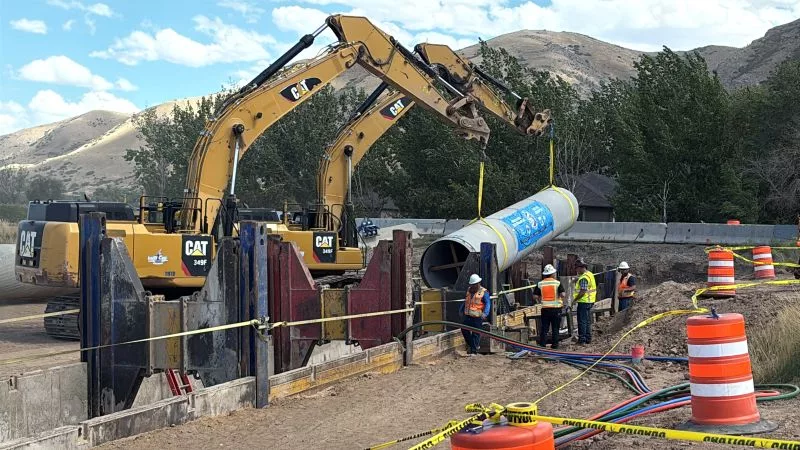
The Santaquin Reach is highlighted by massive 60-in.-dia spiral-weld steel pipes, designed to handle the high pressures required for regional water distribution. Each pipe segment is 40 ft long and weighs between 25,000 and 30,000 lb. Installing them has required more than 500 individual “picks” to complete the 4.3-mile reach.
To protect the pipe during installation, VanCon used two large excavators and 6- to-8-in.-wide nylon straps to ensure the concrete-over-tape coating remained intact.
The pipeline was installed at an average depth of 11 ft to 15 ft, with some areas exceeding 20 ft. “The soil conditions varied from silty sands, sands with gravels, to gravels,” says Chad Hunsaker, vice president of VanCon. He says crews installed more than 50,000 cu yd of controlled low-strength material around the pipe to ensure 100% compaction and to protect the pipeline.
“The pipe was installed using a slide rail shoring system for the 25,000 linear feet,” says Hunsaker. “This type of shoring system is complex and requires a large crew to install and remove shoring and provide a safe work area for the manpower installing, welding and backfilling the pipeline.”
Precision Welding and Protection
While many large-scale water projects rely on gaskets, the SFSP utilizes bell-and-spigot joints with double lap welds. This meant 90,000 linear ft of welding, handled by a team typically consisting of one welder inside the pipe and two on the exterior.
The pipeline contained cylinders of two different thicknesses: 1/2-in. and 5/8 in. The 1/2-in. cylinders required four passes inside and outside of each joint, and the 5/8 in. required five, says Hunsaker, noting that quality control was critical, as every joint underwent visual inspection, air pressure testing, and ultrasonic testing conducted by QTI inspectors who remained on site full-time during installation.
To help shield the pipe in Utah’s rugged, rocky terrain, the steel was primed and wrapped in a system of dielectric tape and several layers of polyethylene tape for corrosion prevention and mechanical protection. For further safeguards, a 1-in.-thick reinforced cement mortar overcoat is applied over the taping system.
“Once installed, the pipe receives additional protection with controlled low-strength material trench backfill,” says Ryan Phillips, project manager for Jacobs, the job’s design engineer. “Internally, the steel pipe barrel is centrifugally lined with a cement mortar coating.” The pipe joints are grouted after being welded in the field for a continuous and smooth finish lining. To provide cathodic protection, passive anodes were installed at regular intervals along the pipeline.
The ‘Golden Spike’ Connection
Laying miles of pipe was challenging, but the most difficult moment was the physical «tie-in»—the point where the new 4.3-mile section finally met the 45 miles of pipe already in the ground. The challenge was that both pipes were capped off and filled with millions of gallons of water. Before the crew could join them together, they had to drain the system and cut off the heavy steel end-caps to expose the open pipe.
Because this required taking the water system offline, the team spent three months planning for the exact right time right after the 2025 irrigation season ended.
“Once the irrigation season was completed, the existing pipeline was drained and the new pipeline was temporarily connected with a smaller pipe between the two to drain the new pipeline into the existing pipeline so that the dished heads [the steel end-caps] could be removed,” says Hunsaker.
With the lines drained and the ends exposed, the team joined these two massive ends by using a “butt strap” connection ring—a 2-ft-wide steel collar that overlaps both the existing and the new pipe. This ring was then welded both inside and out, creating four separate weld locations within a 2-ft area to ensure the joint could handle the massive system pressure. Phillips says that while the double-welded butt strap allows for a tiny bit of flexibility, the tolerance for the tie-in was within inches.
Crossing the Finish Line
The project is currently in final commissioning, with crews finishing the nine turnout vaults that were constructed along the entire stretch of the SFSP, and electrical and IT teams are presently integrating isolation and plunger valves into the SCADA network. Perkins says all work is scheduled to complete June 30, with regular water deliveries beginning next spring.