

More than 40 gigawatts of utility-scale solar generation was installed in 2023 according to Wood Mackenzie and the Solar Energy Industries Association.
That pace is expected to fall as incentives end this year, but even with modest growth, labor demand for big solar projects is expected to remain strong as contractors consistently report that staffing remains a problem. In August, South Korea-based Xpanner launched its X1 Kit, a combination of hardware and artificial intelligence-backed machine controls to automate one of the most demanding jobs on solar sites: pile-driving.
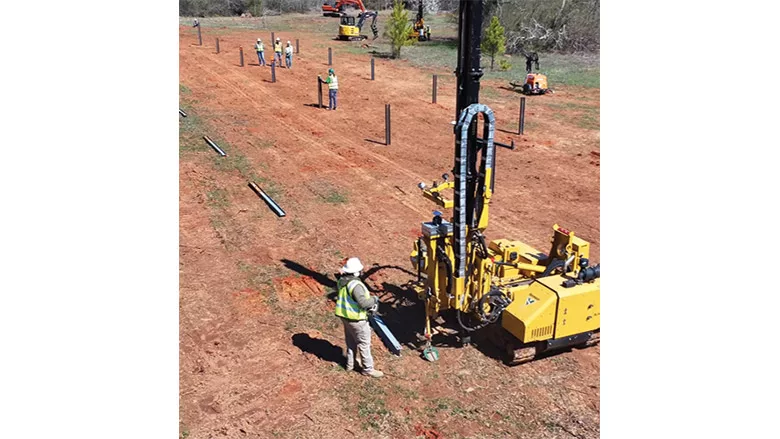
“You usually need a crew of five people to install piles on a site,” says Henri Lee, Xpanner CEO and a former equipment automater for Bobcat and Hyundai Infracore. Crews typically include “a surveyor, laborers, a marking guide for the piles. More than 70% to 80% of the pile drivers are run by two operators. One guy is actually running the machine with a remote control. The other one is on the hook. There’s someone else looking at the number and quality of the work driven. We could remove a total of five.”
In co-founding Xpanner in 2020, Lee sought to create site automation solutions that would bring project executives out of the mindset of answering only questions such as “how many people and how many machines do I need?” and brought a process-based solution to market, first with the X1 Kit.
“I really wanted to change this perspective from making an autonomous machine in the field to making real process automation to remove people around that process,” Lee says.
Having more operators in cabs and fewer workers on foot in the field is one example of eliminating an unnecessary risk exposure on solar projects.
Another common example, said Lee, was having four or five workers standing around one pile-driving machine while two different workers drive piles and move the machine.
Designed for integration with leading pile drivers such as Vermeer’s PD10, the X1 Kit enables deployment and scalable automation. It’s being used by customers who are large EPCs on solar projects in the U.S.
Michael Owens, solar innovation team lead for Black & Veatch in Kansas City, Mo., is working with Xpanner on several projects in the utility-scale solar space.
“What that means is we have less people out there in a work atmosphere that sometimes can be dangerous,” he says. “There’s heavy equipment out there. The less people we can have out there working, the better. We learned a lot of lessons. We did have some things on one project that we needed to correct. We’ve only used it on two projects so far, but we are very excited about it.”
Owens says that the X1 Kit is an attachment to the existing pile-driving equipment used on the project sites, and requires no special equipment to adapt the existing machines. It consists of three technologies: a proprietary software suite; Mango, a hardware control unit that facilitates machine operations; and M2, an on-board processing unit that can scan its environment and transmit real-time operational commands. M2 has machine learning capabilities that let it learn from every pile it places to optimize its work.
“They incorporated AI into our pile drivers to where we just input our locations on our plan,” Owens says. “The pile driver actually drives to where the correct location is. The only thing that the operator does is push a button on a remote kiosk. He’s not on the machine. He hooks up the pile, pushes another button. The pile driver drives to the correct X, Y and Z coordinate. Elevation is in there as well.”
Owens says while there was some learning curve on the first project, the difference between manual pile-driving, efficency-wise, was dramatic. “We had more people having to be out there to do all those activities and then manually decide where was that pile in the end,” he adds.
While pile-driving and the X1 Kit remains Xpanner’s focus as they continue to roll the system out, Lee sees more opportunity for construction process automation.
“The core members of our company all come from equipment manufacturers such as Bobcat, Volvo, Hexagon and some from manufacturing such as BMW,” he says. “The main motivation of Xpanner is we really want to remove as many people around heavy equipment on jobsites as possible.”
Last year, nearly 75% of struck-by fatalities involved heavy equipment such as trucks or cranes, according to OSHA.