

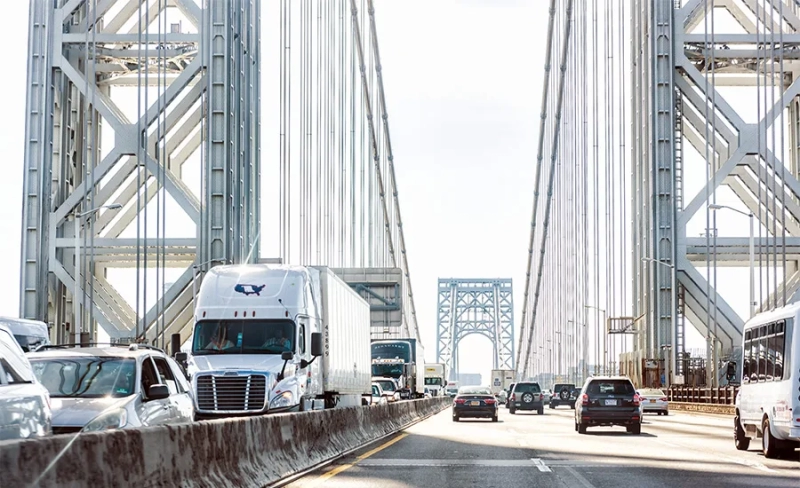
Port Authority settles days before trial judge rules jury could decide if roadway debris remained in place long enough for constructive notice
A $10.5-million settlement that recently came to light has ended a six-year legal fight over whether a truck part that may have been lying on the George Washington Bridge roadway for more than 10 minutes was there long enough for the Port Authority of New York and New Jersey to have found and removed it before it caused a catastrophic accident.
The Port Authority reached the May 8 agreement with motorist Joseph Rosario three days before an Essex County, N.J., jury was scheduled to begin weighing liability. By then, court filings state, Rosario’s claims against Skanska Koch Inc. and El Sol Contracting/GCCOM Construction—contractors working on two major bridge rehabilitation projects underway at the time of the incident in 2020—had also been settled. The filings did not disclose the date or amount of the contractors’ settlement, and those claims were resolved without a determination of liability.
The litigation began after Rosario, then 28, was driving westbound in Lane 3 of the bridge’s upper level at about 10:43 a.m. on March 2, 2020.
Read More
NY/NJ Port Authority —
Aug. 1, 2025 | Summary Judgment
Video showed a leaf spring—a steel component of a truck’s suspension system—lying along the stripe separating two eastbound lanes before another vehicle struck it. That action propelled the truck component over the median and through Rosario’s windshield. Court records say Rosario was left comatose and underwent emergency brain surgery.
Two major construction programs were active on the upper level that morning. Skanska Koch was replacing suspender ropes and rehabilitating the bridge’s main cables, with crews working along the westbound sidewalk and Lane 7 closed. El Sol/GCCOM was performing upper-level structural steel rehabilitation, including underside repairs, finger-joint replacement and paving.
Rosario’s traffic-safety expert acknowledged that Skanska’s westbound lane closure was on the opposite side of the bridge from the eastbound debris. The record does not establish where El Sol/GCCOM’s two workers were positioned relative to the accident site, nor was the source of the leaf spring ever identified.
Skanska, for its part, said its contract did not make the company responsible for lane maintenance. “Skanska Koch was not involved in the incident or the resolution of the claim,” the company said in a statement. El Sol/GCCOM did not respond to ENR’s request for comment.
Looking for quick answers on construction and engineering topics?
Try Ask ENR, our new smart AI search tool. Ask ENR →
Debris Practices Come Under Scrutiny
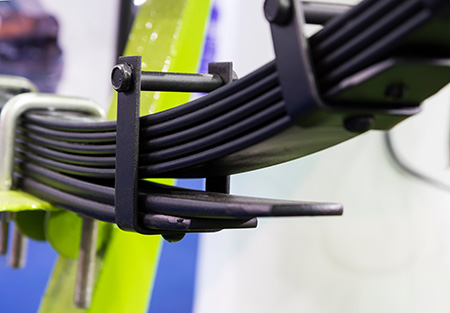
A leaf spring is a steel suspension component used on trucks and other heavy vehicles. A dislodged leaf spring was involved in the 2020 George Washington Bridge accident.
Image/Adobe
Matthew Weinbrecht, the Port Authority’s night maintenance supervisor, testified that crews were assigned to inspect roadways and «grab large debris items that could end up in traffic or are currently in traffic.» Records cited by Rosario’s expert showed large-debris removal occurred daily in the days before the accident, but the bridge was not swept from Feb. 26 through March 2 and the locations of debris collected across 78 lane miles were not recorded.
Weinbrecht also testified that staff did not track the volume, location and removal time of large debris. Rosario’s traffic-safety expert, Eunejune Kim, argued that the lack of location, frequency and debris-type data prevented the Port Authority from identifying recurring debris patterns and targeting cleaning. He also noted that the upper and lower levels were swept at the same frequency despite differing debris volumes.
The Port Authority countered that its police, operations and maintenance personnel routinely patrolled the bridge and removed hazards, and that no debris had been reported near the accident location before Rosario was struck.
Rosario’s expert testified that construction activity can impede street cleaning and that contractors are generally expected to keep their work areas and lane closures clean. The record does not establish that Skanska Koch or El Sol/GCCOM deposited the leaf spring or knew it was in the roadway.
Minutes Become the Liability Question
By August 2025, the competing accounts had reached the summary-judgment stage. The Port Authority characterized the collision as a “freak accident” for which it lacked actual or constructive notice, arguing that Rosario could not prove the leaf spring had remained on the bridge long enough for the agency reasonably to have discovered it.
Rosario’s expert, Kim, reached a different conclusion after reviewing the surveillance video. Although there was no direct image of the leaf spring before the final seconds preceding the accident, he said vehicles appeared to maneuver around something in the eastbound roadway during the 10 minutes and 43 seconds of footage before Rosario was struck.
RELATED
Watch: Restore the George | See the Port Authority’s $2.1B Bridge Rehabilitation Up Close
New Jersey Superior Court Judge Jennifer Critchley denied Port Authority’s summary judgment motion Jan. 6, finding that the competing interpretation created an issue for a jury. She also rejected Rosario’s attempt to extend the “possible period” to 45 minutes but did allow Kim’s opinion regarding the shorter window to be entered into the record, explaining that constructive-notice timing is highly fact-sensitive and «each minute can matter.»
Read More
Superior Court of New Jersey —
Motion to Bifurcate Trial
The Port Authority sought reconsideration, arguing that hundreds of vehicles had traveled through the eastbound lane without incident. The judge denied that request Feb. 19 and separately ordered liability and damages to be tried in separate phases. Her order said the liability phase would focus on whether the leaf spring had been present long enough, within the 10-minute-and-43-second window, to give the Port Authority constructive notice.
Rosario’s attorney, Edward Capozzi, also sought sanctions over surveillance footage he alleged the Port Authority failed to preserve after sending the agency a preservation demand 10 days after the accident. He asked Critchley for an adverse inference, which would have allowed jurors to infer that the missing evidence was unfavorable to the Port Authority. The agency opposed that request and the case settled before Critchley ruled on the merits.
The settlement also kept the central liability question from reaching a jury—whether the leaf spring had been in the roadway long enough for the Port Authority to have discovered it.