

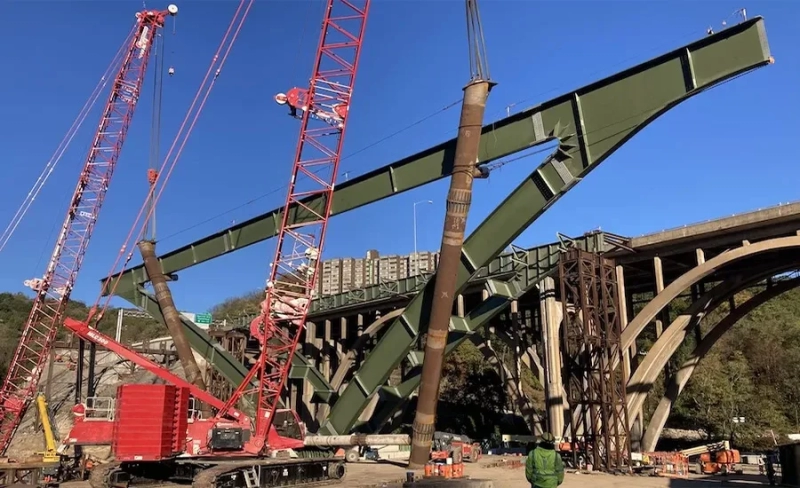
After completing one of the most complex and longest lateral slide-ins of a prebuilt bridge in the U.S.—at 22 million lb in Pittsburgh—crews with Fay, S&B US Construction now are restoring a trail and stream in the city’s Frick Park. The demolition of an existing 846-ft-long, 75-year-old concrete arch bridge followed by installation of the new steel arched delta frame bridge took just 17 days—about half the time allotted for closure of Interstate 376, with the new bridge opening on July 27.
While accelerated bridge construction (ABC) techniques have been used in the U.S. for decades, the Commercial Street Bridge in Pittsburgh not only is one of the heaviest, but also presented a special challenge due to the arch delta frame design, says Nicholas Burdette, Northeast region bridge leader at HDR, the designer working with the Pennsylvania Dept. of Transportation.
“You’re looking for a bridge with an arched appearance that can be slid, and combining that with explosive demolition…really required careful attention to the substructure,” he said/
Many ABC projects use self-propelled modular transporters to carry the new structure, but with limited workspace and heavy weight, Mammoet provided a specialized system consisting of 42 skid “shoes” spread out over four primary locations: the bridge piers and abutments. The new bridge was moved 102 ft in one continuous shift. In a news release, Mammoet stated that it is the heaviest bridge it has ever moved in the U.S., and added: “We are now looking at [using] this system on several other projects now that it is in the US.”
Arch Designs
The old reinforced concrete open-deck arch bridge could no longer handle permit loads and was carrying 100,000 daily vehicles over one of Pittsburgh’s largest parks. Known for its slender concrete arches, it was designed by Richardson, Gordon & Associates, which was acquired by HDR in the 1980s, notes Burdette.
PennDOT wanted the new bridge to retain the open aesthetic of an arched bridge. “Based on public polls and interactions with [stakeholders], it was evident that everybody wanted an arch bridge,” he says.
PennDOT also wanted a slide-in. “The other option was three phases of construction and four years of headaches” due to traffic impacts, says Jason Zang, agency district executive. “The new bridge’s design mimics the old arch; we’re trying to respect the historic nature of the corridor and the old bridge.” The bridge is part of the corridor between Swissvale and Edgewood and the city of Pittsburgh, including the Squirrel Hill Tunnel.
Looking for quick answers on construction and engineering topics?
Try Ask ENR, our new smart AI search tool. Ask ENR →
But typical arch bridges have significant horizontal thrust forces that would be particularly challenging for a slide-in, Zang and Burdette both note. The arched delta frame design satisfied the public desire for retaining the aesthetics while lessening the thrust forces, says Burdette.
“It’s really a fairly conventional structure in terms of maintenance and inspection” he says. “It’s a girder bridge with the delta frames below it.”
PennDOT decided on the late July-early August timeframe for the slide-in, which was allotted 25 days, because of the slight lull in traffic during that period.
Fay won the approximately $95-milion design-bid-build award in 2024, says project manager Michelle Olszewski, adding that the slide portion of the contract was design-build with COWI.
“We had two temporary piers and abutments … designed to interface with the slide system,” she says. COWI also designed for the stability of the bridge during the slide and helped develop the demolition plan, a mix of conventional for the superstructure and blasting for the substructure. “We had to be thoughtful in how we did conventional demolition with equipment spread across the deck, and we had to protect the new substructure that was built directly below the old,” she adds.
The new substructure consists of micropiles as deep as 30 ft, and abutments between 60 to 100 ft, with only a 20-ft clearance under the old bridge. “We started the micropiles at the tail end of 2024, and the temporary substructure in spring of 2025,” she says.
Segments of the new bridge, including the longest girder at 126 ft, began arriving from fabricator Veritas Steel in Wisconsin last summer, and crews at Amelie Construction conducted steel erection through the rest of the year. Olszewski notes that the erector put the pieces of the triangular delta girder together lying sideways and then tipped it up in a two-crane pick.
The structure features three spans and seven 825-linear-ft girder lines. Each delta frame consists of seven pieces of steel as heavy as 80,000 lb. Zang notes that there are no longitudinal joints in the bridge.
Burdette adds that the contract required a trial slide, done in June, in which crews “raised the new bridge, moved it sightly to the north, and back down to the south and set it back down. That was a kind of proof of concept and there were some valuable refinements that came out of that.”
Commercial Break
Before PennDOT shut down the old bridge to traffic on July 10, blasting contractor Veit began drilling some 2,500 small holes in preparation for blast charges in the three arch spans, says Burdette. Conventional demolition began at the center of the deck, working toward the ends. The contractor could then place charges into the holes and conduct the controlled blast on July 16.
Three days later, the slide-in commenced. Mammoet noted in a release that “most skidding systems are likely to move laterally a little when they pick up a heavy load,” but the skidding “shoe” system resists that movement. A temporary frame built between the bridge and the skid shoes provided additional protection.
Mammoet also stated that a “newly revamped” control system gives operators “unprecedented precision and oversight” over the operation, which was crucial given the 1-in. tolerances from piers to abutments. “Each skid shoe can be operated independently, with the integrated hydraulic jack being used to lift the load from its temporary supports and set it down on its permanent bearings.”
The hydraulic shoes lifted the structure about 10 in. off the temporary supports and pushed it forward on four sets of rail 102 ft to the permanent ones in a process that took less than 10 hours. The contractor earned some $2 million in hourly incentives, says Zang.
Crews are now clearing all remaining debris, removing temporary foundations, restoring the street, Nine Mile Run stream and trail below the bridge and planting about 5,000 new trees and shrubs. “Part of the project is to restore the park in better condition that what we found it,” he adds.