

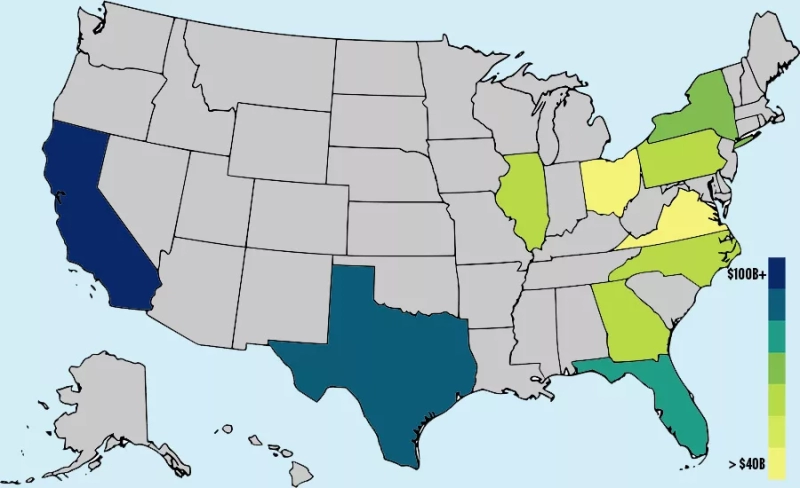
BEA ‘value added’ assessment shows more than half of U.S. construction activity remains clustered in just 10 states
U.S. construction activity remains heavily concentrated in just a few states, and indicators through the first three quarters of 2025 show that this concentration is continuing to grow rather than spreading more evenly across the country, according to an analysis of federal data by ENR.
Permit activity and construction employment through Q3 2025 continue to favor the same dominant markets that already account for the bulk of completed construction activity. Those trends reinforce a pattern visible in the most recent fully reconciled data, which show that more than half of all U.S. construction value added in 2024 was generated in just 10 states.
RELATED
Two Markets, One Industry: Commercial Construction Splits as 2025 Winds Down
Those states—California, Texas, Florida, New York, Georgia, North Carolina, Pennsylvania, Illinois, Ohio and Virginia—form the core of U.S. construction activity and continue to lead the pace nationally.
Directional indicators available through August 2025, the last month government data is current, including building permit valuation data from the U.S. Census Bureau and state-level construction employment data from the U.S. Bureau of Labor Statistics, show that the same markets continue to dominate, reflecting structural advantages such as labor depth, infrastructure readiness and power availability.
Learn More
ENR Methodology Explained
Unlike many construction market assessments that rely primarily on project announcements, backlog surveys or permit filings, analysis here centers on construction value added—a measure reported annually by the U.S. Bureau of Economic Analysis (BEA) that reflects construction’s contribution to gross domestic product through completed residential, nonresidential and infrastructure activity.
Construction value added captures where labor, capital and materials are ultimately deployed, offering a reconciled view of construction activity that places competitive pressure and delivery capacity into sharper relief. In 2024, construction value added totaled approximately $1.31 trillion nationwide, measured in current dollars, and was far from evenly distributed.
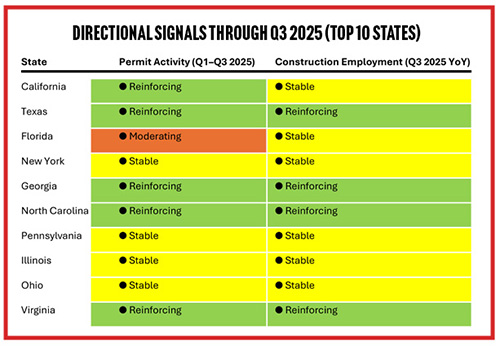
Directional indicators through Q3 2025 show whether leading construction states are reinforcing, stabilizing or moderating relative to their 2024 construction output levels. “Reinforcing” indicates that permitting, employment and pipeline signals continue to support existing activity rather than pointing to a near-term pullback.
For purposes of this analysis, states are classified as “reinforcing” when both permit valuation and construction employment increased year over year, “moderating” when both declined and “stable” when the indicators moved in opposite directions. The directional indicators are used to assess momentum rather than to measure realized output.
The dominance of certain states reflects more than population growth or near-term project cycles. Capital-intensive construction sectors have amplified existing advantages, particularly in data center construction, which demands enormous, continuous power loads, extensive site preparation and complex permitting.
Rather than redistributing construction activity by creating entirely new hubs, hyperscale and colocation projects have flowed toward states already capable of supporting those requirements at scale.
Power availability, however, is only part of the equation. Labor capacity further constrains the extent to which large-scale construction activity can spread. States with deeper construction workforces are better positioned to absorb surges in industrial, infrastructure and power-intensive construction without immediately pressuring schedules or pricing.
That combination of workforce depth and delivery experience narrows the field of states capable of sustaining waves of capital-heavy construction activity.
This dynamic helps explain why Sun Belt states now account for a substantial share of the nation’s largest construction markets. Texas, Florida, Georgia, North Carolina and Virginia alone account for half of the top tier by construction value added.
At the same time, several legacy industrial states continue to play an outsized role. New York, Pennsylvania, Illinois and Ohio remain among the nation’s largest construction markets despite slower population growth, supported by dense transportation networks, institutional construction, public works programs and long-established labor pools.
RELATED
Construction Employment Sees Yearly Gains in 27 States
Their continued presence complicates a simple Sun Belt-versus-Rust Belt narrative and underscores the enduring importance of infrastructure maturity and construction delivery capacity.
Looking ahead, the challenge for contractors and designers heading into 2026 is less about identifying where demand exists than about competing in markets where construction capacity is already concentrated.
In states that dominate completed activity, margins, labor availability and execution risk are increasingly shaped by congestion rather than scarcity, raising the stakes for workforce strategy, partner selection and project sequencing.