

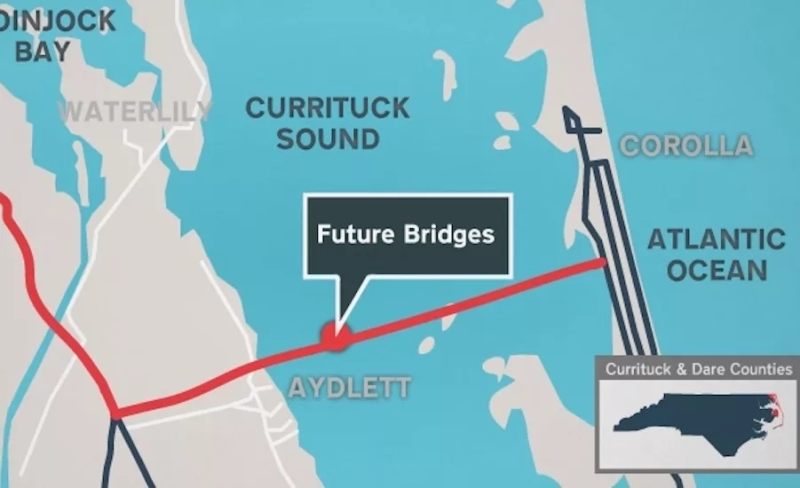
The Mid-Currituck Bridge, a long-planned new crossing to North Carolina’s Outer Banks, may be inching from the drawing board to construction, recently gaining two key state environmental permits. But the estimated $1-billion project still faces multiple uncertainties, including a yet-to-be-defined funding plan and significant local opposition.
First proposed more than 50 years ago, the 7-mile connection between mainland Currituck County and barrier island communities would provide an alternative to the Wright Memorial Bridge, a four-lane causeway to the south that frequently bogs down with visitor traffic, particularly during peak summer months. Expanded access to the mainland would also provide an additional evacuation route for northern Outer Banks communities during hurricanes and other major weather events.
For nearly two decades, the North Carolina Turnpike Authority, an arm of the state Dept.of Transportation, has pursued the Mid-Currituck Bridge as a toll project that would include two-lane spans across Currituck Sound and Maple Swamp. According to a 2024 state DOT construction narrative, the agency envisions prefabricated concrete piles with a concrete cap for the bridge substructure, while the superstructure would consist of prefabricated, prestressed concrete beams with a concrete deck. The structures will be built from deep-water barges, supported by temporary trestles to be constructed from both sides of Currituck Sound, about 2.6 miles. The east-side trestles will be open-deck to allow sunlight to reach submerged aquatic vegetation habitat.
Although the project’s final environmental impact statement was completed in 2012, a subsequent revamp of state funding allocation strategy put the project on hold for more than three years—long enough to trigger a federal re-evaluation of the document and its selected alternative to address changes in traffic volumes, area land uses and other factors. The 2019 federal record of decision was soon challenged in federal court by the Southern Environmental Law Center on behalf of groups opposed to the project, claiming that the review process failed to consider current climate data and development trends, and alternative congestion relief solutions.
Four years of litigation resulted in a ruling from the U.S. Court of Appeals in Richmond, Va., North Carolina and the Federal Highway Administration complied with applicable federal laws and regulations, enabling permitting work to get underway.
This past September, the state issued a Dredge and Fill Law permit and a Clean Water Act Section 401 water quality certification. NC DOT is awaiting a permit decision from the U.S. Army Corps of Engineers to seek a U.S. Coast Guard construction permit.
“These four permits are necessary for construction of the project, and vital to developing a plan for the next steps in [its] delivery,” says NC DOT spokesperson Logen Hodges.
That includes developing a financing plan for an effort that has doubled in cost from an original estimate of $500 million. Hodges says that while the ultimate funding strategy has not been finalized, it likely will include federal and state funds as well as toll-backed debt. Last fall, the project failed in a bid to secure $425 million in funding under a U.S. Transportation discretionary grant program.
Hodges says that in evaluating all potential funding sources, “the project team is continuing work on a comparative analysis to evaluate delivering [it] as a traditional toll project, or a public-private partnership toll project.”
NCDOT says construction contract procurement could begin as early as next year, but a protracted federal government shutdown could alter that timeline. There is also the looming threat of new litigation from opponents who say Currituck County is unprepared for development that the new crossing would spur, compounding its potential environmental damage.
“Any legal challenge to the permits could impact the project schedule,” Hodges says.