

If established in the Great Lakes, Asian Carp could permanently alter aquatic ecosystems.
Congressional representatives from several Midwestern states and a non-profit organization are calling for the Trump Administration to immediately reverse its work stoppage that took effect in late July on the $1.2-billion Brandon Road Interbasin Project intended to prevent Asian carp and other invasive species from entering the Great Lakes.
The U.S. Army Corps of Engineers confirmed the work stoppage on the project that started in May near Joliet, Ill., but has not yet offered a reason for why it has come under another administrative review. Another pause for administrative review took place from January 2026 through May 2026.
Ohio U.S. Rep. Marcy Kaptur (D), co-chair of the bipartisan House Great Lakes Task Force, sent a letter July 30 to the administration asking for the project to be resumed.
«The Army Corps of Engineers has stopped work at the Brandon Road Interbasin Project,” she wrote. “That is terrible news for our Great Lakes. Invasive carp do not belong here. If they reach the Great Lakes, they will destroy our native ecosystem.”
She added that “we learned of a stop work order through the news. The administration and U.S. Corps of Engineers did not provide any legally required notice to Congress nor any public information. That sends a red alert across the Great Lakes basin.”
Other representatives asking for the stop work order to be lifted include U.S. Reps. Debbie Dingell (D) of Michigan, and Dave Joyce (R) and Bill Huizenga (R), both of Ohio.
The Alliance for the Great Lakes, a non-profit seeking to protect and conserve the Great Lakes, is urging “the U.S. Army Corp of Engineers to provide «transparency and resume construction after a recent work stoppage.”
Illinois Gov. JB Pritzker said in a letter to the administration that “these delays threaten the drinking water supply for more than 40 million people and put at risk a $52-billion regional economy that supports more than 1.5 million jobs,» adding, «the Trump Administration repeatedly throws up roadblocks and has now ordered work to stop altogether with no explanations.»
The Illinois Dept. of Natural Resources (IDNR) has asked the federal government for a meeting to discuss how to move forward with the project.
The IDNR states that it first learned of the stop-work order from contractors on site, not from federal officials.
“Despite repeated attempts by IDNR leadership to communicate with the federal government, the state did not receive a response until after the work stoppage had already been authorized,” it says, adding that “this breakdown in communication was inconsistent with the coordination procedures established under the jointly negotiated Project Management Plan that has guided the project.”
Asian carp—a group of invasive fish species including bighead and silver carp—are known for their rapid reproduction and aggressive feeding habits. If established in the Great Lakes, they could outcompete native fish for food, disrupt food webs and permanently alter aquatic ecosystems. The species also threaten recreational boating and fishing, and their spread could significantly harm the Great Lakes’ $7-billion fishing economy, project proponents say.
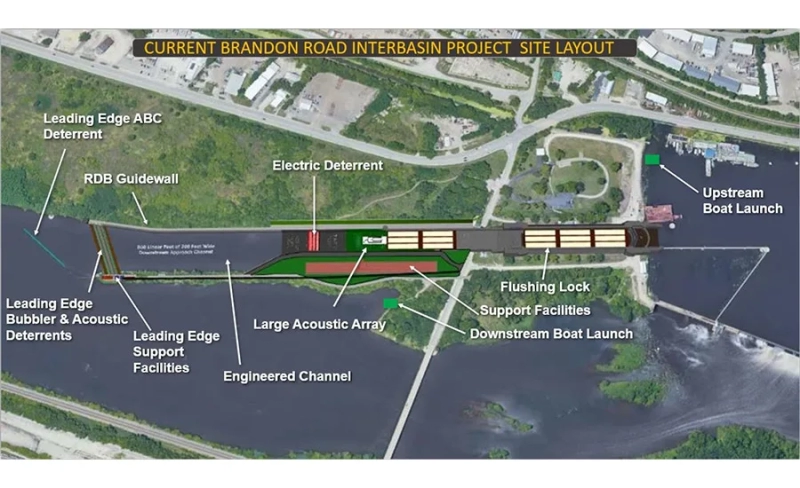
Matt Binsfeld, president and CEO of LaCrosse, Wis.-based J.F. Brennan Co., which has a $113.8-million contract to install an automated barge clearing deterrent, bubble curtain deterrent, acoustic deterrent, support facilities and an upstream boat ramp, said his company had not yet started work and will manage the pause by reallocating its resources.
«You have to make sure that everybody’s notified in terms of subs and things like that, that we have to stand down, and make sure that nobody is expending costs at this moment that are not reimbursable because the contract is under administrative review,» he said. «And then, in terms of other equipment and personnel resources, we look to put them [employees] to work elsewhere.»
The project has already faced years of delays. The Corps completed studies and public outreach before finalizing the plan in 2019. Congress authorized the project in 2020, appropriated $225 million for construction in 2022 and provided an additional $47 million in 2023. Illinois and Michigan, the project’s non-federal sponsors, have invested more than $100 million.
Future phases are expected to include additional layers of deterrents, such as an electric barrier, additional acoustic deterrents and a flushing lock intended to push any remaining larval fish and eggs back downstream.