

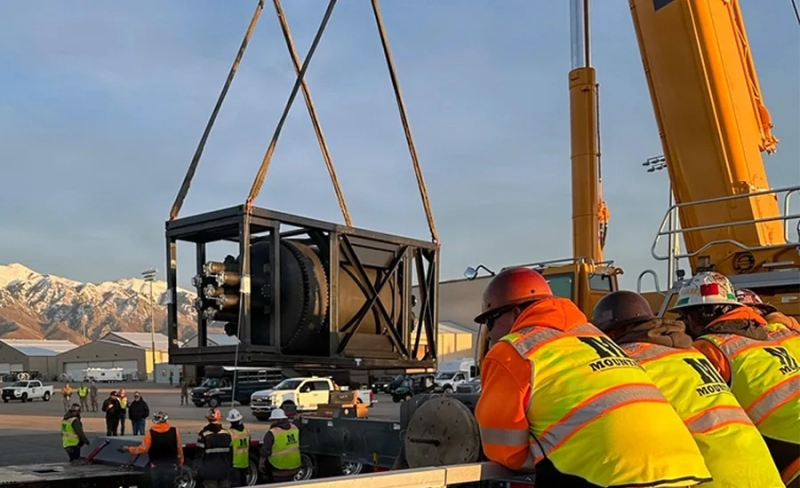
Commercially owned plants would bring modular nuclear construction to military installations
The U.S. Army selected five developers Aug. 26 for a $2.2-billion program to deploy privately owned nuclear microreactors at military installations, moving the technology from demonstration projects toward repeatable construction.
The selections are the first under the Army’s Janus Program, launched in October 2025 to develop commercially owned and operated microreactors that can provide long-term power at military installations. The Army expects the program eventually to result in more than 20 reactors.
Unlike conventional federal power projects, the Army will not own the plants.
Developers will invest alongside the government and retain ownership as they construct and operate the reactors, with federal payments tied to technical milestones. The Army says the model shares development costs and shifts financial risk to the private sector. Federal funding is planned from fiscal 2027 through 2031.
The first five projects pair Antares Nuclear Inc. with Fort Bragg in North Carolina; BWXT Advanced Technologies LLC with Fort Campbell in Kentucky; General Atomics Electromagnetic Systems with Fort Hood in Texas; Radiant Industries Inc. with Fort Benning in Georgia; and Westinghouse Government Services with Fort Drum in New York.
«The Janus Program is about transitioning from designs and experiments to reliable commercial hardware,» Jeff Waksman, Army principal deputy assistant secretary for installations, energy and environment, said.
Projects Advance on Different Schedules
At Fort Campbell, BWXT plans to deploy a 20-MW version of its BWXT Advanced Nuclear Reactor, or BANR, with groundbreaking targeted for late 2028 and operation in the early 2030s. The high-temperature gas-cooled reactor is designed for modular construction, with major components manufactured off site and transported by road or rail.
Looking for quick answers on construction and engineering topics?
Try Ask ENR, our new smart AI search tool. Ask ENR →
Reactor engineering was underway before the Janus selection. As ENR previously reported, Burns & McDonnell is providing detailed engineering for its balance-of-plant systems and plant layout, along with preconstruction and constructability work, scheduling and cost estimating.
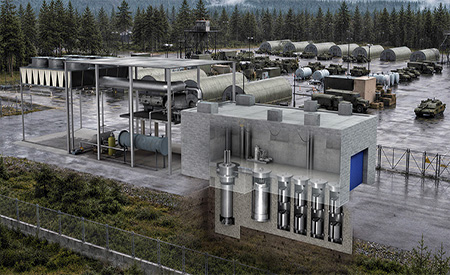
General Atomics’ GA-TES microreactor, shown in a rendering, is advancing toward potential deployment at Fort Hood, Texas, under the U.S. Army’s Janus program. The design has a baseline output of about 5 MW and can scale to about 20 MW.
Rendering courtesy General Atomics
Work leading to construction includes selecting and characterizing the site, completing Army nuclear regulatory reviews and preparing for long-lead procurements. BWXT also plans to begin manufacturing tristructural isotropic, or TRISO, fuel at existing facilities and establish an entity that will operate the plant.
At Fort Hood in central Texas, General Atomics’ initial work covers development, testing and site planning toward potential deployment of its General Atomics Tactical Energy System, or GA-TES. The liquid-metal-cooled reactor has a baseline net output of about 5 MW and can scale to about 20 MW, the company says.
Designed for transport by truck or rail, GA-TES uses natural-circulation cooling and does not require large cooling-water infrastructure, the company says.
Radiant’s plan at Fort Benning, Ga., relies on multiple smaller units rather than a single larger reactor. Its agreement, potentially worth $750 million, calls for deployment of 15 1-MW Kaleidos reactors by 2030.
Radiant is constructing a 300,000-sq-ft. manufacturing, fueling and storage plant in Oak Ridge, Tenn., to support the planned deployments. Kaleidos reactors are designed to arrive at deployment sites sealed and fueled, with Radiant responsible for fueling, refueling and spent-fuel storage.
From Prototype to Repeat Production
The Janus program is a successor to the Defense Dept.’s Project Pele, grew out of a 2016 Defense Science Board study of military energy needs that sought proof of concept for a transportable microreactor for military use, as well as from DOE’s Reactor Pilot Program, according to Waksman. «We are seeking not just reactors capable of turning on for a brief demonstration, but rather systems able to deliver power with high-capacity factors for years of operation,» he said.
Read More
Dept. of Defense —
Project Pele
BWXT won the prototype construction contract in 2022 and is manufacturing a 1.5-MW reactor in Lynchburg, Va., for testing at Idaho National Laboratory.
DOE’s Reactor Pilot Program, launched in June 2025, offers a separate path for private developers to build and operate advanced test reactors. Antares Nuclear, now paired with Fort Bragg under Janus, became the first participant to achieve nuclear criticality June 4 with its Mark-0 reactor test reactor.
A May 2025 executive order directed the DOD, through the Army, to have an Army-regulated reactor operating at a domestic military installation by Sept. 30, 2028. The service said the deadline for its first operational reactor remains in place.