

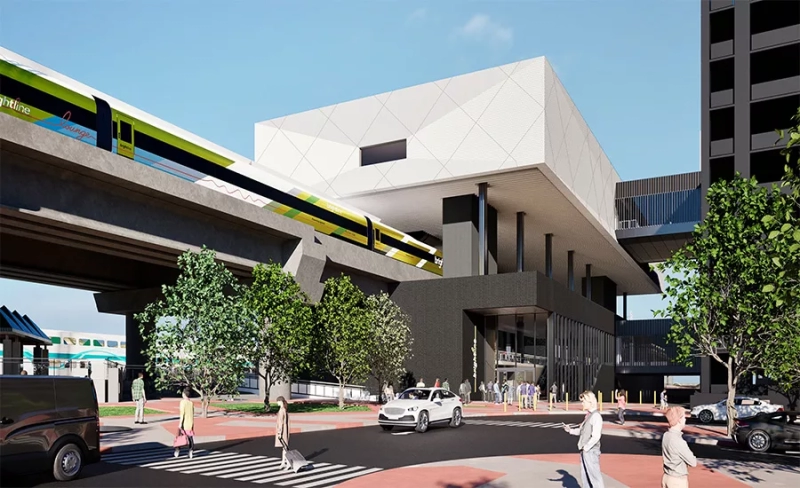
Developers seek $6B federal loan and potential bond restructuring for high-speed rail project
Cost and financing pressures are mounting for Brightline West, the privately financed high-speed rail project that aims to link Las Vegas and Southern California, as the company seeks new federal support and weighs changes to its existing debt.
The rail developer has filed a $6-billion loan request with the U.S. Dept of Transportation’s Build America Bureau, according to the unit’s public listing. Requested under the Railroad Rehabilitation and Improvement Financing program, the loan would replace planned commercial bank debt and extend repayment terms at lower interest rates.
RELATED
Don’t miss updates on key construction sector issues and on billions in Los Angeles region infrastructure development at the ENR LA Infrastructure Forum, Nov. 3 in downtown LA. Click for details now on who’s speaking and how to register!
Separately, Bloomberg reported Oct. 9 that Brightline West is in discussions with holders of about $2.5 billion in private-activity bonds issued earlier this year to exchange those securities for new paper ahead of a November deadline.
As of press time, no restructuring notice has appeared in Municipal Securities Rulemaking Board filings on the Electronic Municipal Market Access disclosure platform.
Trade publications, including Railway Age and Bond Buyer, now place the project’s cost near $21.5 billion, roughly 35% above the estimate cited in the U.S. DOT’s December 2023 grant announcement, which listed the line at “approximately $12 billion.”
RELATED
US Rail Agencies Still Bullish on Future Despite Ongoing Challenges
Brightline West has not confirmed the higher figure publicly, and no revised cost statement appears in federal or state filings.
In comments reported by Railway Age, Brightline CEO Mike Reininger attributed the increase to “rising labor and material costs,” driven by heavy regional demand from data center, power-generation and transportation work.
Federal labor data supports that trend: the US Bureau of Labor Statistics shows double-digit annual wage growth for Western-region specialty trades since 2023.
Read More:
Brightline West High-Speed Train | Federal Railroad Administration
Municipal Securities Rulemaking Board trade data show investor confidence weakening since September. Brightline West’s 9.5% coupon bonds have dropped in price from about 91¢ to 87¢ on the dollar, reflecting roughly a one-percentage-point rise in borrowing costs compared with top-rated municipal issues. The change mirrors a broader market reaction to cost escalation and financing uncertainty.
“Cost escalation raises execution risk, even if the underlying concept remains attractive,” said Chad Farrington, co-head of municipal strategy at DWS Group, a bondholder, Railway Age reported.
Design Adjustments and Schedule
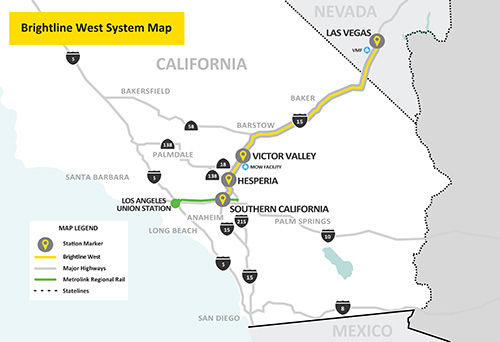
Brightline West’s planned 218-mile corridor will connect Las Vegas to Rancho Cucamonga, Calif., with intermediate stops in Victor Valley and Hesperia. A future link via the High Desert Corridor could extend service to Los Angeles Union Station. Image courtesy of Brightline West
Federal Environmental documents cite cost containment and reduced construction impacts as reasons for running most of the line within the Interstate 15 median. Early iterations of the project envisioned an eventual extension to downtown Los Angeles.
That plan was replaced in 2021 when Brightline West selected Rancho Cucamonga as its southern terminus, giving it a connection to the Metrolink commuter rail and avoiding the need for new tunneling and reducing right-of-way costs.
Field investigation and grading work remain active across both states. In Nevada, crews are sampling soil, mapping terrain and checking utilities near Interstate 15 south of St. Rose Parkway, sometimes overnight to reduce traffic impacts.
In Southern California’s High Desert corridor, teams continue geotechnical borings, utility potholing and core drilling in I-15 median segments, particularly around Victorville and Rancho Cucamonga.
Design and engineering partner HNTB is leading final design and utility coordination for rail infrastructure in California. Heavy civil construction—once projected for early 2025—now appears unlikely before 2026, based on current field-work progress and pending financial closure.
The U.S. DOT awarded $3 billion in grant funding under the Infrastructure Investment and Jobs Act to support the project’s initial phase. Despite cost inflation, Brightline West remains the most advanced privately financed passenger-rail effort in the U.S.
If the federal loan and potential bond exchange proceed, analysts say the financing package could stabilize the venture ahead of full mobilization.
For now, however, the market is signaling that the price of capital—like the price of concrete and steel—has climbed.