

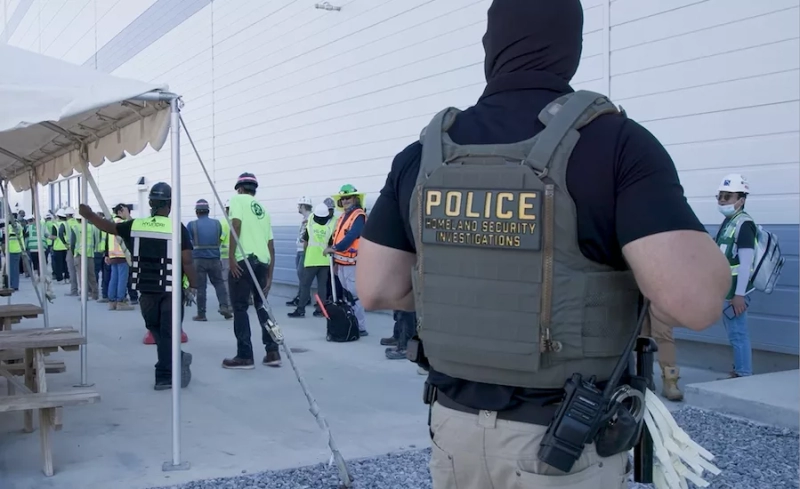
The official name U.S. immigration law enforcers gave the operation was «Low Voltage,» but the jolt it delivered brought work to a halt at a Georgia plant scheduled to start making auto batteries by year’s end.
The repercussions reached both Washington D.C. and Seoul.
On Sept. 4,, officers from almost a dozen federal, state and local agencies, including U.S. Immigration and Customs Enforcement (ICE) at the U.S. Dept. of Homeland Security, executed a federal search warrant at the HL-GA Battery Co. in Ellabell, Ga., detaining about 475 people employed for equipment installation and calibration.
A joint venture between South Korea-based Hyundai Motor Group and LG Energy Solution, the plant is part of Hyundai’s Metaplant America, a 2,906-acre site near Savannah.
The action targeted alleged unlawful employment practices, including workers violating visa terms by performing unauthorized labor during the advanced fit-out phase of the EV battery plant.
ICE is holding the detainees at a facility in Folkston, Ga.
While the project had brought boom times to the local area, there had been grumbling about the number of non-U.S. citizens on hand for the battery plant’s last stages of work.
In a statement, Hyundai said that the detainees worked for subcontractors and that none were directly employed by Hyundai Motor Co. or LG Energy Solution. Those companies emphasized compliance with U.S. laws and are investigating its suppliers.
The HL-GA Battery plant is an essential component of Hyundai Metaplant America’s $12.6 billion investment in Georgia—the state’s largest economic development project. It broke ground in 2022 and the EV assembly plant started rolling out cars in October, including models such as the Hyundai IONIQ 5 and IONIQ 9. The battery facility is designed to produce cells for a variety of Hyundai vehicles.
______________________________________________________
RELATED
ICE Raids Create Chilling Effect on Stretched Industry Workforce
______________________________________________________
Hyundai’s investment is expected to have long-lasting economic benefit. «Eventually, as many as 40,000 indirect and direct jobs created will bring in $4.6 billion in individual earnings every year,» according to the Center for Automotive Research.
The raid stemmed from a months-long criminal investigation into alleged unlawful employment and federal crimes at the site, according to ICE.
Nationalities of Detainees
Of the 475 detainees, more than 300 were South Korean nationals, with others including 23 Mexicans and one Indonesian, according to federal agencies. All were deemed illegally present or working in violation of their visa status. Many entered on B-1/B-2 business/tourist visas or the Visa Waiver Program, which prohibits employment. One Mexican green card holder was detained due to prior convictions for narcotics possession, stolen firearm sales and theft.
Homeland Security department Special Agent in Charge Steven N. Schrank said the operation «sends a clear message that those who exploit the system and undermine our workforce will be held accountable.»
In Washington D.C., President Donald Trump acknowledged the need for skilled foreign labor in advanced manufacturing. In remarks to reporters, he said, «If you don’t have people in this country right now that know about batteries, maybe we should help them along … We do have to work something out where we bring in experts so that our people can be trained so that they can do it themselves.»
Trump advocated temporary legal pathways for foreign trainers in sectors like EV batteries, shipbuilding and tech as a balance between enforcement and economic growth.
In a Truth Social post, he spoke directly to foreign investors: «Your Investments are welcome, and we encourage you to LEGALLY bring your very smart people … What we ask in return is that you hire and train American Workers.»
South Korea’s government also responded swiftly to its citizens being detained. Foreign Ministry spokesperson Lee Jae-woong stated that «the economic activities of our companies investing in the United States and the interests of our citizens must not be unduly violated during the course of U.S. law enforcement.»
South Korean President Lee Jae Myung ordered «all-out efforts» to resolve the issue, sending diplomats to the site and forming a taskforce. The country’s government announced a deal Sept. 7 with the U.S. for the workers’ release and began coordinating transportation for them.
ICE raids, intensified under the Trump administration’s 2025 executive orders, pose challenges in construction. Raids have triggered immediate site shutdowns in Tallahassee (100-plus arrests in May) and Alabama (37 detentions in June), triggering delays, cost overruns and a chilling effect where workers avoid sites out of fear, ENR reported.
The construction industry faces a 439,000-worker labor shortage, projected to hit 1 million by 2030.
The detained workers in the Georgia EV battery plant project were mechanics, technicians, and engineers employed mainly by South Korean subcontractors for the fit-out phase.
There is no direct evidence that American workers were fired specifically to hire the detained workers at the HL-GA Battery plant.
But not everyone in Georgia was happy with who was brought on to work on the huge plant project.
Barry Zeigler, business manager of UA Local Union 188 in Savannah, told the New York Times that «65 union members were laid off months earlier following steel piping installation at the site.»
Zeigler said: “Georgians were promised those jobs…I don’t have a problem with the Koreans being here and trying to make a living over here.” But he said he had a problem with people who were not authorized to work «stealing our jobs.»
There is no direct evidence that Koreans replaced American workers already employed in the plant construction.