

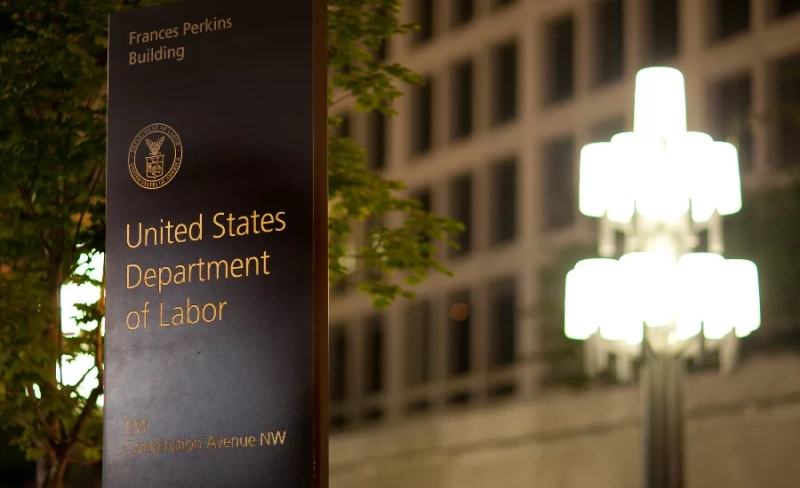
Agency furloughs more than 1,200 workers, halts routine inspections and training
When federal funding expired Oct. 1, the U.S. Dept. of Labor triggered its contingency plan, effectively halting most oversight functions at the Occupational Safety and Health Administration.
The plan, filed Sept. 26 with the Office of Management and Budget, keeps only 460 of OSHA’s 1,664 employees on duty to perform tasks necessary to protect life and property.
Remaining staff are limited to responding to imminent-danger complaints, workplace catastrophes and fatalities, and follow-ups where exposure to grave risks persists, according to the contingency plan reviewed by ENR.
All routine inspections, compliance outreach, training, whistleblower investigations and rulemaking are suspended.
“Although OSHA will cease most operations during the shutdown, some inspection activity deemed ‘essential’ by the agency will continue under limited circumstances,” said attorneys Peter Vassalo, Felicia Watson, Chuck Trowbridge and David Dixon in an analysis by Littler Mendelson.
RELATED
Government Shutdown’s Impacts on Contractors Likely to Vary Across Programs
Legal observers say the pattern echoes earlier government lapses. In previous shutdowns, OSHA furloughed as much as 90% of its workforce, cutting inspection volume to a fraction of normal activity.
“We expect to see OSHA only opening up between 15% to 20% of the number of inspections that would normally occur during any shutdown if history is any guide,” noted a Fisher Phillips analysis cited by EHS Today.
The contingency plan warns that sustaining OSHA’s injury-tracking and information-technology systems could become difficult if the lapse endures, potentially delaying data collection and publication.
A 2020 Government Accountability Office review of the 35-day 2018–19 federal government shutdown found that agencies struggled to clear accumulated caseloads even months after funding was restored.
Echo Effects Ripple
That data disruption is already rippling beyond OSHA. The U.S. Bureau of Labor Statistics, which also operates under the Labor Dept., failed to release its October employment situation report on Oct. 3—the first missed publication since the 2018–19 shutdown.
Economists and industry analysts say the absence of new payroll, construction employment and wage data obscures key signals used to forecast labor demand and inflation trends.
“Inflicting a shutdown that blocks release of the jobs report is a direct assault on transparency and economic stability,” said Rep. Richard E. Neal (D-Mass.), ranking member of the House Ways and Means Committee, after BLS confirmed the delay.
Read More:
Dept. of Labor | Plan for the Continuation of Limited Activities
Analysts warn that prolonged data interruptions could distort modeling, delay Federal Reserve and congressional assessments, and hinder contractors’ ability to gauge labor conditions and bid competitiveness.
A partial buffer comes from the 22 states and seven territories that administer their own OSHA-approved safety programs. Because those plans receive at least half their budgets from federal grants, many could face cash-flow strain as the lapse continues.
The GAO has found several state programs “under-resourced and dependent on federal technical assistance,” raising concern about uneven enforcement if the shutdown drags on. The enforcement slowdown is also creating uncertainty for employers contesting citations.
“While contest and abatement deadlines will continue during the shutdown (even though OSHA personnel may not be present), employers likely will not be able to engage with OSHA via an informal conference or otherwise during the shutdown,” wrote Vassalo and his colleagues.
They added that delays in hearings, settlements and decisions are inevitable until appropriations are restored.
For construction, specialty contractors and engineering firms, the effects are immediate. Delays in inspections or citation processing can stall project close-outs or disrupt schedules that require OSHA clearances in high-hazard environments.
RELATED
Trump Priority Projects Get Fast-Track US Permits Amid Shutdown
Kristen Swearingen, vice president of government affairs at the Associated Builders and Contractors, urged Congress and the president to keep the government open ahead of the Oct. 1 funding lapse.
“Any government shutdown creates uncertainty for ABC contractors throughout the country, including potential delays in federal infrastructure projects,” Swearingen said in a statement.
Broader economic studies underscore the cost of such interruptions. The Congressional Budget Office estimated the 2018–19 shutdown reduced U.S. gross domestic product by $11 billion, $3 billion of it permanently lost.
Research from the Brookings Institution and the Bipartisan Policy Center indicates that delayed permits, withheld federal guidance and suspended loan programs dampen investment across the infrastructure and energy sectors.
As the shutdown continues, OSHA’s enforcement apparatus remains largely frozen. When appropriations are restored, inspectors will face a backlog of cases and a workforce that must be rapidly re-mobilized.
For now, as one analyst described it, the nation’s workplace safety agency is operating on “a skeleton crew”—focused solely on imminent danger while much of the construction industry waits for Washington to turn the lights back on.