

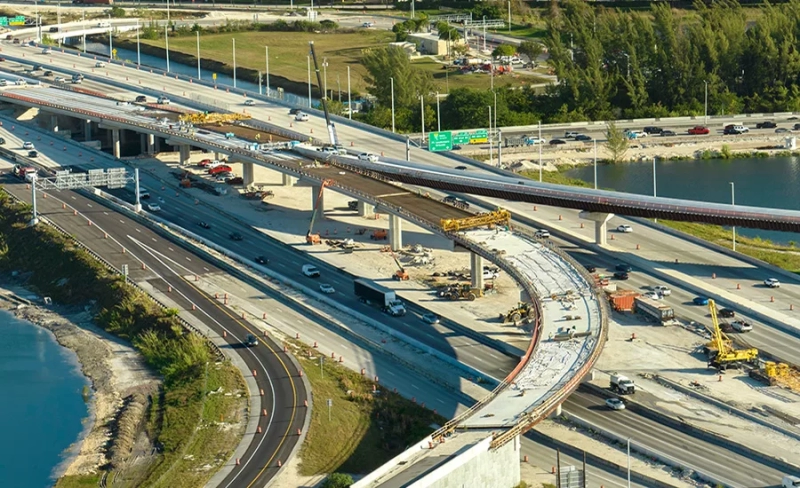
The $580-billion proposal emphasizes formula funding and long-term certainty, even as portions remain tied to future appropriations
Leaders of the House Transportation and Infrastructure Committee this week released a roughly $580-billion proposal outlining how congressional leaders plan to structure federal investment after the sunset of the expansive 2021 Infrastructure Investment and Jobs Act.
The BUILD America 250 Act would authorize transportation spending through fiscal year 2031 and direct funding toward highways, bridges, transit, rail and safety programs.
But the legislation may prove more consequential for how federal dollars flow to projects—and for how owners, contractors and infrastructure investors assess funding certainty.
Committee leaders framed the proposal around formula funding, project-delivery streamlining and greater flexibility for states. More than 90% of highway funding would move through formula programs rather than discretionary channels under committee materials summarizing the legislation.
«I believe the BUILD America 250 Act is the most important surface transportation bill since President Eisenhower built the Interstate Highway System,» Committee Chairman Sam Graves (R-Mo.), said in a statement announcing the proposal.
Ranking member Rick Larsen (D-Wash.) touted the scale of the investment, saying, «You can’t have a big-league economy with little-league infrastructure.»
Industry firms and associations, however, are more concerned about whether the proposed legislation will maintain the funding structures that helped drive a surge in federally backed infrastructure work in recent years.
Looking for quick answers on construction and engineering topics?
Try Ask ENR, our new smart AI search tool. Ask ENR →
Beyond the $580-Billion Headline
Previous ENR reporting found IIJA established two parallel funding channels: traditional Highway Trust Fund mechanisms and supplemental appropriations written directly into law. Those advance appropriations supplied agencies with greater long-term visibility and helped support project planning beyond annual appropriations cycles.
As an industry advocacy and lobbying group, the Associated General Contractors of America has long pushed Congress to prioritize formula funding over discretionary grant structures administered through the U.S. Dept. of Transportation because projects move faster that way, Alex Etchen, AGC vice president of construction advocacy and risk management, told ENR.
«The five-year bill would provide certainty for the construction industry to invest in new construction equipment and hire and train additional workers,» Etchen said. «When funds are provided via formula, the projects are able to break ground sooner.»
Read More
BUILD America 250 Act
Section Breakdown
According to analysis by law firm Holland & Knight, approximately $474.4 billion of the proposal’s roughly $580 billion authorization would come through Highway Trust Fund contract authority, while about $106 billion would depend on future annual appropriations.
Etchen said the legislation would also avoid a series of short-term extensions that could complicate planning for large infrastructure work.
«This bill would provide long-term certainty for the construction industry,» he said.
The structure marks a shift from IIJA-era priorities by emphasizing formula funding and state flexibility while reducing reliance on some discretionary and climate-focused programs.
Analysis by the National Association of Counties indicates the bill would eliminate the Carbon Reduction Program and the IIJA-created PROTECT formula program while consolidating several discretionary grants. Etchen said eligibility for those project categories would continue under core highway programs, allowing states to continue advancing many of the same underlying project types.
Read More
BUILD America 250 Act
Full Text
The legislation also attempts to address longer-term Highway Trust Fund pressure through annual fees of $130 on electric vehicles and $35 on plug-in hybrids beginning in 2027, rising every two years beginning in 2029 and capped at $150 and $50, respectively. Holland & Knight estimated the fees would raise less than $10 billion over five years and approximately $29 billion over a decade.
The bill also increases the threshold for «major projects» requiring heightened review to $1 billion from $500 million and expanding the use of categorical exclusions intended to speed project approvals.
Anirban Basu, chief economist at the Associated Builders and Contractors, told ENR that construction activity supported by the IIJA would likely continue to extend beyond the law’s expiration because projects and funding obligations have moved more slowly than anticipated.
RELATED
Federal Loan Programs Can’t Keep Pace with Growing Clean-Water Needs
Basu also cautioned against assuming financing tools can replace broad federal spending, arguing that public-private partnerships are «no panacea» because «someone ultimately must repay investors and lenders through tolls, taxes or other revenue streams.» This can be especially true in many preservation and rehabilitation projects, which simply lack the dedicated revenue streams needed for private financing.