

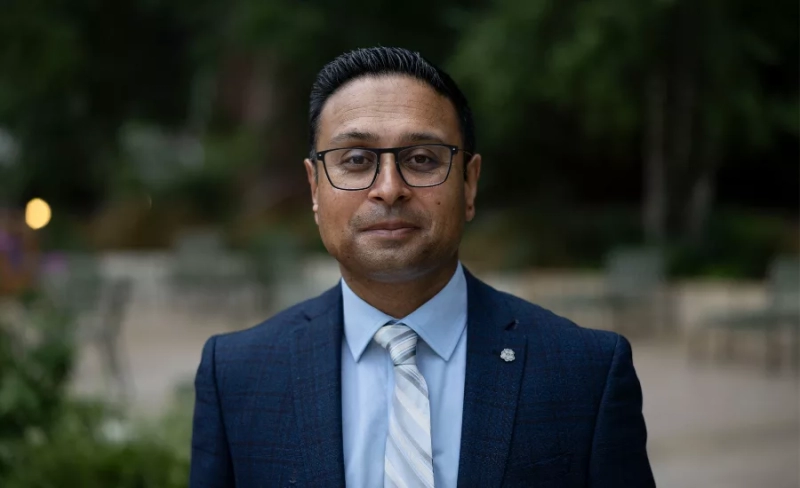
Company will be independent from London-based contractor Mace Group after majority investment by private equity investor Goldman Sachs Alternatives
Mace Consult CEO Davendra Dabasia aims to position the company to hit the ground running once its spinoff from U.K.-based contractor Mace Group, announced July 23, is completed. Leveraging its majority investment from private equity firm Goldman Sachs Alternatives, Mace Consult already has a strategic acquisition under its belt in its August purchase of New York City-based Turton Bond, as it builds up U.S. operations.“We had a very clear view that we wanted to still be a business that had the same culture and direction that we’ve had over the last 35 years,” he says. “We settled on this type of model for Mace Consult to help us drive growth, but still be very much in charge of the business with a fantastic partner, Goldman Sachs.» With over a decade of sustained double-digit revenue growth backing the company’s program management consulting services, Dabasia says its separation from the group has been a “long time coming. We’re really excited about it.” In an exclusive interview with ENR, Dabasia shares why the firm’s first 100 days of independence will be key. This conversation has been edited for length and clarity.
ENR: You’ve seen Mace Group evolve in several ways since joining the company in 2007. What was the deciding factor in moving forward with Mace Consult’s independence?
Dabasia: We’ve been always part of a group. We’ve not been a standalone business. Having said that, we’ve been, since 2022, a very separate engine. So we’ve had all of our functions, predominantly sitting in [the consulting unit] and we [were] driving it like a standalone business. I haven’t been involved in a carve-out like this, but we’ve been setting ourselves up for the last four or five years where this would be efficient and easy to do since I took over as chief operating officer [in 2023]. The mold was set for us to run as a standalone business, which I pretty much have been doing since 2022.
As Mace Consult expands, is there a particular region the company has its eye on?
Debasia: We’re certainly seeing acquisitions as a big part of our growth story, but equally [focused on] organic growth through the connections that we have.
We’ve got an operating model, which is about the six markets that we work in, where we’re going to focus our energies to make sure that we could find the right companies that give us complimentary markets. We’ve got a very clear plan to be on the east coast. We’d [also] want to be in San Francisco, Calif., Texas and Florida as our key locations [in] the U.S. When we’re looking at acquisitions, we’ll be looking at all of those things—cultural fit, the market, the service line and the geography.
As Mace Consult carves out an independent portfolio in the U.S., what steps are you taking to shore up its expertise in public and private markets?
I think it’s a mixture of different things. What we’ve been doing over the last two or three years is bringing people in [with] a huge amount of experience in the public sector, federal [and] state level, different markets. We’ve been strengthening that over the last two or three years particularly and we’ve got a really strong senior leadership team now, and we’ll continue to drive that. Another thing we’ve been doing for a while is partnering. We’ve partnered with different companies around the U.S, big development program managers, etc., and we’ll continue to drive that. So, so it’s not one thing that we’re doing, it’s a combination that will make sure that we start that journey on proper sector jobs.
What would you say are the main differences between program delivery in the US versus delivery outside?
I think the differences here, and it’s a lot of infrastructure space, is around culture and collaborative delivery. There are probably a couple models that most clients and contractors use when we talk about this from a [U.K.] perspective, but even more in the Middle East now, and probably in Asia, you see a much more nuanced delivery model—very collaborative and very focused on the program level, not just on the engineering details, It is something that when we started talking to clients in the Americas market really interested them—how do you unlock the potential of the contract with the client and suppliers, and make sure you’re a true integrated team. Over the last couple of years, I think the U.S. model is going that way. That’s why there’s companies like us getting more and more into the market, and our partners are driving that focus as well.
Where do you see similarities?
When I go around the world, the challenges of bigger infrastructure programs tend to be very, very similar. Challenges focus on simple things, from stakeholder management and land rights to very ambitious programs post-client. They’re very, very similar at that level. It’s just how you get the most efficient organization model to make sure you drive delivery and everyone benefits and outcomes are the right ones for clients.
Once the dust settles and Mace Consult’s spinoff from Mace Group is completed, what are your priorities in those first few months?
We’ve got a very clear plan for the next three months about what our new business will be as a separate company. There’s a lot of work going on, and that sort of 100-day plan we’re driving is really, really important. You have to mobilize really well your processes, systems, structure, governments, [with] all in place so that that’s our No. 1 priority, as well as making sure we’re running the business four months through this process as we have been doing over the last nine years.
Once we get through that, we’ve got a very, very clear business strategy. We’re engaging Goldman Sachs … around [mergers and acquisitions], organic growth sectors and markets. The focus will be to make sure we are leading [based on] that operated model and that business strategy.
We’ve got financial backing. We’ve got industry expertise. We’ve also got the contacts and the different company funds that Goldman Sachs could introduce us to. That’s going to be a key part of benefiting from that, [so we are] hitting that really hard as we go into the separate business.