

In a few weeks, design-build proposals are due in Austin from a shortlist of formidable transportation heavyweights contending for the city’s planned $7.1-billion light rail project. Submissions are due Oct. 24 from a Stacy & Witbeck and Sundt joint venture, Kiewit and FCC.
The Austin Transit Partnership, the public corporation formed to among other things to complete the 10-mile, 15-station project, faces numerous obstacles.
Approved by voters in 2020, the ATP plan still must complete environmental approvals and secure federal funds. The light rail project is part of a broader public transportation plan called Project Connect.
In March 2024, a taxpayer group filed a lawsuit in state court in Travis County to block the light rail project as it was proposed. One of the arguments was that the Texas Tax Code prohibits the use of property-tax revenue to repay railroad construction bonds. That lawsuit still is pending.
Fast-rising railroad construction costs in the U.S. forced ATP to scale back what had been a 27-mile route.
Although the mayor of Austin supports the project, Gov. Greg Abbot (R) has opposed using taxes to pay off bonds.
ATP identified the shortlisted firms and teams in August. The winning firm will perform design and construction of the light rail system, with construction scheduled to start in 2027.
The biggest question-mark is whether federal funds will be allocated for it. The latest project funding plan anticipates $3.4 billion to $3.6 billion in federal grants, with another $1 billion coming int he form of a TIFIA loan.
«Austin has gone to great lengths to tee up federal funds,» wrote Andrew Wheat, managing editor of the Austin Free Press, in August.
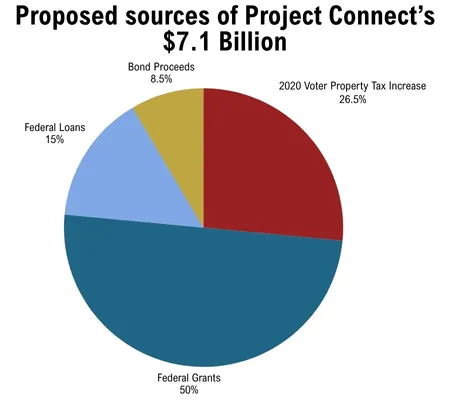
Source: Austin Transit Partnership
But now, the project is under sustained political and legal attack, Wheat wrote. «Today, federal funding for Project Connect looks like a much tougher sell than when Democrat Pete Buttigieg was U.S. Transportation Secretary in 2024.» Wheat notes that under Transportation Secretary Sean Duffy, projects are being withheld until any climate change or equity-related aspects are deleted from the plan.
On the bright side, reported the Austin Free Press, two failed Republican party bills to defund the broader Project Connect failed to pass the state legislature.