

Draft EIS modeling shows Lakes Powell and Mead operating limits to govern basinwide water use outcomes
The future of the Colorado River after 2026 will not be decided by interstate negotiations or policy design. Rather, according to modeling in the U.S. Bureau of Reclamation’s Draft Environmental Impact Statement, it will be determined by something much less flexible: the physical operating limits of Lake Powell and Lake Mead.
ENR’s review of the agency document shows that those limits—defined by reservoir elevation, turbine head and outlet-works capacity—now govern outcomes across the entire seven-state basin.
RELATED
Reclamation Draft Review Maps Future Operations for Colorado River Dams
While policy alternatives differ on paper, modeling shows they converge at the same hard thresholds: where infrastructure constraints dictate when and how water can be released, power can be generated and delivery obligations can be met from the Upper Basin headwaters to Lower Basin delivery systems.
Constraints Arrive Early—And Persist
Reclamation’s hydrologic modeling, summarized in Volume 1, Chapter 3, found that exposure to low-elevation operating conditions emerges early in the post-2026 period and persists across much of the planning horizon under median and dry hydrology scenarios.
Neither lake returns to mid-20th-century storage conditions under any modeled alternative, with reservoir elevations repeatedly clustering in ranges associated with reduced operational flexibility within the first decade after 2026.
In practical terms, the agency frames low-elevation operations not as late-horizon tail risks, but as dominant conditions shaping system behavior over much of the modeled period.
Lake Mead and Lower Basin Delivery Mechanics
At Lake Mead, agency modeling repeatedly places the reservoir in a narrow elevation band with basin-wide implications. Turbine efficiency and release flexibility begin to decline near around 1,050 ft, with minimum power pool reached at roughly 950 ft and dead pool near 895 ft, below which conventional releases are no longer possible.
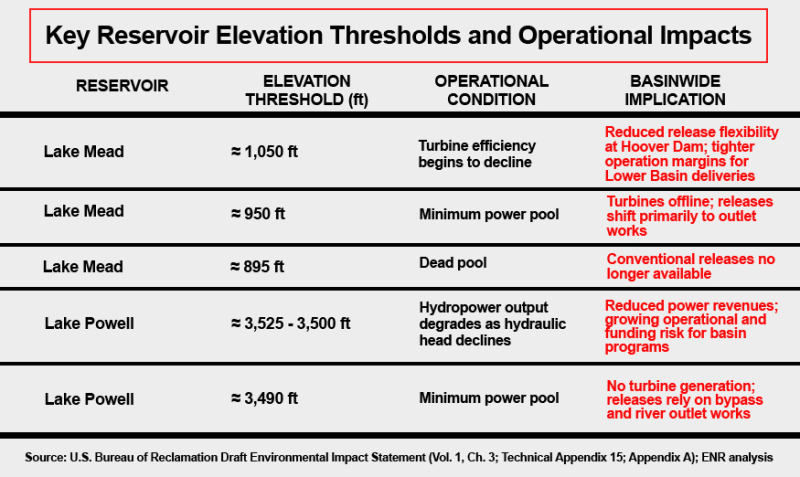
Elevation-frequency tables show multiple post-2026 options that result in extended periods with Lake Mead operating between about 1,000 ft and 950 ft under median and dry hydrology scenarios.
Within that range, Hoover Dam increasingly loses the ability to meet downstream obligations solely through turbine releases. Operators must rely more heavily on outlet works that offer lower total capacity and reduced operational flexibility. Below the minimum power pool, turbine generation ceases entirely, forcing all downstream releases through outlet works regardless of policy preferences.
Read More
Vol. 1, Chapter 3
Affected Environment and Environmental Consequences
ENR’s review of agency hydrologic summaries shows that differences among alternatives are secondary to hydrology at these lower elevations, meaning exposure near minimum power pool is driven more by system inflows than by policy structure.
For the Lower Basin, this is not an abstract engineering concern. As Lake Mead approaches minimum power pool, reduced release flexibility at Hoover Dam directly constrains federally operated delivery systems serving Arizona, Nevada and California.
Central Arizona Project deliveries are increasingly limited by mechanical constraints on releases, Southern Nevada Water Authority operations depend on maintaining outlet-based flows with reduced head and California deliveries routed through Hoover face tighter operational margins, regardless of contractual seniority.
Lake Powell, Hydropower and Upper Basin Exposure
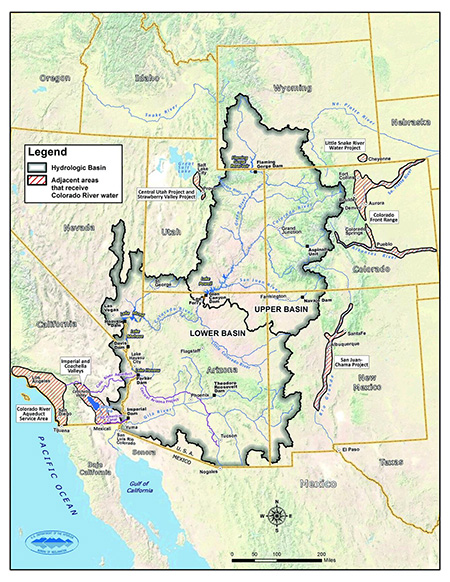
A U.S. Bureau of Reclamation map shows the Colorado River Basin, delineating the Upper and Lower basins and highlighting major reservoirs and infrastructure that govern systemwide operations, including Lake Powell upstream and Lake Mead downstream. The basinwide configuration underpins how reservoir elevation thresholds translate into operational and delivery constraints across the system.
Map courtesy of the U.S. Geological Survey
At Lake Powell, Glen Canyon Dam imposes a different but equally basinwide constraint. Reclamation identifies about 3,490 ft as the minimum power pool, below which hydropower generation ceases.
Technical Appendix 15 shows that power output declines nonlinearly as reservoir elevation drops, with significant degradation occurring hundreds of feet above minimum power pool as declining head reduces turbine efficiency.
Modeling shows Powell repeatedly near 3,525 ft to 3,500 ft under downside hydrology scenarios, meaning revenue and operational impacts tied to declining power output occur well before minimum power pool is breached.
ENR’s review of Volume 1, Chapter 3, indicates these conditions recur across decades under median and dry hydrology assumptions rather than appearing only in isolated drought years.
While Glen Canyon and Hoover dams together account for only a small share of installed capacity in the Western Interconnection—on the order of a few percentage points—Reclamation and associated power analysis make clear that hydropower revenues from those facilities play an outsized role in funding dam operations and basin-wide programs. That dynamic ties reservoir elevations directly to operational and financial risk rather than grid reliability.
When Powell operates near or below minimum power pool, those revenues decline or disappear, shifting financial responsibility toward Upper Basin states even as release obligations remain.
Below minimum power pool, reliance on bypass and river outlet works narrows operational flexibility, increasing risk for states responsible for meeting release requirements of the seven-state Colorado River Compact that dates to 1922, under constrained conditions.
When Infrastructure Overrides Policy
Appendix A of the Draft EIS describes how the outlet works capacity at both Glen Canyon and Hoover dams varies directly with reservoir elevation. As hydraulic head decreases, certain release pathways become unavailable, and maximum feasible releases reduce. In several modeled alternatives, releases mainly rely on outlet works for extended periods rather than just as a short-term backup.
Read More
Appendix A | CRSS Model Documentation
When outlet works limit flow capacity, allocation rules across the river basin become less important than mechanical release capabilities. Policy frameworks cannot be effectively implemented if the infrastructure cannot physically handle the water flow.
The modeling also incorporates sedimentation assumptions that permanently reduce effective storage over the planning horizon. While annual accumulation occurs incrementally, the operational effect is cumulative.
Reduced usable storage increases the chance that Powell and Mead will reach elevation ranges that cause hydropower degradation, outlet-only operations and less release flexibility. These impacts are experienced across the basin, with each state facing higher risks as the system’s operating range diminishes.
Across all modeled options, elevation-frequency curves cluster closely within the same critical bands that determine dam operability. Although policy frameworks vary in how shortages are distributed, they do not significantly alter exposure to minimum power pool or outlet-works-only conditions.
While an EIS is often read as a policy roadmap, read closely, it is also a map of constraints. The takeaway from Reclamation’s modeling is that Lakes Powell and Mead serve as basin-wide control points rather than isolated features.
Their elevation-driven constraints influence operations across both the Upper and Lower Basins of the river, regardless of state boundaries. While the discussion on post-2026 operations will persist, the Draft EIS clarifies that these debates now take place within the boundaries established not through negotiation but through infrastructure.