

Suit challenges DHS and CBP determinations supporting Texas border-barrier construction across five project areas
A coalition of Big Bend-region landowners and the advocacy group Conserve Big Bend filed suit Sept. 14 in federal court in Washington, D.C., seeking to halt about 600 miles of planned border-barrier work across five West Texas project areas, including a segment through Big Bend National Park.
The complaint names the U.S. Dept. of Homeland Security, Homeland Security Secretary Markwayne Mullin, and Customs and Border Protection Commissioner Rodney Scott as defendants. Plaintiffs include Conserve Big Bend and six landowners from the Presidio and Redford communities in Texas, represented by K&L Gates LLP.
Scott said in an email to ENR that CBP is reviewing the lawsuit with the US Dept. of Justice. «We remain confident in our legal authorities and committed to securing the entire border while preserving the unique landscape of the Big Bend region,» he said.
RELATED
$1.7B Border Wall Project Work Begins in Big Bend National Park
Homeland Security did not respond to a request for comment.
Announcing the filing at a news conference outside the Presidio County Courthouse in Marfa, Texas, Clara Bensen, a Conserve Big Bend board member and director of communications for the group’s No Big Bend Wall initiative, said the case turns on a threshold Congress wrote into a nearly 30-year-old statute.
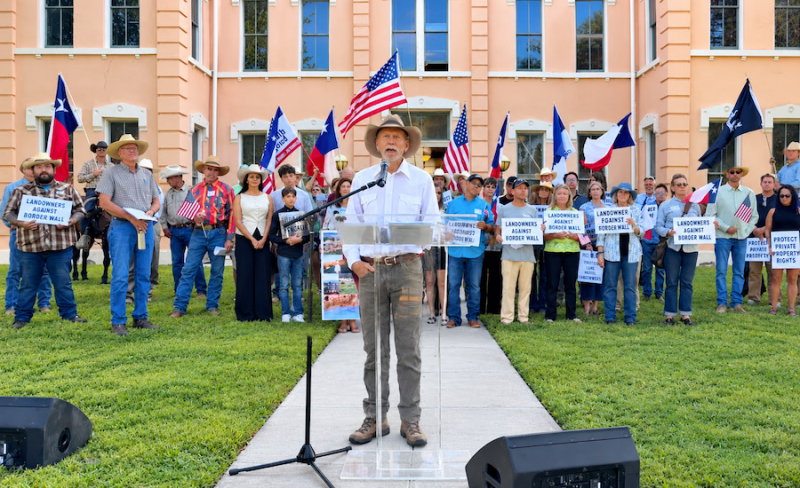
Coalition of opponents to federal border wall construction in Big Bend National Park in Texas at Sept. 14 news conference outside Presidio County Courthouse in Marfa, Texas, to announce federal lawsuit against US agencies.
Photo Courtesy of No Big Bend Wall Coalition/YouTube
«The Secretary of Homeland Security is granted extraordinary, expedited powers to construct border barriers and sweep aside dozens of federal protections, environmental laws, and ordinary due process,» Bensen said, «but Congress explicitly set a strict legal prerequisite for that extraordinary power: it can only be invoked in designated areas of ‘high illegal entry.'»
The suit does not challenge the wall’s design; it challenges the legal trigger CBP used to fast-track the work, which is already under construction along part of the route.
Five Projects, One Legal Trigger
The complaint cites an agency declaration, filed in a related federal lawsuit in the Eastern District of Texas, that breaks the work into five projects across Hudspeth, Presidio and Val Verde counties, plus the Del Rio sector to Lake Amistad. Three segments, awarded March 5, call for 30-ft bollard-style pedestrian barrier; a fourth, a 160-mile vehicle-barrier segment, was awarded June 2.
The fifth and most contested segment runs through Big Bend Ranch State Park, Big Bend National Park and adjacent private land.
Awarded in May to Southwest Valley Constructors Co., a Kiewit Corp. unit, under a $1.72-billion task order, it calls for 17 miles of noncontiguous, low-profile vehicle barrier meant to restrict vehicle access while using the park’s terrain as a natural barrier, plus about 205 miles of patrol-road improvements.
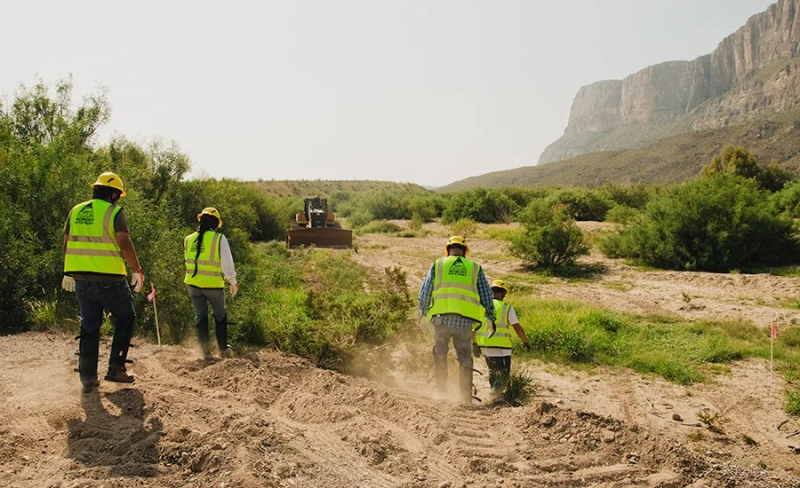
Crews began soil-assessment work inside the park in early August, which CBP says does not mark the formal start of construction. Field work is already underway on the Hudspeth and northwest Presidio County segments, and the agency told the Texas court in an Aug. 24 filing that work on the Presidio County segment through the town of Presidio would begin within weeks.
According to Conserve Big Bend, about 65% of the project footprint is privately owned. But the work going through Big Bend National Park has gained the most headlines, as well as virulent and bipartisan opposition from Democratic and Republican lawmakers, environmental and indigenous advocacy groups, and local landowners.
CBP announced on Aug. 17 that it would pause construction inside the park for two weeks while Scott conducted an on-the-ground inspection, and the agency subsequently extended the pause through Sept. 30.
The ‘High Illegal Entry’ Threshold
The suit challenges Section 102(a) of the Illegal Immigration Reform and Immigrant Responsibility Act, which lets the Homeland Security secretary waive dozens of federal laws to expedite barrier construction, but only in areas formally designated as having «high illegal entry.»
Plaintiffs argue that the Big Bend sector—517 miles, about one-quarter of the southwest border—does not meet that bar, citing CBP figures showing the fewest apprehensions of any southwest sector every year since fiscal 1973, including just 3,096 in fiscal 2025, a 74% drop from fiscal 2023 and the lowest total recorded by any southwest sector since fiscal 1967.
Then-Homeland Security Secretary Kristi Noem first designated the sector as high illegal entry in an Oct. 15, 2025, Federal Register notice, then issued a second determination in February 2026. Mullin, who succeeded her, issued four more determinations between May and July that revised and expanded the boundaries, bringing the total to six, which the complaint says together cover the entire sector.
The determinations waived more than two dozen federal laws, according to the complaint, including several that specifically protect Big Bend National Park, and they rely on the same waiver authority that the Center for Biological Diversity, Friends of the Ruidosa Church and a Big Bend-area landowner are separately challenging in federal court.
Claims and Landowners’ Accounts
The suit brings five claims—two under the Administrative Procedure Act, an ultra vires claim, and Fifth Amendment due-process and Take Care Clause claims—and asks the court to vacate the determinations and issue a preliminary and permanent injunction. Bensen said defendants have 60 days to respond, and that plaintiffs intend to seek a temporary restraining order covering the entire sector.
The complaint also details CBP’s outreach to individual property owners. Nadine Pineda Mata, Joe Pineda and Leo Nunez Pineda, who together hold roughly 270 acres near Redford, received a February notice seeking access for surveys and appraisals; the family says the agency later told them it would need to begin condemnation proceedings within 90 days.
David Keller, an archaeologist and Conserve Big Bend board member, said CBP requested a right of entry in April for survey work on his 10-acre farm near Redford. Laura Allen, a rancher near Lake Amistad and former Val Verde County judge, said the route would run more than eight miles through her property, and that she declined a right-of-entry payment CBP offered.
Speaking at the same event, Keller said Conserve Big Bend’s landowner coalition has grown to 230 members, more than 70 of whom were willing to serve as plaintiffs. «Landowner resistance has slowed this project to a crawl,» he said. «People have refused access agreements. Survey and construction schedules have fallen months behind. Contractors have been sent home.”