

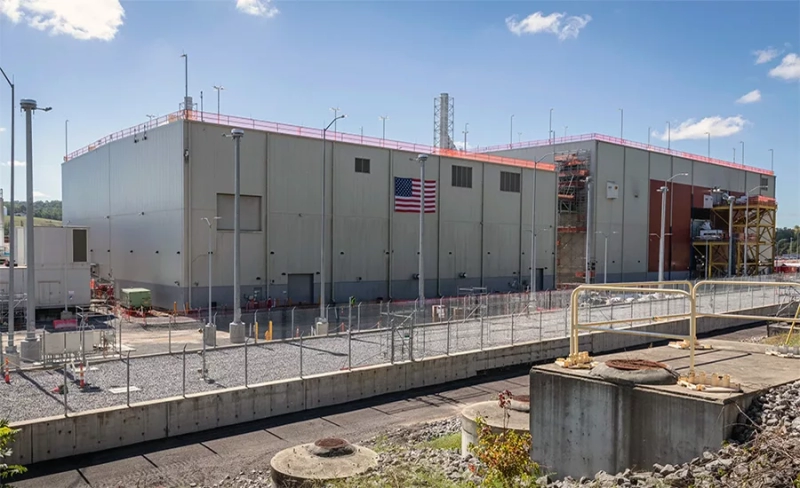
Federal watchdog says cost growth across federal defense agency’s $30B nuclear modernization construction portfolio more than doubled since 2023
A new U.S. Government Accountability Office assessment of construction projects managed by the National Nuclear Security Administration finds that cost overruns and schedule delays across several defense nuclear modernization facilities have more than doubled since 2023.
The Feb. 27 report updates GAO oversight of agency construction projects and compares current performance with a 2023 review of its nuclear weapons infrastructure modernization program.
GAO found cumulative cost growth on key agency construction efforts rose from about $2.1 billion in 2023 to roughly $4.8 billion as of June 2025.
Read More
GAO | Nuclear Security Enterprise Assessment
The agency’s capital program includes new and replacement facilities supporting uranium processing and plutonium pit manufacturing. It manages 28 major construction projects valued at more than $100 million each, representing a portfolio worth at least $30 billion, said GAO. Sixteen are under construction, with 12 in design or early planning.
Within that portfolio, GAO found 17 projects facing challenges, including delays, redesigns, cost overruns or suspensions. Nine are projected to eventually exceed their approved budgets by at least 20%.
Schedule pressures are also mounting. GAO said some projects originally expected to take about nine years could stretch to as long as 30 years from approval to completion.
Major Projects Under Scrutiny
Congressional staff overseeing the agency say the problems reflect deeper structural issues beyond any single project.
Looking for quick answers on construction and engineering topics?
Try Ask ENR, our new smart AI search tool. Ask ENR →

Cumulative cost overruns and schedule delays across NNSA’s portfolio of major construction projects have increased sharply since 2023, according to GAO analysis.
Graph courtesy of GAO
“Every project NNSA has when it comes to construction has been over-budget and very much delayed schedule-wise,” House Armed Services Committee staffers familiar with the portfolio told ENR on background, not authorized to speak publicly.
“The reality is these buildings are old,” staffers said. “These facilities are old. Many administrations since the 1970s have not really prioritized the facilities, and now a lot of them are at the point of failure.”
GAO attributes much of the problem to weaknesses in early cost forecasting and project management, along with contractor oversight issues due to NNSA dependence on the management-and-operating contractor model.
Committee staff said the findings mirror concerns raised during congressional oversight.
“If a building is going to cost $6 billion, it’s going to cost $6 billion,” one staff member said. “The problem is NNSA has historically come in and said it’s going to be $1.2 billion and take six years. I don’t think they have the expertise on their side to fully scope these massive projects.”
Two projects account for most of the cost growth identified in the report: the Uranium Processing Facility at the Y-12 National Security Complex in Oak Ridge, Tenn., and plutonium-related construction at the Savannah River Site near Aiken, S.C.
“ If a building is going to cost $6 billion, it’s going to cost $6 billion. The problem is NNSA has historically said it would cost $1.2 billion and take six years. — House Armed Services Committee staff member
The Uranium Processing Facility is designed to replace aging uranium component production buildings and consolidate operations into a new secure complex at Y-12. The site is operated for the federal agency by Consolidated Nuclear Security LLC, while Bechtel National Inc. serves as the project’s primary construction contractor.
GAO said the project’s main process building baseline cost increased from about $4.7 billion to roughly $7.45 billion, with completion now projected for January 2032 instead of December 2025. The related Uranium Processing Facility Salvage and Accountability Building also saw its baseline increase from about $1.18 billion to $2.25 billion, with the same completion delay.
In 2019, ENR reported that a federal court ruling required the U.S. Department of Energy to reconsider portions of the Uranium Processing Facility’s scope after environmental groups challenged the agency’s approach to replacing aging uranium processing operations at the Y-12 complex.
The facility was estimated to cost around $6.5 billion at the time.
At the Savannah River Site, NNSA is developing new plutonium processing facilities to support expanded pit production. The site is operated by Savannah River Nuclear Solutions LLC, a consortium led by Fluor Corp. and Newport News Nuclear Inc.
The facility is part of a federal push to restore domestic plutonium pit production capacity needed to support long-term nuclear weapons modernization.
GAO said the main process building for that effort is now expected to cost more than $22 billion, with completion targeted for September 2035.
Congressional staff said those projects remain a central focus for oversight.
“I’d put Savannah River on that list and the uranium processing facility,” a committee staff member said. “Those are the two big ones. The uranium processing facility is much further along, so the chance for that one to balloon more is hopefully limited. But there are still a lot of questions around Savannah River.”
RELATED
Court Ruling Impacts Scope of $6.5B Uranium Processing Project
Nuclear weapons infrastructure presents unusual construction challenges given the need to meet stringent safety, security and environmental standards related to handling weapons-grade nuclear material.
Those requirements can dramatically increase costs, congressional staff said.
“Costs are like quadruple to six-tuple if you’re inside the fence line versus outside,” a staff member said, referring to highly secured Category-1 nuclear facilities where special nuclear material is processed or stored.
GAO said those facilities require heavy shielding, specialized safety systems and extensive security infrastructure—engineering requirements that can be difficult to capture in early cost estimates.
Committee staff also pointed to post-pandemic inflation pressure, which has driven up prices for steel and concrete across federal construction programs.
The report notes that the agency has implemented several corrective actions in recent years to strengthen cost estimation and project management practices following earlier cost jumps on the Uranium Processing Facility. However, GAO said additional improvements are still needed.
RELATED
DOE Cancels Disputed $28B Nuke Site Award to Fluor-Amentum
In response to questions from ENR about project management issues raised in the GAO report—including construction at Los Alamos National Laboratory—an NNSA staff member directed ENR back to the recent GAO assessment.
Congressional staff said lawmakers still broadly support the modernization effort despite these challenges.
“If the United States is going to maintain a nuclear deterrent, we need to invest in these facilities,” one staff member said. “But the way the program has been managed clearly raises concerns.”