


Construction restarts across $16B Hudson Tunnel Project after court-ordered federal fund release, but officials warn work may halt again soon
Construction across the $16-billion Hudson Tunnel Project has resumed, but officials warn work could stall again in two to three months if federal funding disbursements remain uncertain.
Officials confirmed on March 10 that workers have returned to construction sites in New Jersey, Manhattan and the Hudson River, where contractors had suspended activity during the funding disruption. Construction was idled in late January after the U.S. Dept. of Transportation halted federal reimbursements tied to the project’s grant and loan agreements.
Federal disbursements had been suspended since Sept. 30, 2025, after the Trump administration halted reimbursements under the project’s grant agreements, prompting litigation by the Gateway Development Commission and the states of New York and New Jersey seeking resumption of contractually obligated funds.
Arrears totaling more than $205 million were released following a court order by U.S. District Court Judge Jeannette A. Vargas, who on Feb. 9 directed USDOT to restore funding flows under the project’s grant agreements, though the administration’s appeal remains pending in the U.S. Court of Appeals for the Second Circuit.
«The Trump Administration’s decision to appeal and fight for its ability to reinstate its unlawful funding freeze is both wrong on the law and harmful for New Jersey and New York, our residents, and the workers on this critical project,» New Jersey Attorney General Jennifer Davenport said in a March 3 statement.
Project officials warned the public during January’s work-stoppage that prolonged funding interruptions could jeopardize nearly 1,000 construction jobs in the short term and as many as 11,000 positions during the life of the project.
Gateway Development Commission CEO Tom Prendergast said the restart allows crews to continue advancing early tunneling work while the agency seeks consistent access to federal funds already committed to the project.
Looking for quick answers on construction and engineering topics?
Try Ask ENR, our new smart AI search tool. Ask ENR →
“Our workers are back, and we are moving full steam ahead across all our construction sites, but we will have no choice but to stop work again if the federal government does not continue to disburse the funds that are committed to the project,” Prendergast said in a March 10 statement.
Two major contracts still awaiting federal funding certainty include the central Hudson River tunnel segment and the New Jersey Surface Alignment, which will build elevated and surface track approaches connecting the new tunnel to the Northeast Corridor in New Jersey.
RELATED
Gateway Tunnel Construction Cleared to Resume Amid Ongoing White House Attacks
Construction Progress Advances Toward Tunnel Boring
The Hudson Tunnel Project is the centerpiece of the Gateway Program, which aims to expand rail capacity between Newark, N.J., and New York Penn Station.
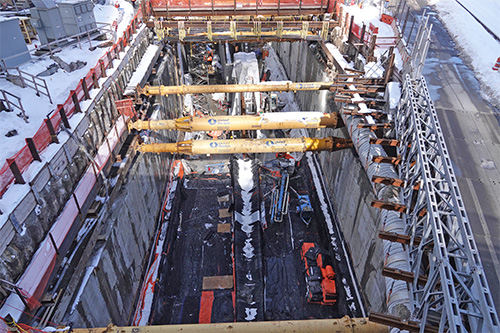
Crews work inside the Hudson County access shaft in Weehawken, N.J., part of the $16B Hudson Tunnel Project, where excavation and ground stabilization are advancing ahead of tunnel boring operations.
Courtesy of Gateway Development Commission
Gateway officials said several construction milestones have been reached as crews prepare for tunnel boring. Components for the first tunnel boring machine that will excavate the Palisades Tunnel segment have arrived at the North Bergen, N.J., portal site. A second TBM from German manufacturer Herrenknecht AG has shipped and is expected to arrive on site this month.
Contractors have also completed installation of the slurry wall for the Hudson County access shaft in Weehawken, creating a watertight perimeter for the underground excavation that will begin this spring. Crews recently began installing piping and constructing an overwater platform to support ground-freezing operations near the Manhattan bulkhead, a technique used to stabilize soils ahead of tunnel excavation.
Work has also restarted inside a cofferdam in the Hudson River, where crews are using deep soil mixing to reinforce the sediment ahead of tunnel-boring operations.
On the Manhattan side, contractors recently completed placement of the invert slab for the Hudson Yards Concrete Casing Section 3 tunnel box. More than 11,000 cu yd of concrete have been placed so far, with wall construction now underway.
RELATED
Gateway Project Officials Sue Feds Over $16B Hudson Tunnel Funding Freeze
Major Contracts Advance Across Tunnel Sections
In February 2025, the Gateway Development Commission awarded a $1.2 billion design-build contract for the Manhattan Tunnel Project to a joint venture of Frontier-Kemper Constructors Inc. and Tutor Perini Corp.
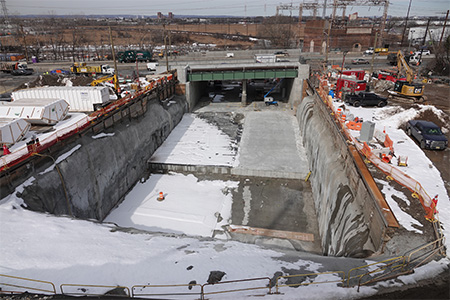
Excavation progresses at the North Bergen, N.J., portal site of the Hudson Tunnel Project, where crews are preparing the launch area for tunnel boring machines that will begin excavating the Palisades Tunnel segment.
Courtesy of Gateway Development Commission
The work includes constructing twin tunnels linking the future Hudson River crossing to the Hudson Yards casing and building a permanent ventilation shaft at 12th Avenue.
On the New Jersey side, the commission previously awarded a $465.6 million contract to Schiavone Dragados Lane JV to construct the Palisades Tunnel segment. The work includes boring two tunnels about 5,100 ft long with a 25-ft, 2-in. diameter, along with six cross passages and a Hoboken shaft for TBM retrieval.
Riverbed stabilization work is also underway where the new tunnel alignment will pass beneath shallow Hudson River sediments, with crews injecting grout to strengthen soils ahead of tunneling operations.
The Hudson Tunnel Project will construct a new two-track rail tunnel beneath the Hudson River while allowing the existing North River Tunnel—opened in 1910 and damaged by saltwater intrusion during Superstorm Sandy—to undergo full rehabilitation once the new crossing enters service.
The corridor is the nation’s busiest passenger rail line, hosting more than 2,200 trains and roughly 800,000 passenger trips daily.
The new tunnels are expected to enter service in 2035, after which the existing century-old North River Tunnel will be taken out of service sequentially for rehabilitation.