

George Harms Construction Co. challenges project’s labor agreement for work on a key design-build package
Bidding on a major component of the estimated $16-billion Hudson Tunnel Project is now the subject of a federal court challenge after a New Jersey contractor claimed the Gateway Development Commission’s new project labor agreement blocks it from competing for the work.
George Harms Construction Co. filed the lawsuit Nov. 26 in U.S. District Court in Newark, N.J., seeking to halt bidding on the New Jersey Surface Alignment package and arguing that the agreement approved by the commission on Aug. 20 excludes the firm’s union workers represented by the United Steelworkers. Bids are due Dec. 10.
RELATED
Gateway Shortlists Three Teams for Contract on $16B Hudson River Tunnel
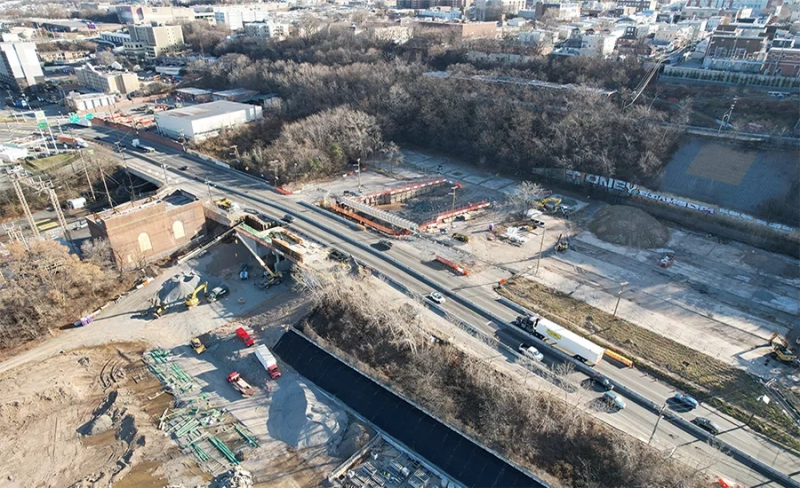
Harms, based in Howell, N.J., is one of four design-build teams the commission shortlisted on Feb. 26 for the contract, which includes trackway, retaining structures, bridges, a wetlands viaduct and extensive utility work in the area from Secaucus to North Bergen, N.J.
ENR reviewed board minutes, public comments, meeting transcripts and the full project labor agreement adopted Aug. 20, as well as the complaint filed in federal court.
The documents show the commission did not identify a project labor agreement in its November 2024 request for qualifications or in its Feb. 28 request for proposals, but introduced the concept publicly at its July 28 board meeting. Resolution 0725-04, presented at that session, authorized CEO Thomas Prendergast to negotiate a project labor agreement for the Surface Alignment package.
Objections Raised Following PLA Public Release
Minutes from the July meeting show that Commissioner Alicia Glen requested a revision requiring that any agreement be returned to the board for approval before taking effect. The session also drew initial objections from Harms and the United Steelworkers.
Gateway Development Commission Board Meeting
Board Meeting PowerPoint
Aug. 20, 2025
In a written comment, the United Steelworkers argued that adopting a project labor agreement excluding the union “would decrease competition for public work and result in higher costs, to the detriment of taxpayers,” adding that its Local 318 “is a qualified source of labor for the project,” recognized by the New Jersey Dept. of Labor.
The union also referenced the longstanding “Harmony Agreement” allowing the Steelworkers and National Association of Building Trades Union to “work side by side on the same work projects in New Jersey and obviate jurisdictional disputes.”
Harms CEO Rob Harms told commissioners the firm could not bid under a project labor agreement that excluded the Steelworkers union. “We will be unable to submit a lawful bid,” he said, according to the meeting transcript reviewed by ENR.
Despite the objections, commissioners voted unanimously on Aug. 20 to adopt Resolution 0825-01 approving the project labor agreement. The 65-page agreement, attached as Exhibit A to the resolution, lists the Hudson County Building and Construction Trades Council and its affiliated unions as signatories; the Steelworkers are not included.
RELATED
Bid Protests Offer a Way Around PLAs, But Will a Slow, Steady Precedent Win the Day?
The project labor agreement states it “will fully apply to any successful bidder for Project work [that] becomes signatory thereto,” and that its terms “supersede any national agreement, local agreement or other collective bargaining agreement” unless specifically exempted.
Gateway Development Commission Board Meeting
Public Comments
Aug. 20, 2025
Public comments at the Aug. 20 meeting again emphasized the exclusion. “Our members have performed heavy and highway work in New Jersey for decades. There is no reason to exclude them,” United Steelworkers representative Mike Fisher told commissioners, according to minutes. Harms repeated that the agreement would prevent it from submitting a bid.
The resolution states that the commission, through outside counsel, engaged a labor consultant whose study found that a project labor agreement would benefit the Surface Alignment package in terms of cost, schedule and labor harmony.
The study was not included in public materials, and minutes do not show commissioners discussing the Steelworkers’ exclusion.
In its lawsuit, Harms argues the project labor agreement violates the Gateway Development Commission Act, which directs the agency to use the existing labor force in both states and foster labor harmony.
Read More
George Harms Construction Co. Inc. et al v. Gateway Development Commission et al | New Jersey District Court Filing
It also cites the commission’s procurement guidelines that require maximum competition. The suit adds claims under the federal Sherman Act, as well as under the due process and equal protection clauses, asserting that the commission exceeded its authority by adopting a labor agreement that excludes a longstanding union representing heavy and highway workers in New Jersey.
Gateway Commission Responds
When asked for comment on the lawsuit, Molly Beckhardt, senior communications associate for the Gateway Development Commission, told ENR that “all shortlisted bidders on the NJ Surface Alignment Project are qualified and permitted to work on the project. No bidder is excluded.” She said that “Project Labor Agreements are an important part of ensuring consistent, predictable work rules that benefit workers and support timely delivery of the project. [The commission] has successfully implemented [project labor agreements] on other Hudson Tunnel Project construction packages.”
According to Beckhardt, “any successful bidder can work on the NJ Surface Alignment Project, regardless of which unions they have agreements with, provided those unions assent to the [project labor agreement],” and that the commission “is confident that procurement for the NJ Surface Alignment contract has complied with all relevant laws, regulations, and internal guidelines.”
Harms filed an internal bid protest on Oct. 29 seeking a formal hearing and requesting that the commission extend the Dec. 10 bid deadline. The commission’s designated protest officer responded on Nov. 10 that additional time was needed to evaluate the issues, but did not say when a decision would be made or whether the deadline would be extended.
On Nov. 11, Harms raised concerns about potential conflicts of interest and renewed its request. Its lawsuit states that the commission inaction rendered the protest process “futile,” prompting the federal court filing.
The complaint asks the court to freeze the procurement until it determines whether the [project labor agreement] complies with state and federal law. A ruling could affect the commission schedule to award the Surface Alignment contract, one of the largest civil works components of the Hudson Tunnel Project. The outcome may also influence upcoming design-build procurements if the commission plans to use similar labor agreement structures on other packages.
The United Steelworkers did not respond to ENR’s request for comment by press time. The court has not scheduled hearings on Harms’ request for a preliminary injunction.