

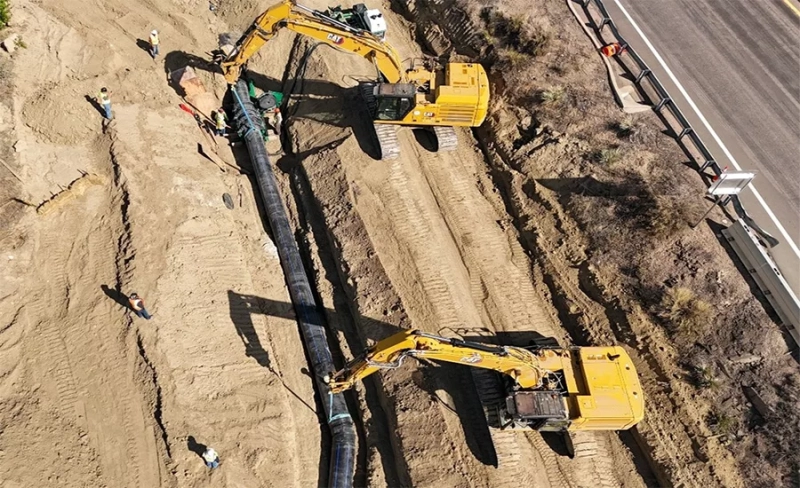
Rejection of bipartisan bill halts repayment fix for a water pipeline currently under construction in southeastern Colorado
President Donald Trump’s veto of legislation intended to ease repayment terms for a long-delayed federal water project has injected new uncertainty into completion of the Arkansas Valley Conduit, a pipeline already under construction entirely within Colorado.
The Finish the Arkansas Valley Conduit Act was one of two bills Trump vetoed at the start of 2026, marking the first vetoes of his second term despite bipartisan passage in both chambers. The other measure was unrelated to infrastructure.
The Arkansas Valley Conduit bill, H.R. 131, did not authorize new construction funding. Instead, it sought to change how local communities repay the federal government by capping local responsibility at 35% of construction costs and allowing the remaining balance to be repaid over up to 75 years at a reduced interest rate, subject to a financial hardship determination by the U.S. Bureau of Reclamation.
Read More
Finish the Arkansas Valley Conduit Act | Full Text
The bill was sponsored in the House by Rep. Lauren Boebert (R-Colo.), with Rep. Jeff Hurd (R-Colo.) as a cosponsor, and introduced in the Senate by Sens. Michael Bennet and John Hickenlooper, both Democrats from Colorado.
The measure passed the House by voice vote and the Senate by unanimous consent on Dec. 14, 2025. Construction on the conduit began in 2023, and more than $200 million has already been invested through a mix of federal, state and local funding, according to the Southeastern Colorado Water Conservancy District.
RELATED
Drinking Water Leaders Convene to Tackle Funding Challenges, Forever Chemicals
Construction is underway on the project’s main trunk line, which includes more than 120 miles of pipeline now being delivered under the Bureau of Reclamation’s rural water program.
Once completed, the full Arkansas Valley Conduit system is planned to include up to roughly 230 miles of pipeline, including distribution spurs, designed to deliver up to 7,500 acre-ft of treated water per year from Pueblo Reservoir to 39 communities across southeastern Colorado.
What It Will Take to Finish
Total project costs have climbed to roughly $1.4 billion, according to federal and local estimates, meaning well over $1 billion in construction and delivery work remains beyond the trunk line now under construction.
Project sponsors and federal officials attribute the escalation primarily to construction inflation, rising materials and labor costs, and scope expansion as the project moved from decades of planning into phased construction. Original cost assumptions from the project’s 1960s authorization did not account for modern drinking-water treatment standards, longer distribution laterals needed to reach smaller communities, or sharp increases in steel, concrete and fuel prices since 2020. Federal construction cost indexes show water-infrastructure inputs remain well above pre-2020 levels, compounding cost pressure on long-duration projects like the conduit.
The project serves communities in Pueblo, Bent, Crowley, Kiowa, Otero and Prowers counties, where many systems rely on groundwater sources that naturally contain radionuclides and do not meet current federal drinking water standards. The Bureau of Reclamation has previously described the conduit as a critical rural water project needed to bring affected systems into regulatory compliance.
RELATED
EPA Parcels Out $6.5B for Drinking Water Infrastructure
With a Veto, What Happens Next?
Trump vetoed the bill Dec. 30, arguing in a message to Congress that it would expose federal taxpayers to additional financial risk.
“My administration is committed to preventing American taxpayers from funding expensive and unreliable policies,” Trump wrote. “Ending the massive cost of taxpayer handouts and restoring fiscal sanity is vital to economic growth and the fiscal health of the nation.”
For construction, the veto halts a financing adjustment for an active federal project by changing how existing construction costs would be repaid, not by blocking new authorization.
“This isn’t a frivolous project,” Chris Woodka, senior policy and issues manager for the Southeastern Colorado Water Conservancy District, told Colorado Public Radio in an interview. “It’s a project that meets federally mandated standards for water quality to ensure that 50,000 people are drinking clean, not carcinogenic, water.”
Members of Colorado’s congressional delegation said the veto undercuts a rare bipartisan agreement on a rural infrastructure project with substantial sunk costs.
“President Trump decided to veto a completely non-controversial, bipartisan bill that passed both the House and Senate unanimously,” Boebert said in a prepared statement.
Hurd said the legislation was designed to protect existing investments rather than expand federal exposure.
“The vetoed legislation did not authorize new construction spending or expand the federal government’s original commitment,” he said. “More than $200 million has already been invested, alongside significant state and local contributions. Further delay risks stranding taxpayer dollars and leaving communities without a viable path to meeting drinking water standards.”
Bennet and Hickenlooper also criticized the veto and urged Congress to consider an override.
While the veto does not immediately halt construction, project officials said current phases are funded and moving forward, though future segments will require either a veto override or alternative financing to proceed on schedule. Unresolved repayment terms could delay or limit later phases of the system.