

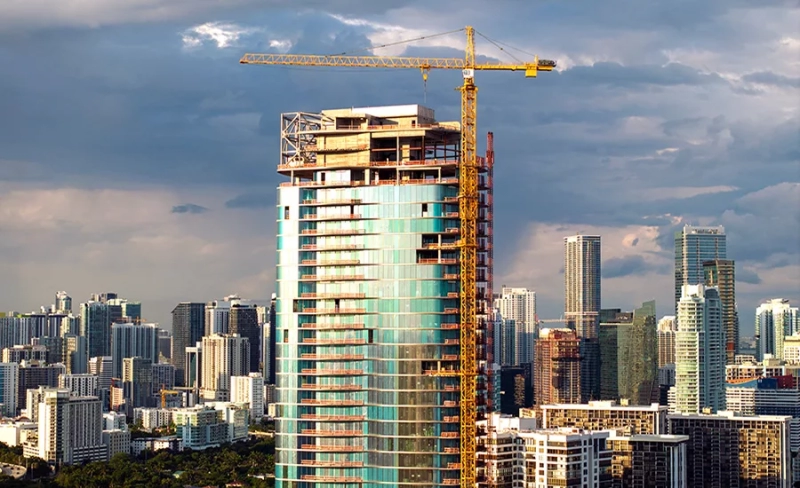
Higher deductibles and tighter insurance terms are pushing owners and contractors to manage losses earlier, shifting risk prevention onto the jobsite
Builders’ risk underwriting is no longer just pricing exposure—it is shaping how construction projects are run, as insurers tighten terms and push responsibility for loss prevention deeper into the jobsite.
Higher deductibles and intensified scrutiny around weather- and water-related losses are pushing owners and contractors to manage construction risk earlier and more deliberately, reshaping long-standing assumptions about what insurance will absorb and what the jobsite must prevent.
RELATED
The Overlooked Insurance Exclusion Lurking in Contractors’ Policies
Recent market commentary from leading brokers shows that while builders’ risk pricing has stabilized or softened in lower-risk segments, underwriters are increasingly managing exposure through higher deductibles, tighter sublimits and closer review of project risk controls. This shift in underwriting practice is most pronounced on large, complex and catastrophe-exposed projects, where insurers are asking owners and contractors to demonstrate how key risks like water damage and severe weather are being mitigated on site.
Read More
Marsh | Construction Specialty Contractors Risk Report
In practice, that shift often shows up in how coverage is structured rather than in its pricing. On large vertical projects in hurricane- and flood-exposed markets, builders’ risk policies are increasingly written with higher water-damage deductibles and tighter sublimits for non-weather water losses, even when base premiums remain relatively flat, according to recent construction risk briefings from Marsh.
Underwriters are also asking for project-specific details—such as how temporary water systems are isolated, whether overnight monitoring is in place and how quickly shutoff protocols can be executed—before binding coverage, pushing insurance considerations into early construction planning rather than treating them as an administrative step at financial close.

How Insurers Are Rethinking Builders’ Risk for Data Centers
Builders’ risk insurers are beginning to treat data centers as a distinct construction category, driven by loss experience on large, fast-tracked projects. One insurer’s response illustrates how underwriting is evolving as deductibles rise and construction-phase risk shifts back onto owners and contractors. Click to read more.
That pressure is not uniform. In hurricane-exposed Gulf Coast markets like Florida, brokers say builders’ risk policies are routinely written with named-storm deductibles that can run into the millions of dollars on large projects, alongside tighter sublimits for water damage and flood-related losses.
By contrast, many interior markets continue to see comparatively lower deductibles and fewer coverage restrictions. Brokers note that while coastal regions often experience these terms first, similar underwriting scrutiny is increasingly being applied to large, high-value projects nationwide — regardless of geography.
Insurers are also differentiating risk by project type, according to broker surveys published by Willis Towers Watson. The London-based advisory company reports that project-specific builders’ risk policies—commonly used on large towers, data centers and other high-value projects—face more volatile terms and pricing than master programs, with rate increases of 5% to 15% for projects exposed to natural-catastrophe risk.
That shift is showing up not just in premiums but in day-to-day construction practice.
From Underwriting Pressure to Jobsite Behavior
Carlos Casal, executive vice president of construction at Mast Capital, said rising deductibles have changed how owners evaluate risk on large projects, particularly in weather-exposed markets.
Mast Capital is a Miami-based real estate developer focused on high-rise residential and mixed-use projects in South Florida and other coastal markets, where wind, water and schedule risk play an outsized role in construction insurance. The firm has developed and delivered multiple luxury condominium towers and is advancing several large-scale projects in dense, weather-exposed urban environments.
“At some point, the deductible becomes large enough that you’re effectively self-insuring the first loss,” Casal said. “When that happens, preventing the loss matters more than how good your claim recovery process is.”
Casal said insurers are increasingly focused on water damage, site conditions, and schedule discipline—areas that were historically treated as construction-management issues rather than underwriting inputs.
“The conversation with insurers has shifted,” he said. “They want to understand what controls are actually in place on the jobsite, not just what’s written in the policy.”
Read More
WTW | Construction Insurance Marketplace
Insurer commentary echoes that assessment. Recent construction insurance analysis has identified water damage and severe convective storms as persistent loss drivers in builders’ risk, prompting greater scrutiny of water-damage mitigation plans and wider use of higher deductibles to share risk. Insurers have also pointed to a growing concentration of value on large projects—such as data centers, hospitals and high-rise towers—where losses can escalate quickly.
For owners and contractors, that environment is accelerating a shift toward managing risk during construction rather than relying on insurance recovery after the fact.
One manifestation of that shift is the growing use of sensor-based monitoring and automated controls to detect and respond to water leaks, curing anomalies and environmental conditions before they escalate.
Toronto-based Brickeye operates in that space, providing sensor-based monitoring and automated shutoff systems designed to reduce jobsite risk. The company says its systems are increasingly being discussed during builders’ risk underwriting, as insurers ask owners and contractors to document how water and environmental risks are being actively monitored during construction.
Brickeye raised $10 million in a Series B funding round in January, reflecting growing investor interest in technologies aimed at reducing exposure during construction as insurers tighten builders’ risk terms.
“What we’re seeing is that insurers are no longer satisfied with general statements about risk management,” said Tim Angus, Brickeye’s co-founder and CEO. “They want to understand what controls are actually in place on the jobsite and how losses are being prevented in real time.”
For some contractors, insurance economics—not technology enthusiasm—have been the catalyst.
RELATED
Viewpoint | Building Sensors Make Financial Sense in Construction Insurance
Blaik Ross, executive vice president at Beauchamp Construction, said his firm initially adopted monitoring tools to reduce water losses and downtime, but later took an equity stake in Brickeye after seeing how documented risk controls affected underwriting discussions.
Beauchamp is a general contractor operating throughout South Florida’s East Coast, with a portfolio spanning high-rise residential, commercial and complex coastal projects—placing it squarely in markets where water damage and weather-related losses have become increasingly consequential. The firm’s work has positioned it directly in the path of rising builders’ risk deductibles and more stringent underwriting reviews.
“Water losses used to be treated as a cost of doing business,” Ross said. “But when deductibles climb into six figures, that mindset stops working.”
Ross noted that insurers are increasingly asking how risks are being managed in real time, not just how they will be reported after a loss.
“Being able to show what controls are in place—and when they’re active—changes the conversation,” he said. “It’s no longer theoretical.”
Casal said Mast Capital has deployed monitoring and risk-mitigation tools across multiple high-rise projects, not as a technology experiment but as a response to insurance market realities.
“This isn’t about gadgets,” Casal said. “It’s about discipline. The insurance market is forcing better behavior, and owners are pushing that discipline down through the project team.”
For owners and contractors navigating higher deductibles and narrower margins for error, that shift is already underway.
“Managing risk used to start with the claim,” Casal said. “Now it starts with how the project is actually run.”