

✕

Faced with recent major breaks to the Transcanyon Waterline (TCWL), the National Park Service (NPS) and contractor Stronghold Engineering Inc. have accelerated work across multiple locations on the $208-million replacement project at Grand Canyon National Park.
The stepped-up effort follows a series of recent failures that forced the park to suspend overnight accommodations on the South Rim for nearly two weeks while crews stabilized the system and conserved water for essential day use services. It was the second time in 2025 and the third time in two years that the park was forced to stop lodging due to water shortages. Additionally, since 2010 there have been more than 85 major breaks that have disrupted water delivery.
The project currently involves crews working across several fronts. They are installing new steel pipeline segments, constructing water treatment plants at the South Rim and Phantom Ranch and developing a new helibase operations building. Work zones span the Bright Angel Trail, North Kaibab Trail, Phantom Ranch delta and multiple inner canyon locations accessible only by foot or helicopter.
“The project has significant phasing and sequencing elements to complete the entire pipeline replacement at different locations based on specific needs for each section,” says Daniel Fleming, project manager with the NPS Denver Service Center.
HDR Inc. serves as the lead design engineer. GSE Construction is the subcontractor responsible for constructing the booster pump station and water treatment plants. Additional subcontractors include Winegardner Masonry and Spear E Enterprises. Approximately 160 workers are on the project at any given time.
As project owner, NPS does not permit Stronghold Engineering or other project team members to discuss the project publicly.
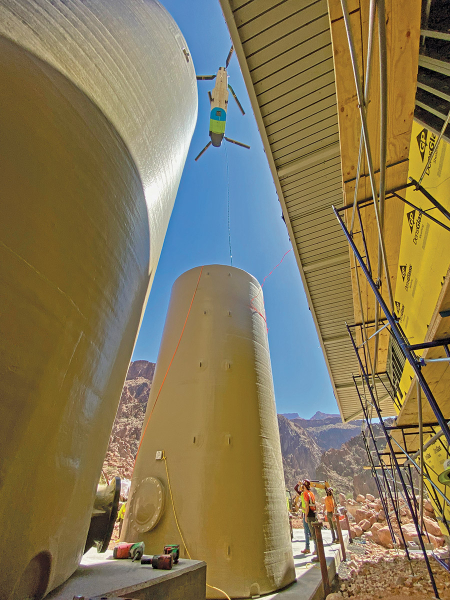
Water treatment plants are being constructed at the South Rim and Phantom Ranch sites.
Photo courtesy nps.gov
Why the Replacement Is Needed
The original TCWL was constructed in the 1960s using lightweight aluminum pipe that could be flown into the canyon with the aviation equipment available at the time. While the material reduced transport challenges, “much of the existing pipeline is surface mounted and exposed to the elements,” Fleming says. “Factors like extreme temperatures, rockfalls, the differential between pipe and water temperatures and the high pressures and velocities conveyed through the system all contributed to breaks.”
Breaks typically cost more than $25,000 to repair and take three to five days to fix. Some failures require extended conservation measures if multiple breaks occur in succession. The repeated disruptions have highlighted the need for a more durable, modern system capable of supporting millions of annual visitors.
Project officials say the overall design of the new water project involved about 10 years of tests, analyses, reviews and coordination to meet the various public health, state and federal standards, environmental laws and historic and NPS resource management policies.
A major component of the replacement project is relocating the water intake from Roaring Springs to Bright Angel Creek. This change will reduce the length of the TCWL by about seven miles and eliminate the segment with the highest concentration of breaks.
The project also includes a new steel pipeline system along the inner canyon corridor; sliplining of existing distribution lines to Havasupai Gardens, Cottonwood Campground and Manzanita Rest Area; and the installation of power and communications conduit along the pipeline route.
“In traditional projects, all utilities are installed in the same trench at the same time. Here, the canyon’s constraints prevent that. Each utility requires separate excavation.”
—Daniel Fleming, Project Manager, National Park Service
Below Plateau Point, crews are also hand-cutting a 5-ft-wide trench on steep grades for the new waterline. A second trench for power and communications will follow this.
The new pipeline is primarily steel, selected for its durability and ability to withstand high pressures and environmental stresses. FlexSteel pipe is being used only between the South Rim and Havasupai Gardens, where topography and diameter constraints make the flexible product suitable, says Fleming.
Sliplining will be used where feasible, but many sections of the existing pipeline cannot accommodate the method due to small diameters and excessive bends.
One of the project’s biggest challenges is topography. The job’s remote locations require crews to work in conditions that differ significantly from typical construction sites. Many work zones are several miles from trailheads, and crews must hike in and out daily unless they stay at Phantom Ranch or other designated areas. Many work areas are narrow, steep and accessible only by rope systems or narrow ledges.
“In traditional projects, all utilities are installed in the same trench at the same time,” Fleming says. “Here, the canyon’s constraints prevent that. Each utility requires separate excavation.”
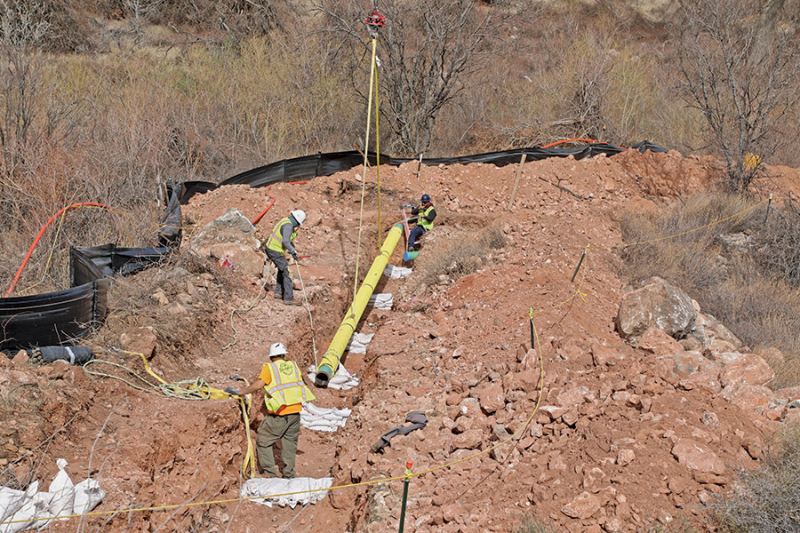
Much of the pipeline is being placed in remote areas that have– no place for helicopters to land or crews to stage equipment.
Photo courtesy nps.gov
Accessibility Logistics
Because most sites are only accessible by air, helicopter operations are crucial to the project. High Performance Helicopters conduct daily sling load flights to transport pipe, equipment and supplies to remote sites in the canyon that have narrow corridors, variable winds and limited landing zones.
Weather conditions, including high winds and sudden storms, can halt flights with little notice. Extreme heat is another factor. Summer heat in the inner canyon can exceed 110°F, while winter conditions on the rims can bring snow and ice. Work schedules are adjusted seasonally to account for these variations.
Environmental and cultural resource protections are also influencing construction. Crews must minimize ground disturbance, avoid sensitive areas and coordinate with park staff to maintain visitor access on heavily used trails.
And then there is the canyon’s geology, which adds another layer of complexity. Rock types vary significantly along the route, requiring crews to adapt excavation methods as they move through different formations. Some areas allow shallow trenching, while others require hand tools or small equipment lowered by helicopter.
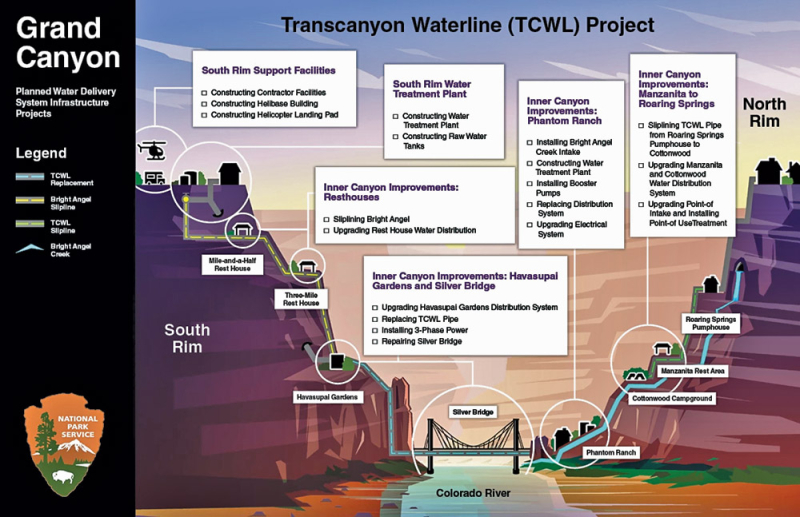
Image courtesy nps.gov
Click on the image for greater detail
Funding and Project Delivery
The TCWL replacement is funded through the Great American Outdoors Act and the Federal Lands Recreation Enhancement Act. NPS leadership says the project addresses long-standing infrastructure needs that were previously deferred due to funding limitations.
“This huge undertaking is an example of the work taking place in national parks across the country to repair or replace vital infrastructure,” Chuck Sams, NPS director, said in a statement. “Bipartisan commitment from funding sources is truly making a difference.”
The new water delivery system is expected to significantly reduce emergency repairs and operational disruptions once it comes online. By eliminating the most failure prone sections of the existing pipeline and replacing aluminum with steel, NPS aims to improve system reliability and reduce maintenance costs.
The redesigned intake at Bright Angel Creek will shorten the pipeline by about seven miles, removing the segment with the highest number of breaks. The new steel pipeline is engineered to withstand high pressures and environmental stresses.
NPS officials say the project will protect natural and cultural resources, maintain the visitor experience and provide reliable water service for the next 50 years or more.
With construction at approximately 70% completion, crews will continue to install steel pipe along remaining sections of the inner canyon corridor, advance work on both water treatment plants and complete the helibase operations building. Additional phases of trenching, sliplining and conduit installation will continue through 2026. Final system testing and certification will occur in 2027 when the project is officially turned over to NPS.