

Pre-publication request for information outlines a redevelopment framework far larger than publicly discussed
The U.S. Dept. of Transportation is considering a sweeping redesign of Washington Dulles International Airport, based on a pre-publication request for information now posted on the Federal Aviation Administration’s website.
The document outlines scenarios for replacing or substantially reworking the airport’s terminals and concourses but has not yet been formally published in the Federal Register and still contains placeholder fields for key deadlines.
Detailed Redevelopment Scenarios
Learn More: Project Scope
Draft Request for Information
Revitalizing Washington Dulles International Airport
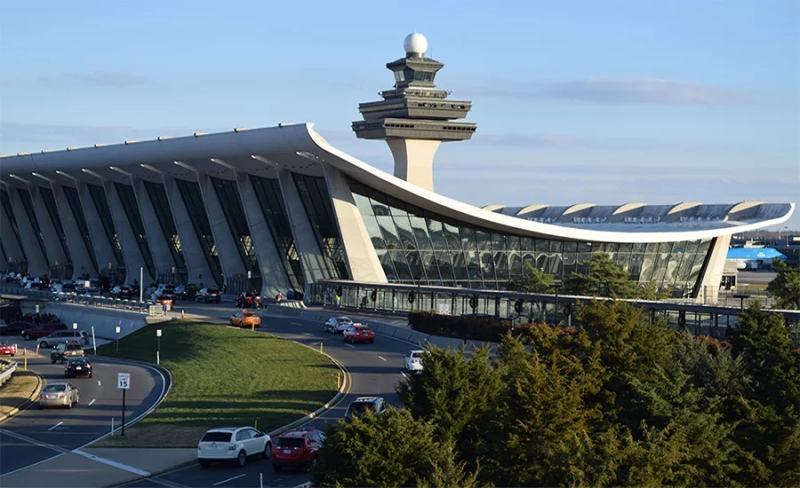
The RFI provides a level of detail beyond the public discussion to date, outlining potential paths for constructing entirely new terminal and concourse facilities, as well as options for integrating, modifying or replacing the Eero Saarinen-designed main terminal that opened in 1962.
Respondents would be expected to submit architectural concepts with corresponding visual renderings illustrating the scale and character of any proposed redevelopment, signaling interest in a transformation that extends beyond routine modernization.
Unlike the broad public remarks President Donald Trump and Transportation Secretary Sean Duffy made on Dec. 2, the document establishes a structured request for technical information.
RELATED
White House East Wing Razed for $300M Ballroom
The draft calls for rough order-of-magnitude cost estimates for multiple redevelopment approaches, descriptions of financing and delivery strategies, including public-private partnerships, and detailed plans to maintain full airport operations during a multi-year construction program.
It also instructs respondents to identify potential impediments, from regulatory constraints to construction sequencing challenges.
The RFI situates redevelopment within the relief of Executive Order 14344, “Making Federal Architecture Beautiful Again,” signed by the president Aug. 28. The EO states that any new terminal complex should reflect architecture intended to “inspire the American people,” suggesting the department is evaluating not only operational and capacity needs but also the aesthetic identity of the region’s primary international gateway.
A similar architectural emphasis has appeared in recent decisions involving federally owned facilities, including a remodel of the White House Lincoln Bedroom bathroom and, most notably, razing the East Wing for an expansive ballroom that has grown in scale since its announcement last July. Collectively, this latest effort reflects the administration’s broader focus on visual identity and modernization across federal property.
A terminal replacement at Dulles would rank among the most ambitious U.S. airport redevelopments in recent years.
Comparable megaprojects, such as the $8-billion LaGuardia rebuild, Denver International Airport’s multi-phase terminal expansion and the $14-billion Los Angeles International Airport modernization all demanded intricate sequencing, extensive airside logistics and long-term airline coordination. Those challenges would be no different for a makeover at Dulles.
IAD (Dulles’ airport code) also occupies a unique governance position among major domestic hubs. Although the airport is federally owned, the Metropolitan Washington Airports Authority (MWAA) manages it under a long-term lease through 2100.
DOT reaffirmed that structure in a Dec. 2 release, noting that the department “holds IAD’s property title” and signed a lease extension to 2100 earlier this year. Any redevelopment pathway would need to reconcile federal interest with MWAA’s existing capital program and longstanding use-and-lease agreements with airlines.
RELATED
Construction Team Named for $1.6B Cleveland Hopkins Airport Modernization
Technical and Procurement Requirements
Public comments have provided none of this specificity. During the Dec. 2 Cabinet meeting, Trump called Dulles a “terrible” airport despite praising the Saarinen terminal as a “great building,” adding that his administration had “an amazing plan.”
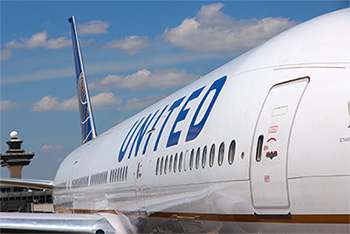
A United Airlines widebody sits at Washington Dulles International Airport, the carrier’s largest East Coast hub that handles more than 200 daily departures during peak periods. United said it will work with the administration on improvements that are “meaningful and cost-effective” as federal officials explore potential terminal redevelopment options.
Photo by Tupungato/Adobe
Duffy told reporters DOT intended to solicit ideas from the private sector. Neither offered details on the scale, design intent or procurement structure reflected in the RFI. Those remarks were reported by the Associated Press, Reuters and The Washington Post.
MWAA is advancing its own $7-billion capital program that includes a new concourse scheduled to open in 2026. In a statement to ENR, Crystal Nosal, MWAA media relations manager, said the authority “appreciates the administration’s interest in making improvements to Washington Dulles International Airport.”
She said MWAA “looks forward to seeing the results of the U.S. Department of Transportation’s request for information and working collaboratively with the administration,” adding that the authority “always embrace[s] new ideas for Dulles, which is the fastest growing international gateway airport in America (year-over-year through September YTD).”
Nosal said MWAA intends to “build on the existing $7-billion capital plan for Dulles,” which includes the new concourse now under construction that is expected to open next fall.
DOT’s Dec. 2 release also stated that the department intends to share RFI submissions with MWAA once received, and that it will “work closely with the airport authority” as the process advances.
United Airlines, the airport’s largest carrier, previously described Dulles as a “national asset” in comments to the Post and said it will work with the administration on improvements that are “meaningful and cost-effective.” No airline has addressed the scale of redevelopment suggested in the RFI.
Although administration officials have cited recent collisions involving the airport’s aging “people mover” vehicles—including a November incident that hospitalized passengers—the request focuses on long-term design, financing and delivery questions rather than those near-term operational issues.
Reuters reported that the White House views the incidents as evidence of the need for modernization, but the RFI does not mention them directly.
Governance and Timeline Uncertainty
The timeline for any formal release remains unclear. The version posted on FAA.gov states that industry questions will be due 10 days after publication in the Federal Register, with submissions due 45 days later, but those fields remain unresolved because the notice had not yet appeared in the register as of this writing.
The RFI also does not identify the procurement authority or statutory pathway a terminal replacement program would follow, leaving open how a federal initiative of this magnitude would align with MWAA’s operating lease and existing capital commitments.
If released in anything close to its current form, the RFI suggests DOT is evaluating concepts that could rival major U.S. terminal redevelopments in scale, complexity and architectural ambition.
For now, the notice remains unpublished in the Federal Register, and DOT has not indicated when or whether a final version with firm deadlines will be issued.