

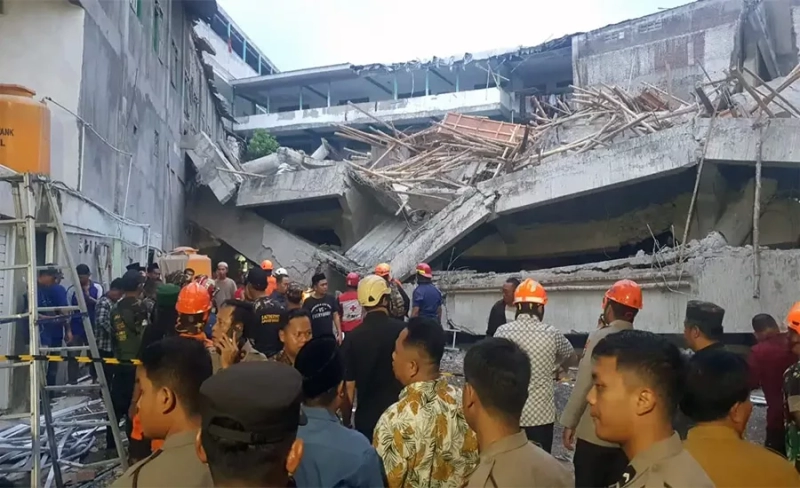
Investigators focus on column and foundation capacity during vertical expansion as forensic team deploys to site
Indonesian investigators are examining a suspected structural failure at a boarding school in East Java that collapsed Oct. 5, killing at least 36 people and leaving more than two dozen missing.
The Al Khoziny Islamic school’s prayer-hall building gave way while crews were casting concrete for a new upper floor, according to East Java Police. The National Disaster Mitigation Agency (BNPB) said initial findings point to the failure of vertical supports and the existing foundation unable to bear added loads from the ongoing expansion.
Structural Overload Suspected
Additional floors were being added to the two-story structure when it collapsed, with police reports indicating fresh concrete was being poured for a fourth-level slab at the moment of collapse.
“Preliminary evidence shows the columns and footings could not support the new load path,” a BNPB spokesperson said.
Rescue teams from Basarnas, Indonesia’s national search and rescue agency, labored for several days amid unstable debris, initially using hand tools to extricate victims, switching to excavators after families agreed to the use of heavy equipment.
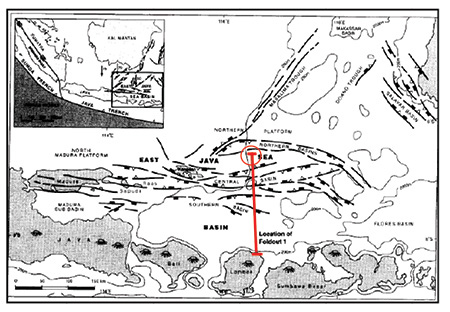
Geologic map of East Java and the Java Sea shows the approximate epicenter of the Sept. 30 earthquake southeast of Sumenep—about 150 km northeast of Sidoarjo, where the Al Khoziny Islamic school collapse occurred—along major regional fault lines. Image courtesy of BMKG/Geological Agency of Indonesia.
The national police have dispatched disaster victim identification teams to gather DNA samples and analyze dental records to verify the identities of many victims, most of whom were students.
While ostensibly unrelated, a magnitude-6.0 offshore earthquake, 12 km beneath the Java Sea, recorded on Sept. 30 near Sumenep—about 150 km from the school site—complicated rescue logistics by destabilizing the rubble.
Officials have been careful not to link the seismic event to the building failure, Indonesia’s Meteorology, Climatology and Geophysics Agency reported.
Engineering and Oversight Gaps
Indonesia has a long, well-documented history of unpermitted and informally supervised construction, particularly in rapidly urbanizing and lower-income areas. Domestic regulators and international observers have repeatedly cited this pattern as a contributing factor to structural failures and uneven code enforcement.
Officials have not confirmed whether the vertical expansion was formally permitted. PUPR has dispatched a forensic team to the site, but no technical findings have been released. Engineering faculty in Surabaya say many Islamic boarding schools, known as pesantren, are built incrementally with limited professional design input.
“This appears to be a classic case of overloading an unverified frame,” said a civil engineering lecturer at the Bandung Institute of Technology, speaking on background to local media. “When columns and foundations are designed only for original occupancy, adding floors without recalculating axial and shear capacity is courting failure.”
The Public Works and Housing Ministry (PUPR) reported in 2023 that fewer than 20% of private and institutional buildings outside Jakarta held valid permits, and many pesantren expansions proceed without licensed engineering review.
The Jakarta Post:
Deadly Boarding School Collapse Exposes Failures in Construction Safety
Investigators are expected to review column sizing, foundation bearing capacity and concrete curing sequences during the pour, along with whether any temporary shoring was in place.
Religious Affairs Minister Yaqut Cholil Qoumas, whose agency oversees school construction, has ordered immediate inspections of similar multi-story facilities across East Java. He pledged tighter oversight and new audit procedures for privately funded school projects.
The Sidoarjo collapse is Indonesia’s deadliest structural failure in years, highlighting persistent enforcement gaps in mid-rise educational and religious construction.
Government officials said forensic findings from PUPR and BNPB are expected to guide revisions to Indonesia’s building-code compliance checks later this year.