

Digitally linked milling, paving and compaction systems aim to help contractors improve quality, address labor shortages
Since acquiring Germany’s Wirtgen Group in 2017, John Deere has focused on making its roadbuilding equipment work as part of a connected paving system. A demonstration for press and investors near Nashville, Tenn., at the end of May showed what that looks like in practice.
Instead of introducing machines one by one, Deere demonstrated a continuous “mill-and-fill” pavement rehabilitation project, with production data moving from a Wirtgen cold mill to a Vögele paver, a Hamm roller and John Deere Operations Center as work progressed. The company gathered several of its team experts for the program.
The trip centered on using shared machine data to improve quality control, document completed work and help contractors address persistent labor shortages.
RELATED
Deere, Volvo CE to Expand US Production of Construction Equipment
«We’re not just equipment specialists, we’re production systems specialists,» Craig Lamarque, vice president of digital products at Wirtgen America and event emcee, said. «We don’t just deliver machines … we enable our customers’ performance.»
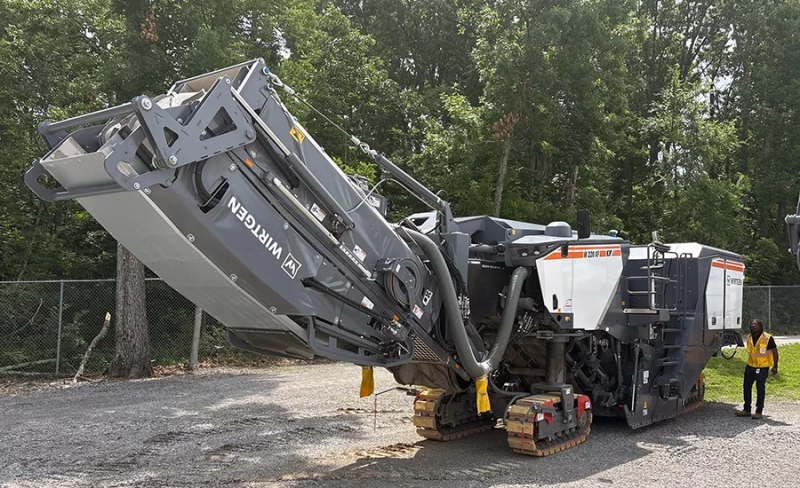
The demonstration began with Wirtgen’s W 220 XF cold milling machine removing deteriorated asphalt before paving and compaction equipment completed the rehabilitation sequence.
As work progressed, quality information flowed into John Deere’s onsite Operations Center, allowing supervisors to remotely monitor activity while automatically documenting completed work for owners and transportation agencies.
Conventional milling generally follows the existing road profile. «The solution to achieve and improve the surface, the ride quality, is to have the mill actually mill at various depths in various locations,» milling product manager Tom Chastain said. «This is called differential milling.»
Looking for quick answers on construction and engineering topics?
Try Ask ENR, our new smart AI search tool. Ask ENR →
ENR briefly operated the W 220 XF, pictured at top, following the demonstration. The cold mill proved intuitive.
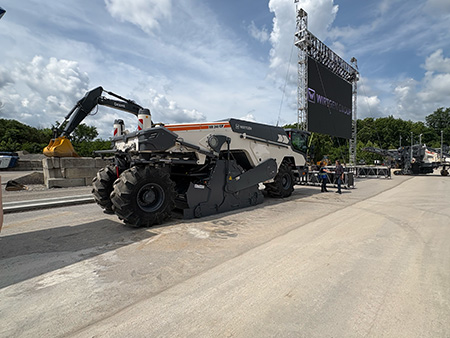
Pictured is a Wirtgen WR-series cold recycler and soil stabilizer. The machine uses digital guidance, automated steering and performance-tracking technologies to document production while recycling existing pavement and stabilizing road base materials in place.
Photo: Bryan Gottlieb/ENR
Dual joysticks mounted on either side of the operator’s platform allowed steering from each position without changing settings, while the machine’s crab-steering capability made precise lateral adjustments straightforward. Steering inputs were immediate enough that the machine felt considerably more agile than its size suggested. The experience reinforced Deere’s argument that improving machine interfaces can shorten the learning curve for less-experienced operators.
Wirtgen specialist Dwayne Kahn noted that the machine itself is well-established, while its digital capabilities continue to evolve.
«The machine, as far as milling itself, we’ve been around for a while,» he said, explaining that newer technologies such as Working Performance Tracker and Smart Level Pro have been integrated into the platform over the past several years.
That emphasis on simplifying operations continued through paving. Tyler Brand, corporate account support manager, demonstrated Smart Pave, which replaces painted guidelines with digital paving models uploaded before work begins.
«No need to paint lines, you save at least two hours a day,» Brand said, adding that eliminating manual layout also removes workers from live traffic during one of the most hazardous stages of paving.
RELATED
Hilti Takes on Heavy-Duty Work with its Unified Battery Platform
Compaction followed the same philosophy. Dan Sandlinsamol, compaction application support manager, said proper density remains one of the most important measures of pavement quality.
«Studies show that a 1% increase in density can extend service life by at least 10%,» he said while demonstrating Smart Compact Pro’s real-time density measurement system.
Hunter Harward, digital technical support manager, demonstrated how production information flowed into John Deere Operations Center as work progressed. He also explained Deere’s digital coring capability, which allows users to generate virtual core samples anywhere on a project from within the Operations Center rather than cutting physical cores from newly paved pavement.
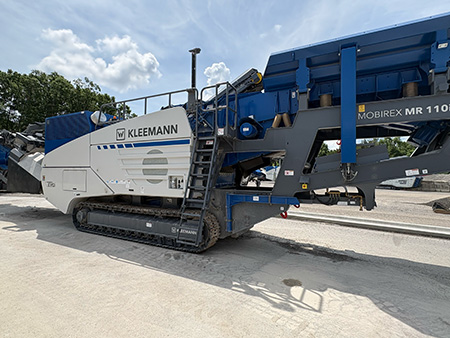
The Kleemann MOBIREX MR 110 mobile impact crusher processes reclaimed asphalt and concrete directly on the jobsite, reducing hauling while producing recycled material for reuse. Its automated feed-control and performance-monitoring systems are designed to optimize throughput and reduce operator intervention.
Photo: Bryan Gottlieb/ENR
Company officials said the technology is intended to reduce destructive testing while creating a permanent digital record of pavement quality, although broader adoption will depend on acceptance by transportation agencies.
Deere also demonstrated Kleemann mobile crushers capable of processing reclaimed asphalt on the jobsite for reuse, to reduce hauling while returning recycled material to new pavement.
While reclaimed asphalt pavement is already recovered at high rates in the U.S., Deere said European contractors have generally adopted higher recycled-content mixes and more integrated recycling practices, an approach the company expects to see expand in North America.
Whether transportation agencies ultimately adopt digital coring as an alternative to traditional pavement sampling remains uncertain.
Throughout the demonstration, Deere repeatedly emphasized that information generated during milling, paving and compaction can be shared across the paving process, allowing contractors to monitor production and quality as work progresses rather than after the job is completed.
Editor’s note: John Deere paid ENR’s travel expenses to attend the demonstration at Wirtgen Group’s technology facility near Nashville, Tenn.