

With Republicans and Democrats in Congress at odds over a stopgap spending measure, the government appeared to be headed toward a shutdown if lawmakers can’t reach an agreement and pass a continuing resolution before 12:01 a.m. Oct. 1, when the government’s 2026 fiscal year begins.
For government construction contractors, impacts are likely to vary depending on the agency, program and type of contract. Ongoing direct federal contracts will likely not be affected, as long as they are not being funded with 2026 appropriations, says Alex Etchen, vice president of government affairs at the Associated General Contractors of America. However, work under indefinite delivery/indefinite quantity, multiple-award task order contracts and similar, as well as contracts that have not yet been awarded and projects that are still undergoing environmental reviews or other permitting could face delays.
“If a shutdown went on for an extended amount of time, a lot of projects could be impacted, particularly if it requires some kind of approval,” Etchen says.
Transportation projects funded through separate legislation like the surface transportation reauthorization do not rely on the annual appropriations process are less likely to face as much disruption, say Etchen and Joung Lee, deputy director and chief policy officer at the American Association of State Highway and Transportation Officials.
Staff at agencies like the Federal Highway Administration who are paid through the Highway Trust Fund, should not be furloughed, as long as the fund is functioning with its own authority, Lee adds. And staff working on programs like the Federal-State Intercity Passenger Rail can also draw their salaries from advanced appropriations.
“We’ve seen an expansion of that approach in the [Infrastructure Investment and Jobs Act] years,” Lee says.
In the event of a shutdown, contractors working for the government should contact their contracting officers in advance to determine how the agency intends to handle projects, Etchen says. He also recommends contractors document all costs associated with the shutdown and notify their contracting officers of all actions taken in response to the shutdown.
Furloughs and Layoffs
What’s less clear is the impact that possible mass firings of federal workers could have, beyond temporary furloughs during a shutdown. In a memo this month, the White House Office of Management and Budget directed federal agency leaders to institute mass layoffs for employees of programs facing funding lapses if they are “not consistent with the president’s priorities.” Once 2026 appropriations are enacted, OMB also advised that agencies should “retain the minimal number of employees necessary to carry out statutory functions.”
Senate Minority Leader Chuck Schumer (D-N.Y.) called the OMB memo “an attempt at intimidation” and said in a statement that any unnecessary firings would be overturned in court, if the administration doesn’t hire the workers back first, as the administration recently did with hundreds of employees who had been fired by the Dept. of Government Efficiency earlier this year.
Schumer and House Democratic Leader Hakeem Jeffries (N.Y.) have been spearheading the Democrats’ effort to get an extension of Affordable Care Act tax credits included in the continuing resolution in order to prevent millions of people from becoming uninsured after Republicans left an extension out of the tax and spending reconciliation package passed this summer. Democrats’ version of the bill would have kept the government funded through the end of October and extended the health care subsidy for low- and middle-income earners, which is otherwise due to expire at the end of the calendar year.
The House did pass Republicans’ version of the bill, which would maintain most funding at current levels through Nov. 21. However, the measure failed to gain the 60 votes needed to pass the Senate on Sept. 19. With the House in recess this week, the seeming only way left to avoid a shutdown before the deadline would be for the Senate to pass House Republicans’ bill. The Senate is scheduled to take up a second vote on Sept. 30.
A meeting between Schumer and Jeffries with President Donald Trump on Sept. 29 yielded no progress, and both sides were quick to blame the other for the impasse.
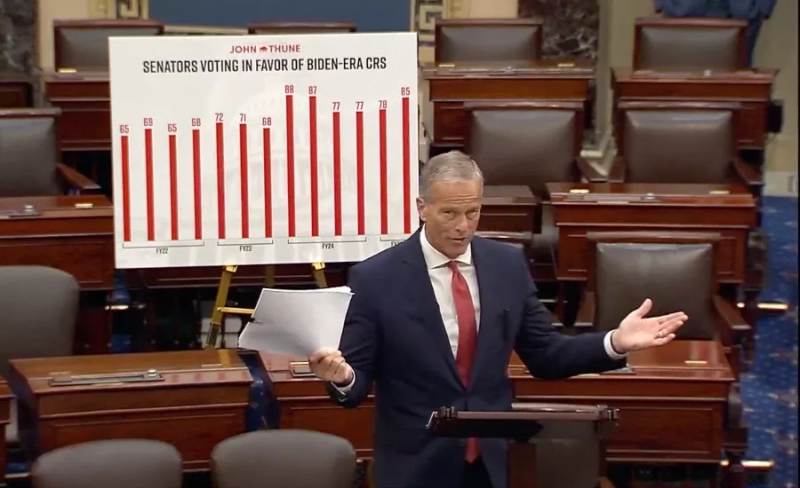
“This is purely and simply hostage-taking on the part of the Democrats,” Republican Senate Leader John Thune (S.D.) told reporters Sept. 29.
Another bill sponsored by Sen. Ron Johnson (R-Wis.), the Eliminate Shutdowns Act, would automatically continue appropriations at current levels for 14 days, and for another 14 days until a full-year appropriation bill is passed. However, Democrats rallied against the bill over concerns it would hand over Congress’ “power of the purse” to the White House.
“If this bill were to pass, Trump could quite literally refuse to sign any funding bill, even a bipartisan bill, unless it met all of his demands, and Congress would then have to override his veto with a two-thirds vote in both chambers if we ever wanted to get off the forever CR that this bill would put in place,” Sen. Patty Murray (D-Wash.) said on the Senate floor. “No way.”
Kristen Swearingen, vice president of government affairs at the Associated Builders and Contractors, called for Congress and the president to keep the government open.
“Any government shutdown creates uncertainty for ABC contractors throughout the country, including potential delays in federal infrastructure projects,” Swearingen said in a statement.
The government most recently faced a shutdown in March. At the time, some Democrats agreed to support a stopgap measure over concerns of potential mass firings. The last time the government actually shut down was during Trump’s first term, when disagreement over border wall funding contributed to a 35-day partial lapse in late 2018 and early 2019.