

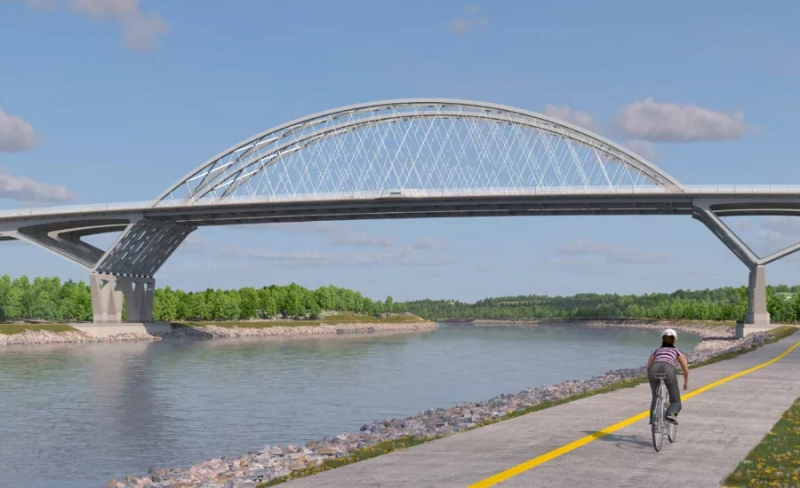
Agency seeks design-build services to update link to one of the state’s most popular summer destinations
The Massachusetts Dept. of Transportation is soliciting Letters of Interest from contractors in program to replace the Sagamore Bridge, one of two roadways connecting Cape Cod with the rest of the state.
Just under $2.5 billion is set aside for the work, with initial letters due at noon on May 27 at noon and a Request for Qualifications and Request for Proposals to follow. The RFP will be issued this summer. “For a very large-sized project, we’re moving quickly,” says Luisa Paiewonsky, executive director of the MassDOT Megaprojects Delivery Office. “Everybody needs to keep up.”
The announcement is MassDOT’s first procurement step in a broader initiative called the Cape Cod Bridges Project, which will replace the Sagamore Bridge, as well as the Borne Bridge located further west along the Cape Cod Canal— both completed in 1935 and functionally obsolete: They were designed for one million annual trips but now share about 38 million crossings each year, she says.
For Sagamore Bridge construction, two federal grants—$993 million from the Bridge Investment Program and $372 million from the Mega Grant Program—are contributing, along with $350 million from the U.S. Army Corps of Engineers and about $750 million from the state.
The eventual design-build contract for Sagamore will include constructing interchanges with more efficient layouts—an element crucial to meet modern capacity requirements, Paiewonsky says. The new bridge will also have shoulders and a merging lane to smooth traffic flow.
Most of the design plans the agency committed to publicly won’t change. Residents shared that they wanted arches in the design so the structure will be a network tied-arch bridge type. But MassDOT would like proposals to suggest other technical concepts and seeks other ideas from contractors, particularly in lowering costs or speeding up the schedule, Paiewonsky says.
Contractors will also build out some of the nine additional miles of bike and pedestrian pathway to be be added to the area once both bridges are complete. The footprint of the project means 13 homes and a few businesses will be seized via eminent domain on Cape Cod. MassDOT aims to have all property acquisitions finished by fall of 2027. Construction should be nearly completed by spring of 2037, with the structure to be owned and operated by the state. The Corps is responsible for the current bridge.
Paiewonsky says the project scale and the bridges’ prominence has attracted interest from around the country.
“Everybody on our project team is focused and determined to deliver these bridges, so we’re really excited about it,” she says. “We are ready to go.”