

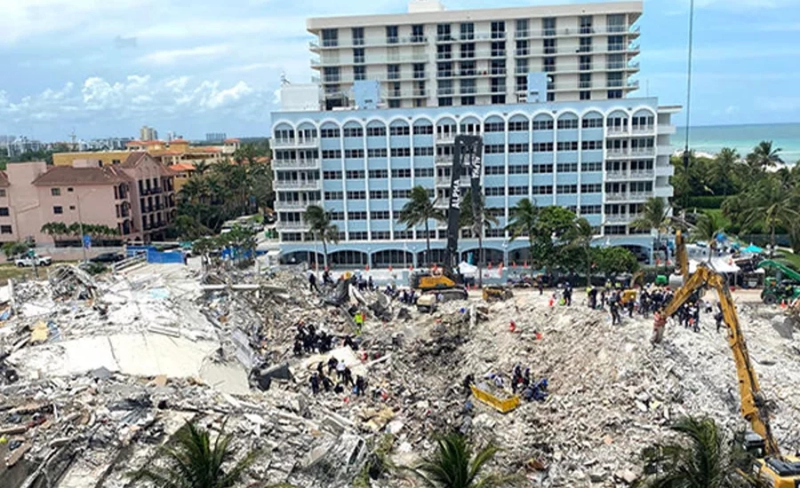
Champlain Towers South lacked adequate structural safety margins from the start, investigators say
The National Institute of Standards and Technology on June 22 released technical findings and further details regarding the events leading to the collapse of Champlain Towers South and the tragic deaths of 98 people that occurred five years ago.
The agency concluded that the collapse sequence began weeks before the building fell, when two slab-column connections beneath the Surfside, Fla., condominium’s pool deck experienced punching-shear failures, initiating a progressive sequence that culminated in the partial collapse of the 12-story reinforced-concrete tower on June 24, 2021.
«When building structures are designed and built to required codes and standards, they have margins against failure, meaning they should be able to support much more load than they are expected to bear,» Judith Mitrani-Reiser, co-lead of NIST’s National Construction Safety Team investigation, said in a video presentation accompanying the findings.
«In the case of Champlain Towers South, however, these margins against failure were too narrow from the start,» she added.
Collapse Sequence Began Weeks Earlier
According to the agency, the collapse most likely began in early June 2021, about three weeks before the tower came down, when two connections between garage columns and the pool deck slab failed.
Those initial failures did not immediately trigger collapse. Instead, surrounding portions of the pool deck and the street-level parking structure temporarily absorbed the loads, increasing demand on neighboring connections that were already vulnerable.
«Once the first connections failed, other elements of the pool deck were left to carry their loads,» investigators said in the presentation. «But they were not strong enough to handle them due to problems that stemmed from the original design and construction of the building.»
Looking for quick answers on construction and engineering topics?
Try Ask ENR, our new smart AI search tool. Ask ENR →
NIST said the failure spread through the pool deck and parking structure before progressing into the tower itself.
«The low margins against failure were primarily caused by two factors,» investigation co-lead Glenn Bell said. «First, severe and widespread deviations in the building’s original structural design from the codes and standards of the day, but also some limitations in those codes and standards. And second, deviations in the building’s construction from the design drawings.»
NIST said portions of the pool deck and street-level parking slab failed to meet code requirements for flexural strength and slab-column connection strength, with some areas providing less than half the required strength.
Investigators also found construction deviations, including misplaced reinforcing steel and fewer reinforcing bars crossing over columns than required by the design.
Read More
NIST | Champlain Towers South
Technical Findings on the Cause
Bell’s reference to «limitations in those codes and standards» suggests the findings may have implications beyond Champlain Towers South. While NIST did not identify specific code changes in its June 22 findings, the investigation focused heavily on slab-column punching-shear behavior, joint performance and the interaction between aging structures, added loads and long-term deterioration. The agency said recommendations for changes to codes, standards and industry practices will be included in its final report.
Additional loads added during the building’s life further reduced structural capacity, according to the agency. These included large planter boxes that were not shown on the original drawings, as well as later rehabilitation work that added pavers and sand bedding to portions of the pool deck system.
Long-term deterioration provided the final link in the failure sequence.
«We found no evidence of any specific initiating event,» Bell said in the presentation. «The final factor that brought the critically low margins of safety to the point of failure was most likely long-term degradation from corrosion.»
NIST said the findings rule out several theories that emerged in the aftermath of the collapse, including nearby construction vibration, foundation failure, sinkholes, settlement, hurricane effects, explosions and accidental overloads from a roof project underway at the time.
The findings build on NIST’s September 2025 conclusion that the collapse originated in the pool deck.
RELATED
Pool Deck Failure Cited as Starting Point in Surfside Condo Collapse
Findings Reinforce Florida Reforms
For Greg Batista, president of Fort Lauderdale-based G. Batista Engineering & Construction, the findings largely confirm patterns he has encountered during decades of work evaluating and repairing aging Florida condominiums.
«Nothing surprised me. Absolutely nothing at all,» Batista said. «Having done this for so long, you get to see a pattern, and the pattern just repeats itself and repeats itself and repeats itself.»
Batista, who said NIST interviewed him during the investigation, noted that the findings reinforce concerns engineers have long raised about deferred maintenance, deteriorating structures and the need for adequate funding to address problems before they become critical.
In his opinion, the findings also support the rationale behind Florida’s post-Surfside condominium reforms, including structural integrity reserve studies and expanded inspection requirements enacted after the collapse.
«The most important thing that that bill brought about was the structural integrity reserve study,» he said, referring to the state’s condominium safety legislation. «That requires boards and homeowners associations to actually have reserves.»
The requirement was designed to reduce the risk that associations defer major structural repairs due to inadequate reserve funding, an issue that has drawn heightened scrutiny since the collapse.
NIST said it will now prepare its final report, which will include supporting evidence, testing results, computational modeling and recommendations for changes to building codes, standards and industry practices.
The agency did not provide a release date for that report.