


As federal review resumes for the modernization of the White House East Wing, President Donald Trump’s planned ballroom is emerging as a case study in how large, privately funded construction interacts with federal facilities sustained by far narrower public budgets.
The shift comes after the U.S. Commission of Fine Arts regained a quorum earlier this month and scheduled a Jan. 22 meeting on the project, reopening a review sequence that had been stalled since late 2025.
At the same time, the National Capital Planning Commission (NCPC) received an information presentation on Jan. 8, an early, nonbinding step that allows commissioners to question a project before formal submissions are filed.
Together, those milestones restart the federal process that governs how donated construction is introduced into the White House complex—and what responsibilities may follow once a privately funded structure begins interacting with federally maintained facilities.
A Privately Funded Structure Within a Public Campus
The president and various administration officials have repeatedly asserted the ballroom will be privately funded. Early coverage cited projected costs of around $200 million, while more recent reports have placed estimates as high as $400 million. None of those figures appear in official budget documents or planning submissions, leaving the cost publicly discussed but formally undocumented.
RELATED
White House Ballroom Build Advances as Oversight Gaps Emerge
Under existing law, the White House and Executive Residence may accept private gifts for construction, allowing donated structures to proceed without congressional appropriations so long as the work is treated as an addition rather than an alteration of core federal facilities—a model that still requires federal planning and design review.
NCPC records show the same framework governed earlier White House campus projects, including perimeter security improvements and the Tennis Pavilion.

President Donald Trump points to a scale model of the proposed East Wing ballroom as he briefs Australian Prime Minister Anthony Albanese during an October 2025 meeting at the White House.
Photo by Daniel Torok/Courtesy of The White House
In those cases, public review focused on massing, siting and architectural character, while security systems and subsurface work remained outside the public record. That precedent matters because it defines what federal planning bodies are designed to surface—and what they are not. Visible architecture moves through public review; systems, operations and security integration are addressed through separate channels.
Neil Flanagan, a Washington, D.C.-based architect and public historian, said projects like the proposed ballroom often test the limits of established review frameworks. “As is typical of this project, the ambiguity of what is public and what is private is unprecedented in D.C.,” Flanagan said.
A humanities scholar in residence at the Heurich House Museum, he is working on a book examining how early American urban planners tested governance and planning models across Washington’s neighborhoods.
That review often begins under Section 106, a requirement of the National Historic Preservation Act that mandates federal agencies to evaluate and consult on a project’s impact on historic properties before approval. It often becomes the initial stage where issues related to design scope, compliance, and schedule pressures arise in federal and public-private projects.
Those procedural stakes are now being tested in court. In December, the National Trust for Historic Preservation filed a lawsuit in federal district court seeking to halt the ballroom project until required reviews are completed, arguing that construction moved forward without proper planning submissions, environmental review or public consultation.
Plaintiffs’ attorneys with Foley Hoag said the case is intended to enforce statutory safeguards, stating that the firm was “proud to represent the Trust in this matter of national significance” and was committed to preserving its congressional mandate to provide input on construction at the White House. The White House did not respond to a request for comment on the lawsuit or the project’s review status.
Where Scale Introduces Pressure
As with other large projects introduced into constrained campuses, the question becomes how far the effects of a privately funded addition extend beyond its footprint.
Recent reporting that the project’s architect suggested adding a second floor to the West Wing to help visually balance the ballroom illustrates that dynamic. The idea has been described as conceptual, not approved, and no public submission or funding plan exists.
Analytically, the suggestion functions as a stress test: the West Wing is an active federal workplace with permanent operational, security and maintenance obligations. Any vertical or structural expansion would be difficult to classify as a privately funded amenity and would more closely resemble a federal capital improvement—typically requiring congressional authorization and appropriations.
Flanagan said projects framed as discrete additions can nonetheless trigger broader federal oversight once they begin affecting landmark elements or adjacent operational spaces. Alterations to exterior features or interior elements that contribute to a building’s historic character typically draw review from NCPC and CFA, even at highly secure facilities, he noted, while sensitive issues may be addressed through nonpublic channels.
RELATED
Court Filings Push White House Ballroom Project Into New Phase
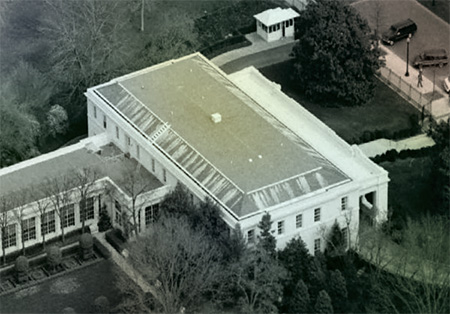
An aerial view of the White House East Wing from the southeast in 1992 provides historical context for the complex now undergoing federal review as modernization plans and a proposed, privately funded ballroom advance through oversight processes.
Courtesy of the Historic American Buildings Survey/National Park Service
This pattern is familiar across federal construction. A privately funded or narrowly authorized project can introduce downstream federal obligations—on circulation, utilities, security interfaces or maintenance—that fall outside the original funding envelope. In practical terms, those obligations can include expanded utility capacity, additional Secret Service staffing, and long-term maintenance of new circulation space—costs that persist well beyond construction. The initial structure remains financed; the secondary effects do not carry an automatic funding source.
The closest analog would be dynamics that have played out at the Smithsonian Institution, where donor-funded museums expanded the federal campus while leaving Congress to absorb long-term operating, security and maintenance costs not part of the original gift.
The Government Accountability Office has repeatedly flagged this mismatch, releasing multiple reports over the past decade warning that donor-driven growth at federal cultural campuses has outstripped allocated funds for operations and maintenance. This creates long-term budget pressures that only become apparent after construction is finished.
The Budget Constraint in the Background
That distinction is sharpened by the scale of the federal budgets associated with the White House. Congress typically appropriates only a few million dollars per year for repair and restoration of the Executive Residence, alongside operating budgets in the mid-teens of millions. Those accounts are structured to sustain existing facilities, not to absorb new programmatic or operational demands introduced by large additions.
The planning process reflects those limits. NCPC has stated it does not review demolition or below-grade work, while CFA’s advisory role excludes funding, operations and system integration. The practical effect is that early submissions document how a project looks and where it sits, but not how it is supported, operated or sustained once built.
Because those bodies do not review funding sources, operations or system integration, the impacts most likely to influence downstream costs—such as expanded circulation, utility capacity, security interfaces and long-term maintenance—do not appear directly in early review materials. Instead, those pressures surface indirectly, through reported cost escalation, conceptual design responses to scale, or the growing functional relationship between new construction and existing federal buildings.
As the project advances toward formal design review, how firmly the boundary between donated construction and federally funded assets is maintained will shape what ultimately moves forward.
That boundary—not unresolved questions about cost or subsurface scope—defines how projects like this are delivered.