

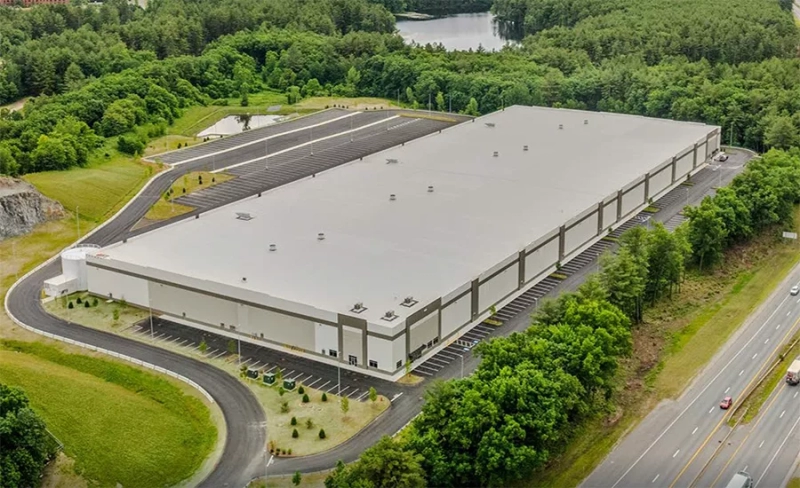
Federal documents outline plans to repurpose a 324,000-sq-ft logistics warehouse, but no permits, contractor or delivery model have been filed locally
A proposal to convert a large logistics warehouse in Merrimack, N.H., into a federal immigration processing center highlights how delivery risks for contractors and designers can emerge well before a project reaches procurement.
Documents released through public-records requests show U.S. Immigration and Customs Enforcement, operating under the U.S. Dept. of Homeland Security, notified state historic preservation officials on Jan. 9 that it was considering plans to “purchase, occupy and rehabilitate” a warehouse property at 50 Robert Milligan Parkway for ICE operations. The correspondence initiated federal review under Section 106 of the National Historic Preservation Act but did not identify a project cost, contractor, designer or construction schedule.
At the municipal level, officials say they have received no formal filings tied to the proposal.
“My office has not received anything at all,” said Casey Wolfe-Smith, Merrimack’s planning and zoning administrator, in a phone interview with ENR. “We don’t have any kind of permit applications. There’s nothing on file—no general contractor or architect attached to this. Absolutely nothing.”
That absence of filings underscores a recurring challenge in federally driven adaptive-reuse projects: federal agencies can begin environmental or historic review while local land-use processes—and the construction teams that rely on them—remain entirely unengaged.
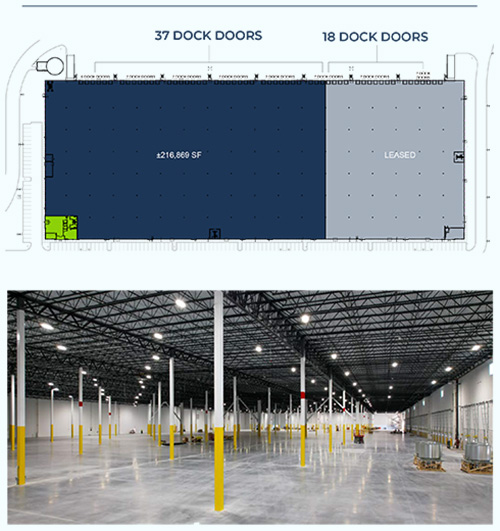
A floor plan and interior view illustrate the scale of the Merrimack, N.H., logistics warehouse, showing extensive dock frontage and a wide-open interior designed for high-volume distribution rather than detention or processing use.
Image courtesy of Cushman & Wakefield
A Class A Logistics Facility
Marketing materials for the site illustrate the scale of the potential conversion. According to a Cushman & Wakefield brochure, the property totals about 324,000 sq ft, including roughly 321,000 sq ft of warehouse space and 3,400 sq ft of office, on a 43-acre site in Merrimack Technology Park. The Class A facility features 36-ft clear heights, 55 tailboard loading docks, two drive-in doors, ESFR sprinklers, a 7-in concrete slab and 6,000 amps of electrical service.
The building was designed for high-volume logistics and advanced manufacturing users, suggesting that any detention or processing use would require extensive interior reconfiguration, a change in occupancy classification, and new security, life-safety and medical infrastructure.
Looking for quick answers on construction and engineering topics?
Try Ask ENR, our new smart AI search tool. Ask ENR →
Homeland Security correspondence outlines a potential scope that could include “interior modifications” for processing and holding areas, administrative offices, bathrooms, cafeterias and health-care spaces, as well as exterior work such as fencing, cameras and access-control features.
The New Hampshire Division of Historical Resources ultimately determined that the proposal would result in “no adverse effect” on historic properties, clearing an early federal review step. That determination, however, does not replace local approvals tied to zoning, building codes, utilities, traffic and emergency services.
RELATED
Dallas Fed Flags Immigration Slowdown Impact on Texas Construction Workforce
Local Opposition and Fiscal Concerns
Merrimack officials have made clear that the town opposes establishment of an ICE facility without local consultation. In a Jan. 23 letter to the Dept. of Homeland Security, the town council warned of fiscal and operational impacts if the federal government acquires the property.
“If the potential non-verified warehouse is purchased by the federal government, there would be a $529,000 decrease in the tax revenue,” the letter states. “This would result in an increase in the tax rate for our citizens.”
The council also cited public safety concerns, writing that “potential difficulties and civil protest would necessitate Police and Fire/Rescue Department services,” creating “potential financial impact upon those departments and their budgets.”
Gov. Kelly Ayotte (D) has publicly urged federal officials to consult with Merrimack leaders, emphasizing that while immigration enforcement is a federal responsibility, the impacts of large facilities are felt locally.
Town officials have said they first learned of the proposal through media reports rather than direct federal outreach, adding to uncertainty around timing and scope. For now, Merrimack continues to treat the site as a vacant warehouse. Wolfe-Smith said there have been no pre-application meetings or informal discussions that would indicate who might deliver the project.
“We have not had any direct contact with DHS,” she said.
RELATED
Court Halts USDOT Plan to Link State Funding to Immigration, DEI Compliance
That lack of engagement leaves contractors and designers with little visibility into procurement timing or delivery structure. Nationally, ICE has been exploring warehouse conversions as part of a broader detention and processing strategy, but formal solicitations tied to specific sites have not yet been issued.
For the construction industry, the Merrimack proposal illustrates how adaptive reuse can speed up federal planning on paper but leave local approvals—and construction risk—unresolved.