

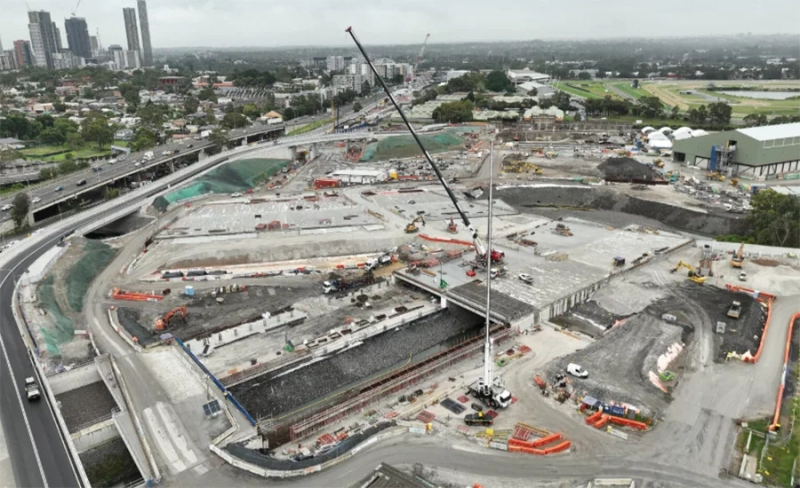
Scope expands work fronts across deep stations, CBD interfaces and rail systems on the 24-km line
Sydney Metro West, an underground rail megaproject valued at roughly $19 billion, moved into a major execution phase at the end of last month after Sydney Metro signed four major contracts for stations, track and systems, trains and long-term operations.
The contract signings on Dec. 29, 2025, mark the project’s transition from predominantly linear tunneling work to station construction, systems installation and long-term operations planning, amplifying construction activity as multiple complex work fronts advance simultaneously.
Construction of the underground network, nearly two decades in the making, finally began in 2022 after years of planning, obtaining required environmental approvals and conducting geotechnical investigations.
Early works and major tunneling packages established the physical backbone of the 24-km subterranean line linking Parramatta—the city’s second-largest commercial center—with Sydney’s central business district (CBD).
Project scope includes twin running tunnels, turnbacks, new underground stations and supporting systems infrastructure, with a targeted opening in 2032, according to documents reviewed by ENR.
RELATED
2025 Global Review +: Shifting Priorities Drive Projects
Under new agreements, John Holland, an Australian contractor, won the Linewide Package worth about $2.2 billion. It includes installing 60 km of track, power, communications, ventilation, fire systems and building a 38-hectare stabling and maintenance facility at Clyde, an industrial rail precinct near Parramatta.
The Stations Package West, valued at about $1.9 billion, was awarded to Gamuda Berhad, a Malaysia-based tunneling and infrastructure contractor, for the design and construction of five new underground stations at Westmead, North Strathfield, Burwood North, Five Dock and The Bays.
Read More
Sydney Metro Annual Report 2024–25
Highlighting the role those stations will play in the broader network, New South Wales Minister for Transport John Graham said, “New interchange links at Westmead and North Strathfield will allow metro passengers to connect directly with Sydney Trains service, strengthening the wider transport network.”
A contract for trains, systems, maintenance and operations worth approximately $2.7 billion was awarded to the Metro Trains West consortium, led by MTR Corp. with CRRC Corp. The 22-year contract covers the procurement and commissioning of the system’s trains, operations and maintenance.
Sydney Metro also appointed the Metropolis consortium—led by Lendlease with Mirvac and Coombes Property Group—as precinct development partner for Hunter Street Station. That package, valued at about $1 billion, includes delivery of the underground station and two over-station commercial developments in the CBD.
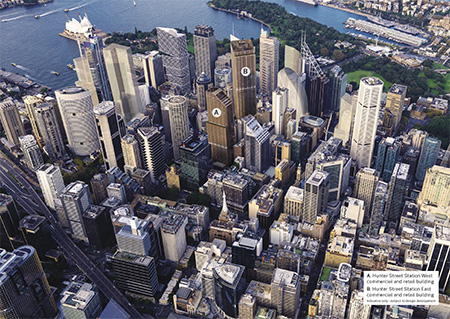
An aerial view of Sydney’s central business district shows the Hunter Street precinct, where Sydney Metro West will deliver a major underground station and over-station commercial development designed to anchor the line’s primary CBD interchange.
Photo courtesy of Sydney Metro West
Hunter Street is planned as the western line’s principal CBD gateway and interchange, providing direct connections to multiple existing Sydney Trains and metro services beneath the city’s busiest commercial district.
Project documents describe the station as a high-capacity node designed to handle peak-hour passenger flows while accommodating turnback operations at the end of the line, a combination that concentrates both operational importance and construction risk within a tightly constrained underground footprint.
Taken together, the four contracts total about $7.6–$7.8 billion, representing the largest single tranche of awards since tunneling began on the project.
Project documents identify Westmead Station—a deep underground stop in a dense medical and education precinct—as representative of the engineering complexity expected across multiple stations.
Crews there recently finished installing what the state described as the largest formwork arch in the Southern Hemisphere—a 69-ft-wide temporary structure supporting cavern excavation—followed by an 82-hour jacking and winching operation and a 1,941-ton concrete pour forming cavern walls up to 8-ft thick, one indication of how construction intensity is increasing as station works advance.
Ground Conditions Shape Delivery Strategy
Environmental approvals and hydrogeology assessments show that Sydney Metro West is being shaped as much by subsurface conditions as by alignment geometry. The corridor is dominated by Ashfield Shale, with deeper sections of Hawkesbury Sandstone and localized zones of alluvium and disturbed fill near river crossings and former industrial land.
Read More
The Bays and Sydney CBD | Hydrogeology Report
Groundwater is shallow along much of the alignment, with regulatory approvals requiring active dewatering and continuous monitoring tied to trigger thresholds for ground movement. In some locations, station caverns are expected to remain open for up to two years, increasing reliance on staged excavation, temporary ground-support systems and real-time instrumentation.
Those constraints are most acute at Hunter Street, where station and turnback caverns are planned beneath dense high-rise development and near existing underground rail assets. Planning documents highlight tight clearances and conservative movement limits, requiring carefully sequenced excavation and continuous monitoring to protect adjacent structures.
RELATED
Bangkok Sinkhole Forces Halt of $2.2B Subway Extension
Construction Outlook
Sydney Metro has said tunneling across the corridor is targeted for completion in 2026, with station construction, tunnel fit-out and systems installation accelerating from 2027 as the newly signed contracts progress. Additional station contracts for Parramatta, Sydney Olympic Park and Pyrmont are expected to be announced later this year.
With delivery contracts formally executed and technically demanding underground work expanding, Sydney Metro West ranks among the world’s largest active publicly funded urban rail projects. For contractors and engineers, the project illustrates how geology, groundwater management and dense urban interfaces increasingly define delivery risk as megaprojects’ transition into station construction, systems integration and long-term operations.
Sydney Metro Chief Executive Peter Regan said the contract signings position the program for a sustained surge in activity, adding, “With these landmark signings in place, Sydney Metro West is set for a busy and exciting 2026.”