

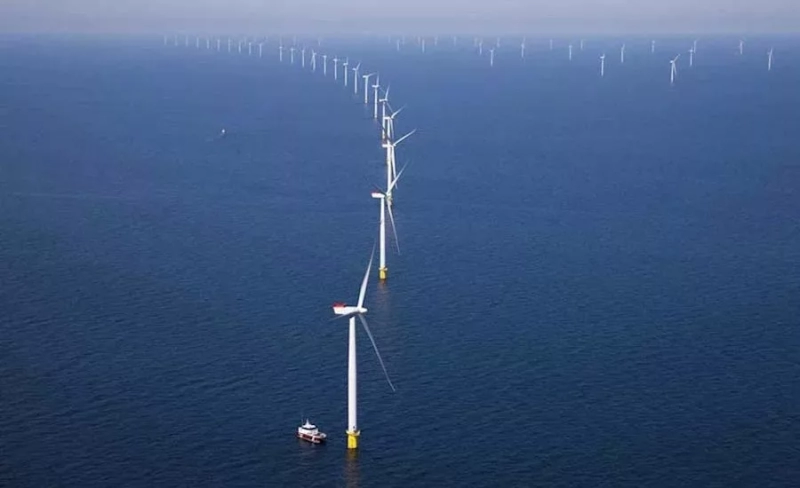
French energy developer TotalEnergies confirmed March 23 it will accept an offer by the Trump administration to scrap plans to build offshore wind energy projects in long contracted lease sites off New York and North Carolina in exchange for a $928-million payoff by the Trump administration to cover development costs.
TotalEnergies said it agreed to a “settlement” with the U.S. Interior Dept. that will cancel its $795-million lease for the firm’s proposed 3-GW Attentive Energy offshore project in the New York Bight ocean area between New York and New Jersey, and the $130-million Carolina Long Bay project lease, both awarded at auctions held in 2022 by the Biden administration.
But according to some observers, TotalEnergy will gain back investment it could have ultimately lost with the high fees of that New York auction likely causing Attentive Energy’s overall development cost and power price to be non-competitive.
The offer had been pre-reported by The New York Times last week, ENR previously noted.
The New York lease sale generated $4.37 billion in winning bids for six sites totaling 488,000 acres. The department called it at the time “the highest-grossing competitive offshore energy lease sale in U.S. history, including oil and gas leases.” TotalEnergies subsequently sold a 44% stake in Attentive Energy to Corio Generation and electricity producer Rise Light & Power for $420 million.
The projects were set to begin generating power in the early 2030s, but had been paused in November 2024 by TotalEnergies CEO Patrick Pouyanné after Donald Trump’s election. The CEO said at the time that the projects could be built under a new president.
In his statement reversing course, however, Pouyanné said the firm has “decided to renounce offshore wind development in the United States, in exchange for the reimbursement of the lease fees,” claiming that “other technologies are available to meet the growing demand for electricity in the United States in a more affordable way.”
Looking for quick answers on construction and engineering topics?
Try Ask ENR, our new smart AI search tool. Ask ENR →
Under the deal, TotalEnergies “will invest an equal amount” to develop natural gas export and power production capacity in the U.S., including financing construction of four trains at the estimated 29-million-tonne-per-year Rio Grande LNG export plant in Brownsville, Texas, and other not specified oil and gas projects.
«Following [its] new investment, the United States will reimburse the company dollar-for-dollar, up to the amount … paid in lease purchases for offshore wind,» said the Interior announcement.
The Texas export terminal is set to supply Europe «with much-needed LNG providing gas for data centers,” Pouyanné said, claiming the investment is «a more efficient use of capital» in the U.S. But the firm’s shift does not affect its commitment to wind power in other countries, he told media March 23 at the CeraWeek by S&P Global energy conference in Houston.
Some energy analysts were skeptical. «You removed a planned large energy production facility that would solely have produced electricity fed into the American grid, and instead you’re going to build a liquefaction terminal that will take American natural gas and send it abroad,” Seth Kaplan, vice president of energy market consultant Grid Strategies told online publication E and E News. “Do the math on that.”
The buyout is a new administration strategy against offshore wind development, after its late December work shutdown orders against five large east coast projects—two in New York, two in New England and one in Virginia—were all revoked by federal courts in four succeeding weeks as «arbitrary and capricious.» Three of the projects also announced construction completion or major power generation milestones, with energy capacity equal to natural gas plants, some said.
“Using a pay-not-to-play scheme to pressure a company to not build offshore wind is an outrageous abuse of taxpayer dollars,” New York Gov. Kathy Hochul (D) said. “I remain committed to moving forward with my all-of-the-above approach that includes renewables, nuclear and other energy sources needed to keep the lights on and costs down.” Nicole Malliotakis, a Republican House member in New York, agreed, saying the agreement «sounds like a colossal waste of taxpayer money.»
Senate Environment and Public Works Committee ranking Democrat Sheldon Whitehouse labeled the deal a «crappy transaction,» but said bipartisan negotiations to develop project permit reform legislation would continue unless «stupid stuff like that continues to pile up.»
U.S. offshore wind energy advocacy group Oceantic Network termed the buyout “political theater meant to obscure the fact that offshore wind capacity is being pulled out of the pipeline when energy prices are skyrocketing. Winter Storm Fern showed how offshore wind helped keep the lights on and rates down for millions in the Northeast.”
It added that “offshore wind’s long-term trajectory remains secure in the U.S. as states continue to make the power source a foundational part of their energy mixture.”
The administration did not disclose further information on whether other wind lease holders have been offered similar buyouts.