

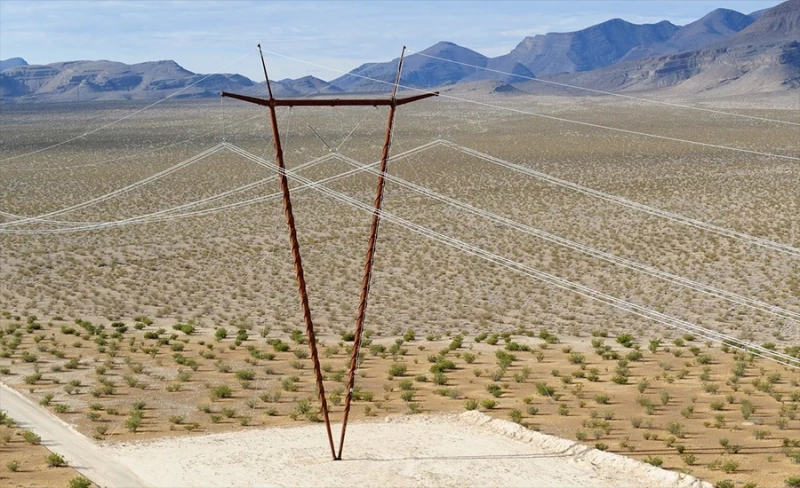
LS Power’s 285-mile SWIP-North advances after financing and capacity arrangements evolved over decades
LS Power has started construction on a 285-mile, 500-kV transmission line between Idaho and Nevada, advancing a $1-billion-plus project that has spent decades in development while its financing structure and expected uses have evolved.
Great Basin Transmission LLC—an affiliate of LS Power—marked the project’s construction start Sept. 3 with a groundbreaking in Ely, Nev., for the Southwest Intertie Project-North, or SWIP-North, which will fill the missing link in a high-voltage corridor stretching from Idaho’s Magic Valley to the Las Vegas area.
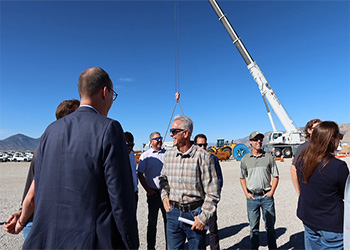
Nevada Gov. Joe Lombardo joined project officials Sept. 3 in Ely, Nev., for the SWIP-North formal groundbreaking on the 285-mile transmission line.
Photo courtesy Nevada Gov. Joe Lombardo via X
Combined with two existing transmission lines through Nevada, the completed 576-mile corridor will be able to move 2,000 MW in either direction. That bidirectional capacity has become central to the project’s value as California and Idaho pursue distinctly different uses for it.
California grid planners advanced SWIP-North primarily to gain access to Idaho wind generation moving south. Idaho Power, by contrast, is securing 500 MW moving north from Desert Southwest markets to help meet growing power demand.
The corridor was first conceived in the 1980s, according to LS Power, which acquired development rights in 2005. Federal authorization dates to 1994, although the northern segment remained unbuilt.
California’s Stake in the Line
ENR reported in May 2024 that the U.S. Energy Dept. had committed up to $331 million to help advance the roughly $1-billion project, then expected to start construction in 2025 and finish in 2027. The federal capacity agreement provided a temporary backstop while Idaho Power pursued participation.
By November 2024, the California Independent System Operator (CAISO), California’s grid operator, put the project’s capital cost at $1.23 billion, excluding construction financing costs. About $950 million was associated with the share allocated to its ratepayers.
Looking for quick answers on construction and engineering topics?
Try Ask ENR, our new smart AI search tool. Ask ENR →
Read More
CAISO Development Agreement:
SWIP-North Transmission Project
California’s stake grew largely from state plans for about 1,000 MW of Idaho wind. Grid studies identified broader benefits, including reduced congestion on the California-Oregon Intertie and a route for excess California solar power to move north. CAISO called SWIP-North the “only active transmission solution” providing the state direct access to Idaho wind. The Federal Energy Regulatory Commission accepted the CAISO-Great Basin development agreement in January 2025, finding its voluntary cost-sharing arrangement just and reasonable and roughly commensurate with expected California ratepayer benefits.
Idaho Power reached agreements with Great Basin the following month for 500 MW moving in the opposite direction—north from Desert Southwest markets. The utility will own an interest carrying 250 MW and hold rights to another 250 MW for 40 years.
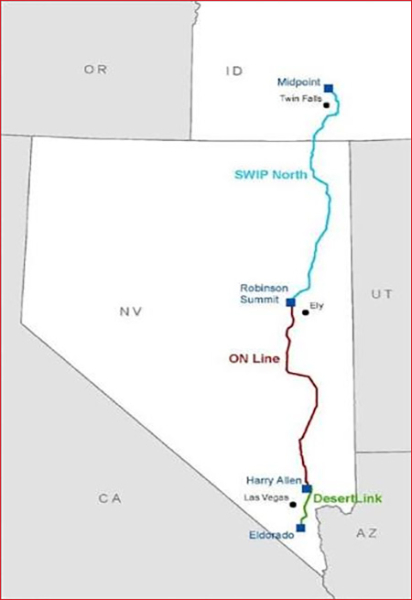
SWIP-North will connect Idaho’s Midpoint substation to Robinson Summit near Ely, Nev., completing a transmission corridor through Nevada to the Las Vegas area and California ISO system.
Map courtesy LS Power
“SWIP-North will help Idaho Power meet growing energy demands and reduce costs for our customers by connecting Idaho Power to the Desert Southwest’s low-cost energy resources,” Mitch Colburn, utility vice president of planning, engineering and construction, said in a statement.
Idaho regulators approved the arrangement in December 2025. Without SWIP-North, commission staff projected Idaho Power would face capacity deficits of 154 MW in 2028 and 384 MW in 2029 and characterized the northbound capacity as a least-cost, least-risk option.
The Idaho Public Utilities Commission did not approve recovery of project costs, however, reserving any prudence determination for a future rate proceeding.
The proceeding drew opposition from residents concerned about California market integration and renewable-energy development. Stop Lava Ridge argued that new Idaho wind projects were unlikely to materialize, while Idaho Power said SWIP-North is a transmission-only project independent of the Lava Ridge wind project, which the Trump administration’s U.S. Interior Dept. canceled last year despite being scaled down to 1 GW and 241 turbines.
Nevada regulators also approved grid construction in January 2026. By March, California ISO said the project had secured 99% of its right-of-way and remained on track for operation in June 2028.
Construction Moves Ahead
Great Basin had much of the project engineering and procurement underway before work began. POWER Engineers, now a unit of WSP Global, is engineer of record and had completed at least 75% of design by late 2024. The transmission-line construction agreement uses fixed lump-sum pricing for the majority of its scope and includes liquidated damages tied to schedule milestones.
The work extends beyond the 285-mile line: expansions at the Midpoint and Robinson Summit substations and new series-compensation equipment on SWIP-North and the existing One Nevada line, which operate within NV Energy’s system.
The electrical workers union Local 1245 reported in January 2025 that Wilson Construction had been awarded the SWIP-North line work. The union said in August that Summit had begun foundation work while Wilson prepared to start line construction.