

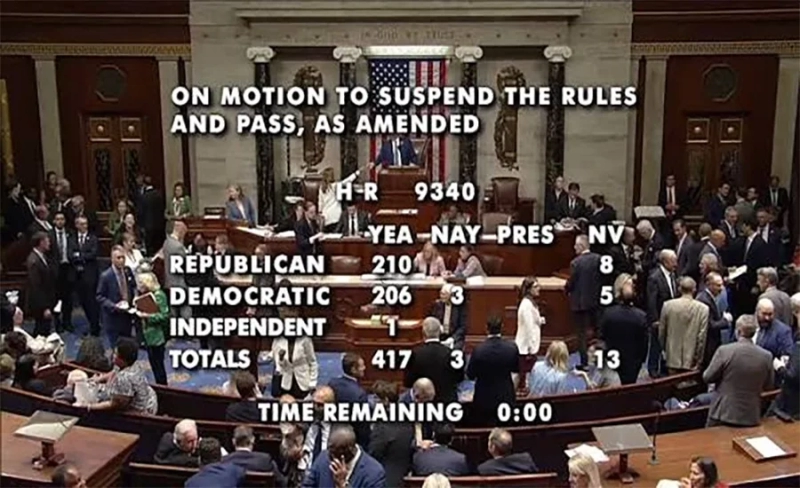
The House on Sept. 16 overwhelmingly backed a federal standard requiring the largest U.S. data centers to pay for the power infrastructure built to serve them, advancing an approach already emerging in state utility regulation.
H.R. 9340, known as the Ratepayer Protection Act, passed 417-3 but stalled in the Senate the next day amid disagreement over whether states should merely consider the proposed standard or large-load customers should face a direct federal requirement to pay certain grid costs.
Covering data center campuses with peak demand of at least 100 MW, the House bill says rates should recover from those customers the “full, incremental cost” of generation, transmission and distribution upgrades needed to serve them, including costs remaining if they stop buying power. Customers also would provide financial assurances or contributions before utilities undertake the upgrades.
Read More
H.R. 9340Ratepayer Protection Act
The House approach leaves state regulators with the ultimate rate decision. House Energy and Commerce Committee Chairman Brett Guthrie (R-Ky.) said in prepared floor remarks that the bill is intended to protect customers from infrastructure costs needed for AI development “while protecting existing state authorities.”
Sen. Martin Heinrich (D-N.M.) blocked Sen. Jon Husted’s (R-Ohio) unanimous-consent request to advance H.R. 9340 on Sept. 17. “It’s not enough for us to just tell states to consider making data centers pay for grid upgrades,” Heinrich said on the Senate floor. Heinrich instead sought passage of his GRID Savings Act, which would directly require large-load customers to cover certain grid-connection costs. Sen. Bernie Moreno (R-Ohio) objected to Heinrich’s request.
Utilities can face generation and grid investments years before knowing whether enormous new loads will arrive as forecast.
Utilities Put More Risk on Large Loads
An August Lawrence Berkeley National Laboratory study found that utilities and regulators are developing large-load tariffs and special contracts to manage risks, including insufficient power supply and underused infrastructure.
Looking for quick answers on construction and engineering topics?
Try Ask ENR, our new smart AI search tool. Ask ENR →
Minimum-demand provisions are increasingly common among the tariffs Berkeley Lab reviewed, with a median requirement equal to 80% of contracted demand regardless of actual usage. Dominion Energy Virginia’s Schedule GS-5 sets minimum billing at 85% of contracted transmission and distribution demand and 60% of generation demand.
Other approaches tie customers directly to infrastructure costs. Pennsylvania regulators recommended recovering all interconnection costs, including network transmission upgrades that otherwise would not be built. A proposed Minnesota Power agreement would make Google responsible for early development costs associated with new generation and related infrastructure, along with transmission upgrades needed for its data center.
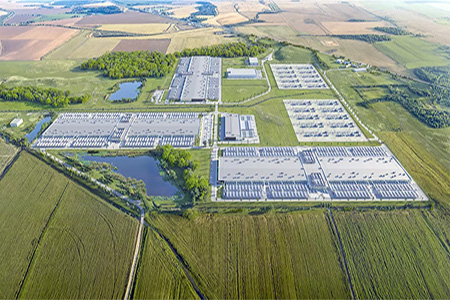
A rendering shows the planned 1,383-MW data center in Saline Township, Mich., where DTE Electric contracts include long-term payment protections and customer-funded energy storage.
Rendering courtesy Related Digital
One project ENR has been tracking shows how those protections can translate into actual infrastructure commitments. In December 2025, the Michigan Public Service Commission conditionally approved DTE Electric Co. contracts to serve a planned 1,383-MW data center in Saline Township for Green Chile Ventures LLC, an Oracle Corp. subsidiary.
The primary agreement runs 19 years and requires payment for at least 80% of contracted demand. If the facility stops operating early, Green Chile could owe as much as 10 years of minimum billing demand.
MPSC Chair Dan Scripps said in a statement at the time that the provisions offered “strong protections for ratepayers against the risk of stranded costs and cost subsidization.”
The project’s construction commitment extends beyond its electricity purchases. Green Chile would bear the costs over 15 years for DTE to develop, own and operate 1,383 MW of energy storage matching the data center’s contracted demand. The storage agreement also contains early-termination, credit and collateral requirements.
Courts are weighing whether those safeguards adequately protect other customers. Michigan Attorney General Dana Nessel argued in an August appellate brief that DTE sought approval for billions of dollars in infrastructure investment without adequately establishing that the resulting costs would not reach other customers. She also challenged the commission’s decision to approve the contracts without a contested proceeding.
The MPSC had conditioned approval on DTE’s representations that Green Chile’s payments would cover the costs of serving it so those costs would not be borne by other customers. DTE subsequently accepted the conditions.
From Financial Commitment to Construction
Recent ENR reporting on the power construction pipeline found data centers were both the biggest driver of MSI Economics’ electricity-demand growth forecast and its biggest uncertainty.
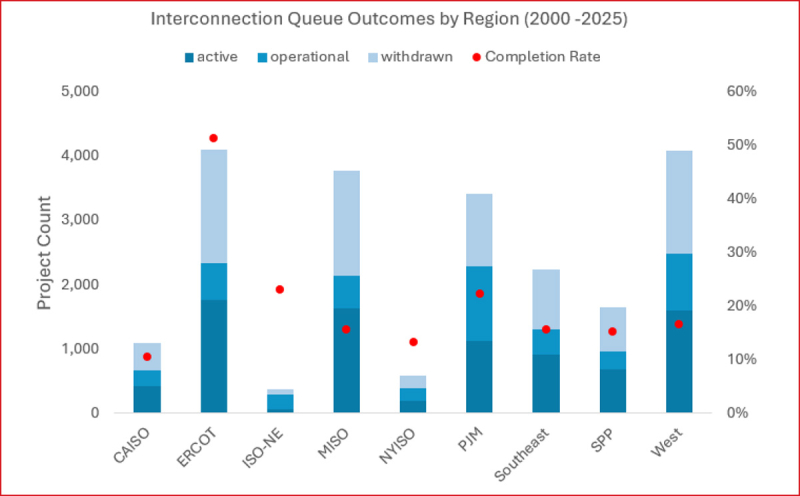
Interconnection queues show a wide gap between proposed and completed power projects across U.S. regions. MSI Economics uses queue status as one criterion for distinguishing announced capacity from projects positioned to reach construction. Click on image to enlarge.
Courtesy MSI Economics/MOCA Systems Inc.
Of 12 GW to 16 GW of data-center-related capacity projected for 2026 delivery, MSI found only about 5 GW actually under construction. Its model looked for an advanced interconnection position, an executed interconnection agreement, reserved long-lead equipment and committed financing to distinguish executable projects from announcements.
“You can build the whole project and then have it sitting at risk until those transformers, until those switch gears are available,” MSI Chief Economist Brandon Michalski said in a Sept. 14 interview with ENR.
Associated General Contractors of America Chief Economist Ken Simonson separately told ENR he saw “significant constraints in the supply of natural gas turbines and custom transformers,” citing limited production capacity and supplies of grain-oriented electrical steel as well as “fierce competition for skilled electricians” among data centers, semiconductor plants, LNG facilities and power projects.