

Federal design commissioners declined to advance review, indicating early scrutiny amid an active court challenge questioning project sequencing and oversight
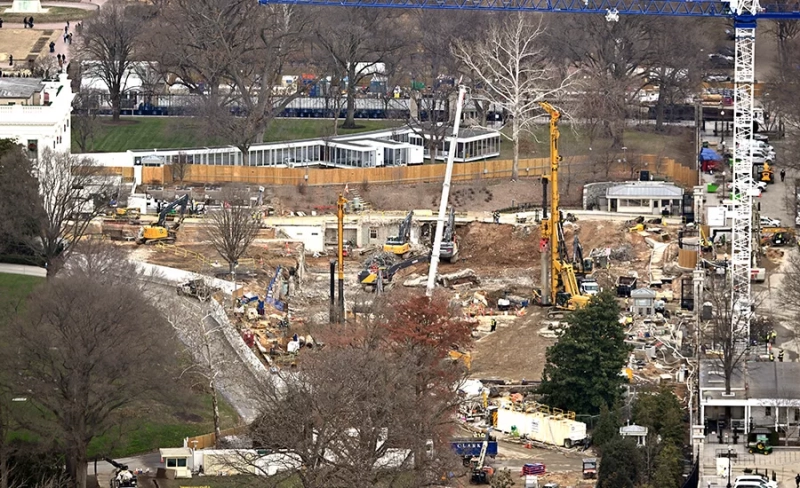
Federal design commissioners on Jan. 22 declined to advance the proposed White House ballroom, requesting physical models and additional materials, indicating the project remains stuck in an early stage of the federal approval process despite demolition being completed and underground work proceeding.
The U.S. Commission of Fine Arts, responsible for reviewing design proposals for Washington, D.C., structures, held a discussion on the proposal, but did not vote or offer recommendations. Commissioners raised questions about scale, massing and how the addition would integrate into the White House campus, the Associated Press reported. Commissioners asked project representatives to return with physical or three-dimensional models before further evaluation.
RELATED
Court Filings Push White House Ballroom Project Into New Phase
The meeting also marked the commission’s first review of the ballroom since President Donald Trump dismissed all six sitting commissioners on Oct. 27, 2025, effectively disabling the body for months by depriving it of a quorum. On Jan. 16, Trump quietly appointed four new members—just enough to reconstitute the panel of seven and convene the session.
The Associated Press reported commissioners also noted public comments submitted ahead of the meeting were largely critical, reflecting concerns about both the design and the process by which the project has advanced.
In large-scale design review—particularly for prominent public projects—a request for physical or three-dimensional models typically signals that reviewers are still assessing fundamental questions of scale and context rather than refining architectural details. Procedurally, it places the ballroom at an early stage in the approval pipeline, even though site work has already moved forward.
The Lawsuit
National Trust for Historic Preservation in the United States
v.
Donald J. Trump, in his official capacity as President of the United States, et al
The design discussion unfolded alongside parallel legal scrutiny that could affect construction sequencing. Later the same day, a federal judge heard arguments in a lawsuit filed by the National Trust for Historic Preservation seeking to pause further work while required federal review processes are completed. Reuters reported that the court questioned whether demolition and early activity moved ahead of statutory approvals, but did not issue a ruling or indicate when a decision would be forthcoming.
Administration officials have repeatedly described the ballroom as privately funded. However, Thursday’s developments reinforced that projects on federally controlled property remain subject to federal design and preservation oversight regardless of funding source.
From a construction standpoint, timing is the central risk. Advancing demolition or enabling work before approvals are secured can expose projects to redesign requirements, schedule delays or additional federal obligations if oversight bodies later require changes.
The Commission of Fine Arts serves an advisory role in reviewing projects that affect the appearance of federal buildings and monumental spaces in Washington, D.C. Its recommendations are part of a broader approval framework that typically includes the National Capital Planning Commission and, for historic resources, consultation under federal preservation law.
RELATED
Private Funding May Deliver Trump’s White House Ballroom—but What Pays for the Rest?
No timeline was reported for when revised materials would be submitted or when the commission might revisit the ballroom proposal. The court likewise did not set a schedule for a ruling following the injunction hearing.
As a result, the project now sits in an unusual posture: demolition completed, formal design review still preliminary and litigation unresolved—conditions that could shape the timing and scope of the next construction phases.