

A federal judge on Feb. 26 denied preservationists’ request to halt construction of President Donald Trump’s planned White House State Ballroom, allowing excavation and foundation work to continue as the project approaches a March 5 vote by the National Capital Planning Commission.
In a 22-page memorandum opinion, U.S. District Judge Richard J. Leon ruled that the National Trust for Historic Preservation failed to bring the proper legal claim to test whether the president exceeded statutory authority in advancing the $400-million project without additional congressional approval. “Until then, however, I have no choice but to deny Plaintiff’s motion for a preliminary injunction for lack of likelihood of success on the merits,” Leon wrote.
A separate order formally denied the preliminary injunction and related stay motions.
Read More: Judicial Opinion
National Trust for Historic Preservation in the United States v. National Park Service, et al.
Demolition of the former East Wing was completed last fall, and the site has shifted to heavy civil and structural work. The roughly 90,000-sq-ft ballroom, funded primarily by private donors, was announced July 31, 2025.
Court filings described excavation underway, followed by footings and structural concrete. Satellite imagery ENR reviewed Feb. 18 showed no above-grade construction, consistent with the administration’s position that National Capital Planning Commission jurisdiction attaches at “vertical build.”
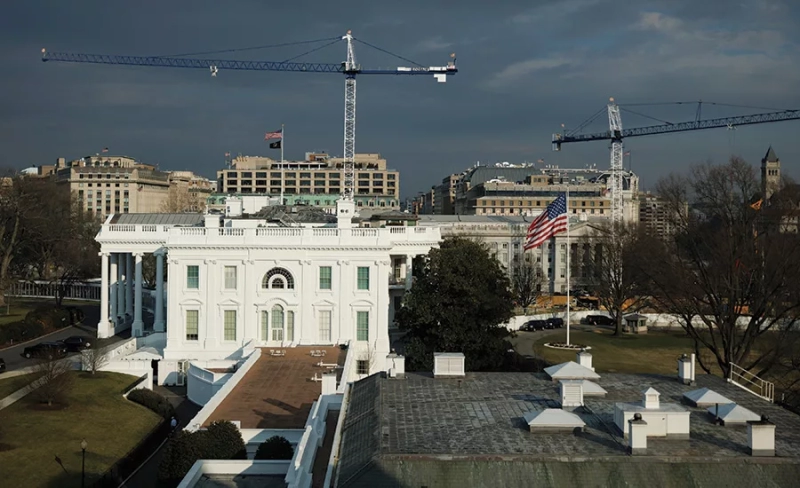
The White House has already positioned heavy equipment and a crane on site, according to the court’s factual background notes.
The legal dispute focuses on whether current federal law allows the president to alter the White House complex without additional congressional approval. The administration claims that laws related to funding and managing the Executive Residence permit the project with existing funds and private donations. The plaintiffs argue that federal law explicitly requires congressional approval before starting new construction on public grounds in Washington.
Looking for quick answers on construction and engineering topics?
Try Ask ENR, our new smart AI search tool. Ask ENR →
RELATED
White House Ballroom Project Heads to Vote by National Capital Planning Commission
Leon rejected the plaintiffs’ Administrative Procedure Act claims as argued, stating that the Office of the Executive Residence, which is directing the project, is likely not an “agency” subject to APA review.
But the opinion stops short of endorsing the administration’s position. Leon wrote that if the National Trust amends its complaint to assert that the president acted beyond his statutory authority—the court would “expeditiously consider it.”
Read More
Judicial Order Denying Plaintiff’s Injunction Request
The ruling removes the immediate risk of an emergency halt but leaves open a path for renewed judicial scrutiny as the project nears a federal planning threshold.
The U.S. Commission of Fine Arts granted concept-level approval Feb. 19, addressing height, massing and architectural compatibility. Final authorization for above-grade construction rests with the National Capital Planning Commission, scheduled to vote March 5.
With the injunction denied, below-grade construction may proceed while litigation continues. Whether vertical work advances on schedule now turns on two parallel tracks: the outcome of the upcoming NCPC vote and whether plaintiffs recast their claims to squarely challenge the project’s statutory footing.