

Systems overhaul targeting HVAC, structural and life-safety deficiencies advances as legal, funding and oversight questions intensify
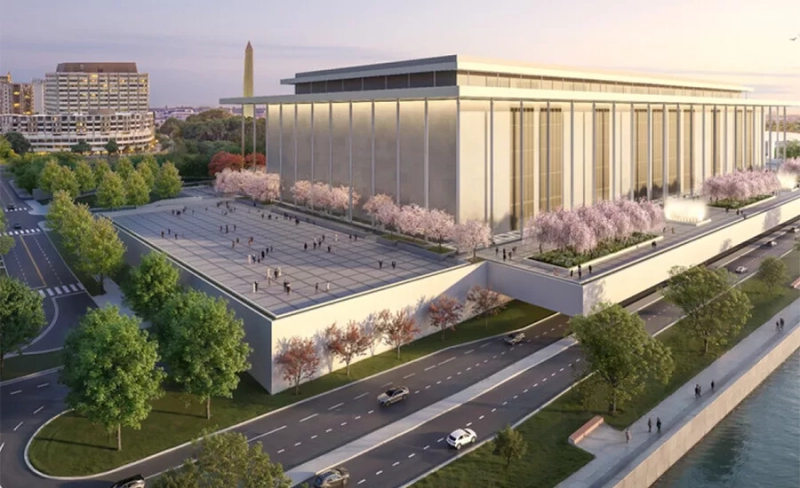
The Kennedy Center board of trustees on March 16 unanimously approved a $257-million overhaul that will shutter the 1971 Washington performing arts facility for roughly two years, advancing a full systems overhaul as litigation and funding questions intensify.
The vote, taken at a White House board meeting, clears the way for the center to close following a July 4 celebration. The decision formalizes President Donald Trump’s Feb. 1 Truth Social announcement describing the project as “Construction, Revitalization, and Complete Rebuilding” and stating financing was “completed, and fully in place.” ENR previously reported on the administration’s broader renovation plans for the facility.
RELATED
Trump Announces Sweeping Kennedy Center Renovation Plan
Framing the decision as driven by construction realities, Trump said during the March 16 meeting broadcast on C-SPAN that “the place is falling down,” adding that “air conditioning, heating is going to be ripped out in its entirety and it needs new.”
Trump said the project would draw from the House reconciliation package, which includes $256.7 million for the Kennedy Center, most of it earmarked for capital repair and restoration.
Project descriptions and public statements, including remarks during the March 16 board meeting, cite deficiencies across HVAC and chilled water systems, electrical infrastructure, structural elements, service tunnels, waterproofing and life-safety systems.
Engineering Scope Meets Political Scrutiny
The project’s engineering-focused scope conflicts with a broader political narrative that views it as a major transformative reform. Trump has described the effort as creating “the finest performing arts facility of its kind anywhere in the world.”
Read More
H.R. 4754 | Appropriations for the Department of the Interior
Congressional criticism has focused on whether the underlying work justifies the scale of intervention. In floor remarks entered into the Congressional Record on Feb. 4, Rep. Chellie Pingree (D-Maine) raised concerns about the lack of consultation with Congress and whether available budget documents support a two-year closure.
Looking for quick answers on construction and engineering topics?
Try Ask ENR, our new smart AI search tool. Ask ENR →
The funding structure has also further intensified scrutiny. Congressional correspondence has questioned how the $257-million allocation—originally tied to capital repair and restoration—would be applied to a project of this scale, highlighting a gap between documented repair needs and the larger funding package.
RELATED
White House Ballroom Project Heads to Vote by National Capital Planning Commission
Litigation and Authority Questions
The project also faces active litigation. Rep. Joyce Beatty (D-Ohio), an ex officio board member, sued Trump and other defendants in December 2025 and amended the complaint earlier this month to challenge the project and closure.
Filed in the U.S. District Court for the District of Columbia as Beatty v. Trump et al., the case is before Judge Christopher R. Cooper. The amended complaint characterizes the project as “the ongoing desecration and impending destruction of a cherished national monument” and argues that “only Congress may authorize the kind of demolition and rebuilding” at issue.
Read More
Beatty v Trump | Memorandum Opinion and Order
On March 14, Cooper granted in part and denied in part Beatty’s request for a temporary restraining order, requiring advance documentation of the closure and an opportunity for her to address the board, while denying her request to vote. A broader preliminary injunction request that could halt the closure remains pending.
Beatty told reporters after the March 16 meeting that the renovation decision was “unlawful,” arguing that “there was no due process of going through anything with the United States Congress, which by law they must do,” according to media reports.
Taken together, the scope indicates an intervention nearing a complete building-system replacement rather than individual repairs. Mechanical, electrical and life-safety upgrades of this scale require building-wide access, while structural, waterproofing and subsurface tunnel work complicate sequencing.
For contractors, that combination blurs the line between renovation and reconstruction in a high-visibility federal facility. Similar full shutdowns are uncommon in performing arts venues, where phased construction is typically used to maintain programming and revenue.
Trump said the closure “will enable us to complete the work much faster and of a much higher quality,” citing the difficulty of installing finishes and seating during active operations.
The board named Matt Floca as chief operating officer and executive director to lead the effort following the vote.
RELATED
Private Funding May Deliver Trump’s White House Ballroom—but What Pays for the Rest?
Federal Review and Delivery Uncertainty
Beyond construction logistics, the project is expected to undergo multiple layers of federal review that could influence its scope and schedule.
As a federally funded undertaking involving a congressionally established institution, the project is likely to trigger Section 106 review under the National Historic Preservation Act, along with oversight by the National Capital Planning Commission and the U.S. Commission of Fine Arts.
The interplay between those requirements, an accelerated timeline and active litigation could become a defining constraint. Projects involving multi-system replacement and federal review rarely proceed without schedule adjustments.
Despite the board’s approval, detailed project documentation—including engineering assessments, scope definitions and sequencing plans—has not been publicly released. Federal projects of this type are typically delivered through design-bid-build, though no procurement approach has been confirmed.
The absence of a defined delivery strategy leaves uncertainty around contractor engagement and risk allocation. Trump said at the March 16 meeting that some materials, including seating and marble, had already been purchased.
Whether the two-year timeline holds will depend on how project leaders align scope, funding intent and regulatory requirements as the effort moves into procurement and execution.