

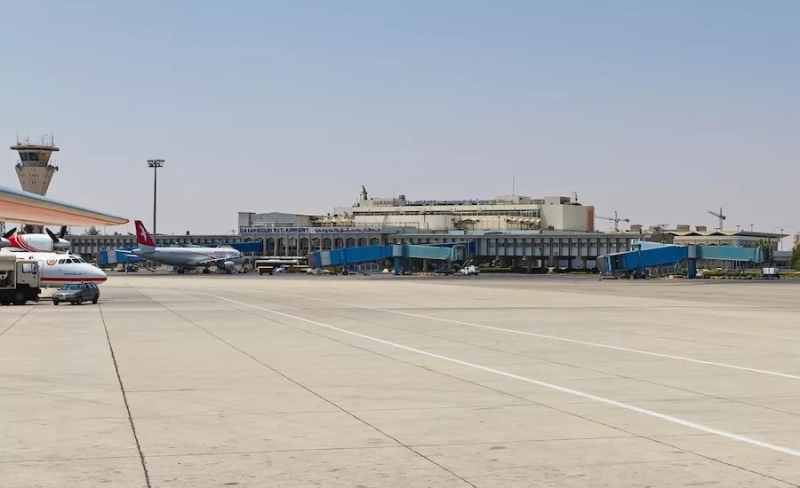
Masterplan by Zaha Hadid Architects will significantly expand facility capacity and amenities
In a move to bring much needed investment to Syria, the General Authority of Civil Aviation has signed a $4-billion contract with a Qatar-led consortium to reconstruct and refurbish Damascus International Airport, including a new five-star hotel.
Qatar’s UCC Holding leads the consortium that includes subsidiary Urbacon Concessions Investment, New York City-based Assets Investments USA LLC and Turkish construction companies Cengiz Insaat Sanayi ve Ticaret AS and Kalyon Insaat Sanayi ve Ticaret AS. The contract is a long-term build-own-operate agreement to rebuild and expand the airport and facilities through multiple phases that will ultimately serve 31 million passengers a year, according to a statement released by UCC Holding. The masterplan for the airport, including terminals, runways, hangers and hotel, was drawn up by London-based Zaha Hadid Architects.
The airport contract follows a recent agreement between the Syrian government and UCC Holding enabling Urbacon Holding to build and operate eight power generation stations throughout Syria with a total capacity of 5,000 MW.
Work on Terminal 2 and the five-star airport hotel are already underway, according to UCC. The refurbished modern airport will have a significant impact on Syria’s struggling efforts to rebuild its economy and set the war-ravaged country among the international community. its developers say.
It has been only one year since Bashir al-Assad was overthrown as dictator of Syria and the Islamist militant group Hayat Tahrir al-Sham, once allied with Al Qaeda, seized the capitol of Damascus and declared a transitional government. The new regime’s efforts have led to the easing of sanctions by the U.S., the EU and the UK, and widening, if cautious, international support for economic development.
Within that time, the new interim President, Ahmad al-Sharaa, has promised to implement political and economic reforms. Although some rebel groups continue to fight with each other, the new government and the Israel Defense Forces, some political and economic progress has been made toward rebuilding a country destroyed by 13 years of civil war. Syria faces enormous challenges, but is receiving international help.
Assad’s ouster led to the reentry of Syria to the Arab fold and pledges by other nations to support the new government and provide money for investment and infrastructure. In recent months Syria has signed paperwork pertaining to at least 12 investment agreements worth $14 billion for infrastructure projects.
Signing the contracts for a new airport “constitutes a strategic step toward rebuilding Syria’s air gateway, strengthening the national economy and opening new investment and employment opportunities,” said Omar al-Hosari, new civil aviation authority head, said. He is the founder and CEO of Dubai-based UAS Trip Support. Hosari said on X that he would work to make aviation a strategic sector that would serve as Syria’s gateway to the world.
A Long Overdue Expansion
The $40 billion airport price tag is the largest investment that Syria has ever seen. The facility will have a world-class architectural design that reflects the distinctive identity and spirit of Damascus, officials said, Spain-based HESCO Hammada Engineering Services will provide detailed design and rehabilitation for Terminals 1 and 2, as well as design for Terminal 3 and its facilities.
The masterplan calls for a renewed passenger terminal at Terminal 2 to be in operation by mid-2026. Terminal 1 is scheduled to be redesigned with updated interior and service facilities and operate by the end of 2026. These will boost airport initial capacity to 6 million people annually. The completion of phase one of Terminal 3 will increase the airport’s yearly capacity to 16 million people, although this phase is expected to take several years to complete.
Terminal 3 will incorporate advanced operation facilities including 32 gates with modern boarding bridges and a duty-free zone. Upon completion, 31 million people will be able to use the airport over the course of a year. The airport project is expected to create more than 90,000 direct and indirect job opportunities across various stages of construction and development.
The project also includes a $250 million financing program for new aircraft.
Several other companies will also take part in the project including Dar al-Handasah of Lebanon which is providing project management services, design review, site supervision and schedule verification. DG Jones and Partners, also based in Lebanon, is providing contract management, cost control and quantity surveying.
A statement issued by legal advisor White & Case on Dec. 4 called the project an ‘impactful investment in Syria.” Charbel Abou Charaf, leader of the negotiating team, said the contract “highlights the focus of foreign investors on Syria, this time in a sector which is vital for regional and international connectivity.” White & Case said the deal’s structure required development of a multi-phase concession framework,