

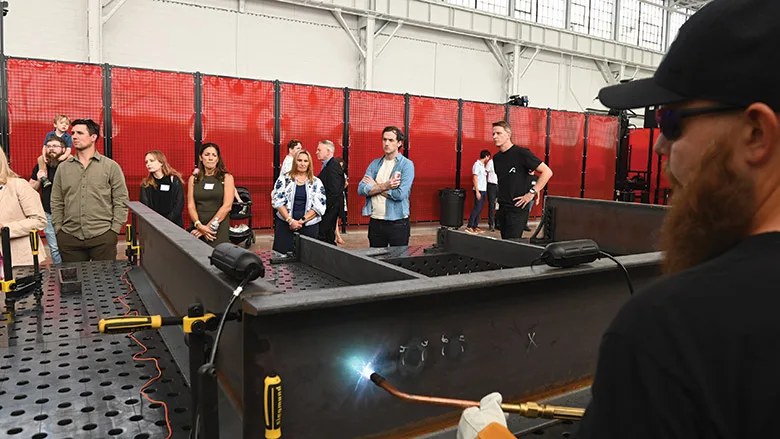
Startup steel fabricator 1872 opened its first facility in Cincinnati last month, with an eye on how automation can augment skilled welders’ workflows.
Founded by three engineers with backgrounds at GE Aviation and SpaceX, 1872 is creating what it calls AI-native manufacturing. It has secured a $15-million seed funding round, one of the largest in Ohio history, through private funds advised by the Ohio High-Growth Investment Opportunities (O.H.I.O.) Fund. Working from a former stone masonry building in Camp Washington, the startup’s proprietary system integrates AI spacial awareness software with automated robots from firms, including Path Robotics.
“The idea really came from one of my partners here, Mark Kwame, who made the investment in Path Robotics at his last fund, and he and the founders had always talked about staring a ground-up, greenfield steel fab company focused on automation,” says Mike Venerable, O.H.I.O. Fund founding partner. “There’s an incredible amount of demand for industrial fabrication, it is multi-dimensional in its growth across the country, and I would say capacity is saturated,” he adds. “Nothing is going to fill the gap in labor. That’s going to continue, and welders are critical to what we do anyway.” The firm’s name is a reference to the year industrialist Andrew Carnegie built his first steel mill, in Braddock, Pa.
Venerable says steel fabrication and its post processing for construction relies on a labor market where there is expertise but not the connections necessary to fully meet existing demand. He adds that the backgrounds of 1872’s founders in both aviation and automation provide expertise needed to fill that gap for contractors and other buyers.
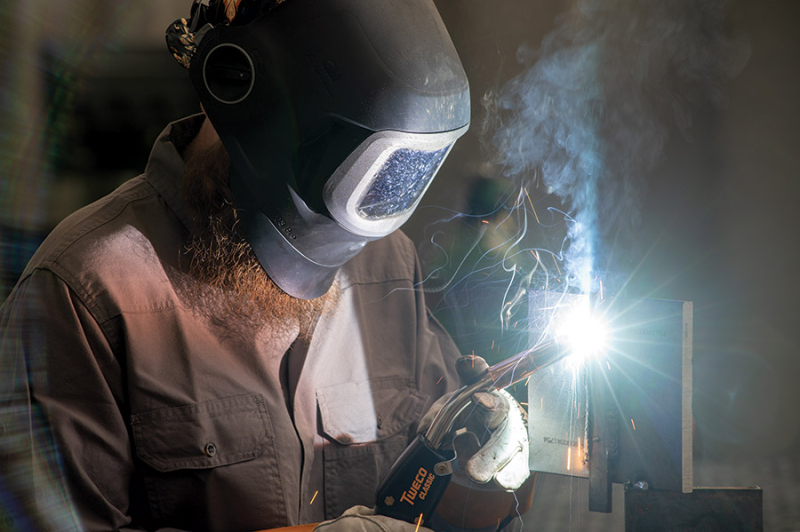
Human welders and fabricators will work alongside robotic systems at 1872’s facility.
Photo courtesy of 1872
The company plans to use its Factory OS platform to coordinate materials sourcing, cost estimates to stock availability and production planning, and for the movement of materials, machines and robots. It will then use its own AI agents trained to think like welders, buyers, material planners, logistics professionals and other experts to build, monitor and maintain Factory OS. Path’s Obsidian robots and other robotic welding platforms will work with human welders, using a foundational physical AI model to perform intelligent, adaptive welding.
“A lot of the [steel fabrication] market is leveraging automation,” says Dan Summers, CEO and cofounder of 1872 and a former SpaceX engineer. “[But] they’re taking automated systems and dropping them into largely manual operating workflows. They’re not fully utilizing the technology.”
Summers felt that automation could be at the core of the fabrication process. “Automating a large steel structural fabrication line was one key element of it. The other is my experience at SpaceX, with my cofounders understanding the power of vertically integrating software with hardware and product development.” Both Summers and Venerable say they plan to have skilled welders and fabricators as key stakeholders in the company.
Looking for quick answers on construction and engineering topics?
Try Ask ENR, our new smart AI search tool. Ask ENR →
“Do we reallocate some of our skilled labor to go and build some of those other products that maybe can’t be automated as easily as a structural piece of steel weldment? We feel very passionately that this is an approach that solves both problems,” says Summers. “We’re able to show that you know we can automate this and we can let robots build these weldments, and we can have our people go and build the more complex, challenging stuff.”
1872 already has customers but its founders are not revealing them until their fabrication facility reaches full autonomous production by 2027, Summers says.