

Interior Dept. ruling finds its BLM unit likely violated NEPA by reusing an environmental review prepared for unbuilt solar project
A federal appeals board halted a 167-MW data center approved for construction on U.S. Bureau of Land Management property Sept. 1 after finding the agency likely violated environmental law by relying on a review prepared for a previously approved but materially different project to authorize the development.
BLM approved the Townsite Data Center near Boulder City, Nev., in June without preparing a new or revised environmental assessment, instead relying on its 2023 review of an unbuilt 19-MW solar project proposed for the same site. Boulder City, the Center for Biological Diversity and Sierra Club appealed the decision.
The stay comes as the Trump administration pushes federal agencies to accelerate construction of large data centers and supporting energy infrastructure on federal land.
Read More
Bureau of Land Management —Townsite Data Center Portal
Townsite’s May federal filing scheduled construction for the first quarter of 2027 while still describing the geotechnical investigation needed before construction and leaving final building dimensions and other key details unresolved. No general contractor or EPC contractor has been publicly identified for the project.
Developer Townsite Solar 2 LLC is owned by a joint venture between TS2 Investments LLC, an affiliate of Houston-based energy developer Skylar Opportunities LLC, and renewable energy developer Arevon Energy. Houston-based Overwatch Capital joined the effort under a November 2025 teaming agreement to help secure entitlements, power and water and develop the AI-ready facility. Arevon has experience developing and financing large energy projects, including the nearby Townsite Solar facility.
ENR previously reported that Arevon and Rosendin delivered the nearby $250-million Townsite Solar project.
Federal filings describe the data center as representing about $3 billion in planned capital investment, including buildings, computing equipment and supporting infrastructure. Townsite has not identified a separate construction cost.
BLM documents show four planned data center buildings, a 70-MW battery energy storage system, electrical substation and 167 MW of backup generation connected to 230-kV transmission infrastructure.
Townsite had advanced some long-lead electrical procurement before seeking approval for the federal site. In a March filing for a related data-center proposal on adjacent Boulder City-owned land, the developer said a main transformer and high-voltage breakers had been ordered. The May federal plan called for startup and testing in late 2027 and commercial operation in the second quarter of 2028.
Solar Project Review Repurposed
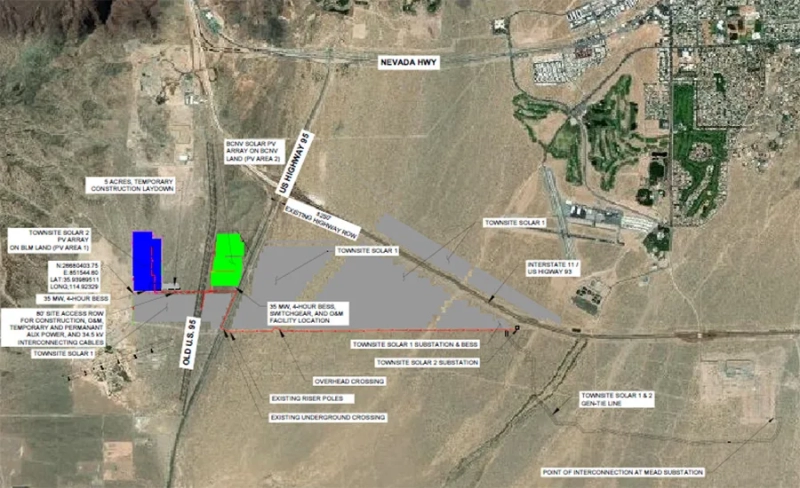
The federal development originated with BLM’s 2023 right-of-way authorization for a 19-MW photovoltaic solar facility and battery storage system of up to 35 MW that was never built. Townsite later shifted toward data centers «in part because the market for solar projects has deteriorated,» according to its argument summarized by the appeals board.
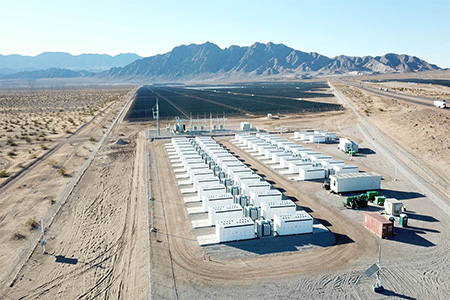
The completed $250-million Townsite Solar project near Boulder City pairs a 180-MW solar array with 90 MW of battery storage. It is separate from the unbuilt solar project whose environmental review BLM repurposed for the planned data center.
Image courtesy Arevon Energy
BLM responded to the replacement proposal with a Determination of NEPA Adequacy, or DNA, concluding the earlier analysis satisfied National Environmental Policy Act review requirements. The agency called the developments «essentially like,» noting they would occupy the «exact same location, same acreage and same perimeter» and describing both as industrial uses involving technologies «predominantly electrical and solid-state in nature.»
BLM also cited the same utility corridor, access roads and construction laydown footprints, saying both would involve «construction timeframes of 12-18 months using similar equipment and vehicles.»
The Interior Board of Land Appeals found the challengers likely to succeed on their NEPA claim. Administrative Judge David Gunter said no cited case had upheld use of a DNA for projects «as different as a data center and a solar plant.» Courts had rejected the approach even when projects shared more similarities, he wrote.
BLM’s own analysis exposed another problem. The agency analyzed data-center-specific cooling emissions, visual impacts and potential wildlife effects to show the earlier solar review was sufficient. Gunter said that «gets the analysis backwards.»
Construction differences were also blurred. The solar assessment estimated about 12 months of construction. BLM estimated up to 18 months for the data center, then grouped both into «construction timeframes of 12-18 months.»
That formulation «masks the potential for a 50% increase in the duration of construction impacts,» including noise, dust, emissions and traffic, Gunter wrote. He later reduced the dispute to a simpler point: «Applying NEPA requires ‘common sense.'» A 300,000-sq-ft data center, he wrote, «is a different project from a 19-MW solar power generating facility.»
Federal Push Meets NEPA Review
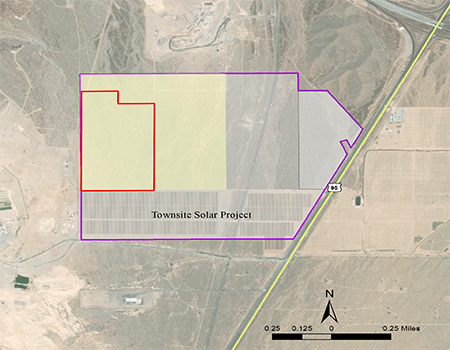
The proposed Townsite Solar 2 site, outlined in red, sits on BLM-managed land north of the completed Townsite Solar project. BLM later approved the same federal site for the 167-MW Townsite Data Center.
Courtesy Bureau of Land Management
President Donald Trump’s July 2025 executive order directs agencies to accelerate permitting for data centers and supporting energy infrastructure and to make federal land available for development. It defines qualifying projects to include data centers with more than 100 MW of incremental electric load.
BLM invoked the policy in approving Townsite, saying the development «supports federal efforts to accelerate permitting for data center infrastructure.» The board found any financial harm from delay could be limited through an expedited appeal, while construction could permanently alter the site.
Townsite said it will participate in the appeal and «will conduct a comprehensive environmental review» of construction impacts, water use, biological resources and operating systems.
ENR sought clarification about whether the stay prevents all work authorized by its June decision and whether the agency will defend that decision on appeal but received no reply from BLM by press time.
The stay does not overturn the approval. BLM must file the administrative record by Sept. 21, with expedited merits briefing to follow.